
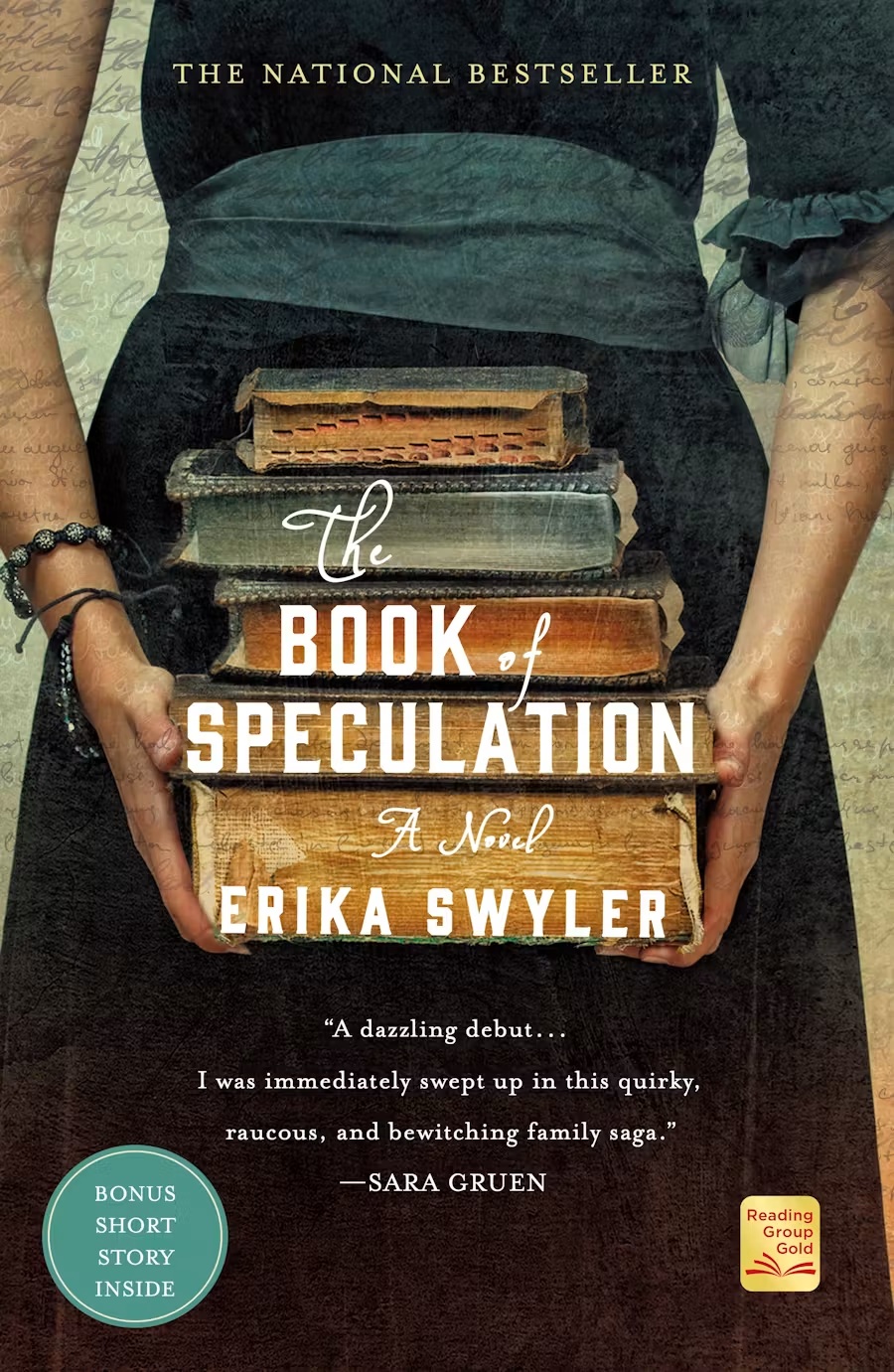
The Book of Speculation
When a damaged 18th-century carnival journal arrives at librarian Simon Watson’s crumbling Long Island home, he finds it connected to his grandmother and to a disturbing family pattern: generations of women associated with mermaid performances have drowned on July 24.
About
Spoiler notice: Spoilers cover the premise and early setup: Simon receives a damaged carnival journal, learns of the July 24 family pattern, and expects Enola’s return. Later revelations and the ending are not disclosed.
The Book of Speculation is Erika Swyler’s debut novel, a family mystery that braids a contemporary story on Long Island with an eighteenth-century carnival journal. In the selected St. Martin’s Griffin paperback, Macmillan describes the book as a story about books, family and magic, and identifies the journal as a water-damaged record kept by the owner of a traveling carnival in the 1700s. The pages open in Napawset, where librarian Simon Watson lives in a colonial house perched above the Long Island Sound. The bluff is eroding, the house is difficult to maintain, and his finances make repair or selling it painful choices. These pressures are practical, but they also give the setting emotional weight: the home holds the family history Simon has inherited along with its physical instability. The sea is close enough to threaten the building and to recall the death around which his memories of his mother have formed.
Simon’s mother, Paulina, performed as a circus mermaid, a role that involved holding her breath underwater. She died in the Sound when Simon was seven. He has remained in the family home, while his younger sister Enola left years earlier and now reads tarot cards for a traveling carnival. Their separation is neither a solved past event nor a simple estrangement: Simon has promised to look after her, and he still worries about her, but their contact is sporadic and complicated. Early in the novel, Enola leaves a message saying she plans to come home in July. Her return matters because Simon knows her as restless and difficult to reach, while the date she names approaches a pattern he has not yet understood. The story’s suspense grows from these ordinary facts—the house, the sister’s return, and the remembered loss—before it becomes a question about whether the family’s history contains something more uncanny.
The immediate mystery arrives as a package from antiquarian bookseller Martin Churchwarry. Inside is a fragile, water-damaged journal connected to Simon’s grandmother Verona Bonn and written by Hermelius Peabody, an owner of a traveling carnival. Simon’s work gives him a way into the puzzle: he studies the volume, tries to identify its contents and contacts the bookseller for more information. The book’s worn condition limits what can be learned from it, so discovery proceeds through incomplete clues rather than a clean explanation. In this way, the title refers both to a physical artifact and to the uncertainty of interpreting evidence when the past has left only damaged traces.
A second narrative follows the people recorded in Peabody’s journal, shifting the novel back to the world of the traveling show. Kirkus’s independent review identifies Amos, an abandoned boy who joins the troupe as a Wild Boy, and Evangeline, an aquatic performer whose relationship with him becomes central to the historical strand. The fortunes of these performers and the modern Watson family gradually converge through the journal and the clues Simon finds. The two timelines create a useful tension: the reader sees that the carnival story has emotional and historical substance of its own, while Simon encounters it as a partial document whose gaps he must interpret. The historical sections also place the mermaid performance within a working carnival, where unusual acts, fortune-telling and precarious relationships shape people’s lives. Rather than treating the old book as a prop that merely unlocks a puzzle, Swyler makes its contents another family-scale story, with its own desires and losses.
The mystery’s unsettling pattern is that generations of women in Simon’s family associated with mermaid performances have drowned on July 24. The publisher’s synopsis places the approaching date only weeks away and frames Simon’s growing concern around whether a curse might be involved and whether he can understand the book in time to help Enola. Simon’s mother died in the water; the old journal describes another performer’s drowning; the house itself is being consumed by the shoreline. Simon’s investigation is also shaped by the grief and responsibility he carries, so the family pattern functions as more than a riddle. It presses him to consider what he owes his sister, what he can know about the people who came before him, and whether inherited stories determine the lives of those who follow.
Simon’s present-day relationships keep the book’s focus on people as much as clues. Alice, his friend and fellow librarian, watches his concern deepen; Frank, a longtime family friend, helps him face the immediate danger to the house and remembers Simon’s parents. Enola is physically absent for much of the opening movement, yet her voice and expected return organize Simon’s attention. Kirkus also notes the pressure of Simon’s library job and the instability of his home life. The novel’s family members inherit habits and memories as well as a possible curse. Simon’s effort to interpret the journal therefore has an intimate stake: he is trying to understand how a pattern may have formed, while confronting the limits of what one person can repair or protect. The book’s emotional center lies in this combination of curiosity and care.
The Book of Speculation brings together literary fiction, family drama, historical storytelling and elements of magical realism. Its two timelines allow the carnival journal to act as a bridge between centuries, while the coastal house and the approaching July date keep the contemporary strand moving. Macmillan’s edition also includes two-color illustrations by Swyler and a bonus short story, The Mermaid Girl. The novel’s central question remains deliberately suspenseful: how much of Simon’s inherited pattern can a damaged book explain, and can understanding it change what happens next?
Book details
- Author
- Erika Swyler
- First published
- 2016
- Series
- No series listed
- Subgenre
- Literary fiction, Magical realism, Family novel
- Primary genre
- Literary Fiction, Fantasy
- Tags
- No tags for this book.
Review
Editor profile
Baby Bat
Goodreads and social links will be added soon.
- Goodreads — link coming soon
- Social media — link coming soon