
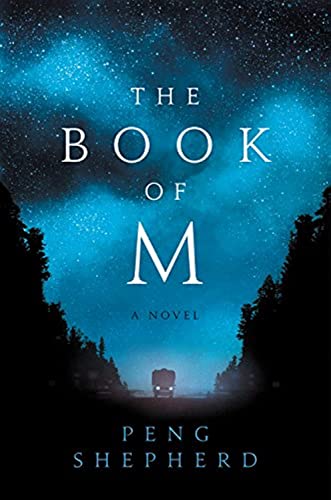
The Book of M
When an unexplained phenomenon begins erasing people’s shadows, those affected gain the power to change the world through magic but lose their memories.
About
Spoiler notice: Spoilers for the premise and major character developments follow; the ending and final revelations are withheld.
The Book of M begins with a public event that cannot be explained: at an outdoor market in India, a man loses his shadow. The occurrence spreads into an epidemic known as the Forgetting. Those who lose their shadows gain a strange power, while their memories begin to disappear. The catastrophe changes more than individual lives. As people forget how familiar things work or what they mean, reality itself becomes unstable, and society is reshaped by fear, scarcity and competing attempts to understand the shadowless. Peng Shepherd uses this speculative rule as the hinge between intimate loss and large-scale collapse. A person’s past is not merely private history in this world; memory helps determine what can be recognised and what can be made real.
The central relationship is between Ory and Max, a married couple who have sheltered in an abandoned hotel in the woods. For a time they build routines that make their isolation feel almost ordinary. Their refuge depends on watching supplies, managing danger and maintaining their connection while the outside world deteriorates. When Max’s shadow disappears, the danger enters the shelter with them. Ory understands that the Forgetting will erode the memories on which Max’s sense of self and their shared life depend. He gives her a tape recorder so she can preserve what she knows about herself. Max, however, fears that as she loses memories she may become dangerous to Ory. She leaves, turning their effort to protect one another into a painful separation: each person’s attempt to keep the other safe creates more distance.
Ory follows Max into a country that no longer behaves like the one they knew. The journey brings him into contact with shadowless people whose forgotten knowledge can twist ordinary objects and living things into unfamiliar forms. The connection between memory and the ability to reshape reality makes survival depend on interpreting what remains after familiar meanings have broken down. Ory encounters dangerous altered beings and a book-collecting army. He is not simply travelling through ruined landscapes; he is learning the new rules of a world where another person’s forgotten memory can become a physical threat. At the same time, his search is guided by the intimate record Max leaves behind and by rumours about a possible cure.
The novel also follows Max’s separate path. She is moving away from Ory because she believes the Forgetting could make her a danger to him, yet she is also searching for a way to hold onto herself and the life she remembers. Her recorded messages make that struggle concrete: memory becomes something she can address, revisit and try to preserve rather than an invisible faculty taken for granted. Rumours point to a new force in the south that may offer a cure. He wants to find her; she needs answers that may matter even if she cannot keep the person she was.
Other characters and storylines widen the book beyond the couple. Mahnaz, an archer, has her own history and reasons to cross a dangerous landscape. The Amnesiac, a character without a past, adds another angle to the book’s questions about identity. These figures make the crisis more than a test of Ory and Max’s marriage. They bring different relationships to memory, family and survival into the same unsettled world. Shepherd also presents events out of chronological order, moving among the period before, during and after the apocalypse. This structure asks readers to revise their understanding of people as new context appears. A character’s current choices can look different once the experiences that shaped them become visible, and the catastrophe feels like a process rather than one isolated moment.
The novel’s speculative premise keeps returning to a practical question: what remains of a person when memory can disappear, be altered or be replaced? The story asks how memories shape identity, whether two people can remember the same event differently, and why fiction books are preferred as replacements for lost memories. Those questions connect the fantastical mechanism to storytelling itself. Books in this world can serve as a kind of substitute for what has been lost, so stories become tools for constructing a self as well as objects to collect. The idea also complicates the difference between remembering and inventing. If a borrowed narrative can help someone continue after losing a personal past, the book asks whether identity rests only on what happened or also on the stories a person can inhabit.
At its emotional centre, The Book of M treats love as a form of attention under pressure. Ory and Max care for one another, but the epidemic makes closeness risky and separation no guarantee of safety. Their choices unfold alongside threats from other survivors and the unstable world itself. Shepherd combines post-apocalyptic travel with questions usually associated with intimate relationships: how well can one person know another, what can be preserved when memory fails, and whether a bond can endure when its shared history is disappearing? The answers are carried through the characters’ distinct journeys rather than delivered as a single rule. The result is a novel in which the supernatural crisis repeatedly tests ordinary acts of protection, trust and recognition. Its spoiler-sensitive plot turns are part of that design, so this overview leaves the final revelations undescribed.
Book details
- Author
- Peng Shepherd
- First published
- 2018
- Series
- No series listed
- Subgenre
- Dystopian, Post-apocalyptic, Science fantasy
- Tags
- No tags for this book.
Review
Editor profile
Baby Bat
Goodreads and social links will be added soon.
- Goodreads — link coming soon
- Social media — link coming soon