
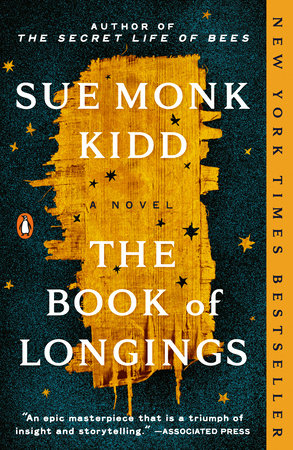
The Book of Longings
In Sue Monk Kidd’s imagined first-century story, Ana, a privileged young woman with a gift for writing, resists a marriage arranged by her parents and meets Jesus of Nazareth.
About
Spoiler notice: Setup spoilers: the novel imagines Ana’s marriage to Jesus and follows her flight to Alexandria after an act puts her in danger. Later revelations and the resolution are withheld.
The Book of Longings begins with a question the historical record cannot answer and gives it a fictional life. Sue Monk Kidd imagines Ana, a young woman in first-century Galilee, as the wife of Jesus of Nazareth. The novel is clear in its form: Ana and her marriage are inventions, and the story does not offer them as historical fact. Instead, it places an imagined woman beside familiar religious figures and asks what her private life, work and ambitions might look like within that world. Ana’s story is told in her own voice, keeping the focus on the person usually missing from accounts shaped by men. The premise lets the novel consider not only what Ana longs for, but who gets to leave a record of longing at all.
Ana grows up with unusual advantages and equally sharp limits. Her father is a wealthy scribe connected to Galilee’s ruler, so she has access to learning that her society would rarely grant a girl. She is curious, ambitious and serious about writing; her interests take the form of secret study and stories about women whose lives have been neglected or silenced. Those pursuits are more than a private pastime. In Ana’s surroundings, a girl’s prospects are largely decided by her family, and her parents expect her to marry an older widower. She dreads the match. The conflict gives the book a concrete starting point: Ana’s wish to shape a life of her own collides with a future arranged to serve other people’s plans.
Her aunt Yaltha becomes an important source of encouragement. The independent Historical Novel Society review describes Yaltha as having returned after service in the cult of Isis and as a forceful presence who challenges the limits placed on Ana. The novel’s central women’s bond helps make Ana’s awakening social as well as individual: she is not simply discovering a desire to write in isolation, but receiving permission to take that desire seriously. Kidd’s own author Q&A explains that Ana wants to write narratives, make her voice heard and create her own inks; she also describes the character’s longing as the force that propels the story. The book turns those material acts of writing into a way to talk about a person claiming room for thought and expression.
An encounter with eighteen-year-old Jesus changes Ana’s expected course. The relationship that develops is part of Kidd’s explicitly imagined history, not a claim about the life of the historical Jesus. In the novel, marriage brings Ana to Nazareth, where she makes a home with Jesus, his brothers and their mother, Mary. Domestic life gives the story space for affection, friction and humor, while Ana’s own aims remain in view. Her husband is a central figure, but the author has said the story and journey belong to Ana. That emphasis shapes the reading experience described by the publisher: the familiar figure does not displace the invented woman whose intellectual appetite, work and choices carry the narrative.
The home life in Nazareth sits beside political tension. Roman occupation and resistance form part of the book’s setting, and Ana’s brother Judas is drawn into the struggle against Rome. These are events and character relationships as arranged by the novel; the religious figures’ dialogue, private bonds and motives belong to Kidd’s fictional construction. That boundary matters because the book places invention close to material many readers approach through faith or history. Kidd’s Q&A describes her intention to imagine Jesus as fully human and to use an alternate history to open questions about women’s presence and absence in religious narratives. The novel therefore works at two scales: a household story about people who love and disagree, and a speculative retelling that asks how a woman’s perspective could alter the telling of a much larger story.
Ana’s effort to write about women keeps connecting those scales. She notices how easily women’s experiences disappear from official accounts, and she tries to preserve stories that would otherwise go unrecorded. Her interest is not abstract: writing requires time, materials and a measure of safety, all of which are affected by her family’s expectations and the society around her. The book also gives her a private image for that inward ambition. In Kidd’s author Q&A, she describes Ana writing her deepest longing in an incantation bowl and singing it as a prayer; the bowl makes an internal wish tangible within the novel. This detail links the title to Ana’s habit of giving form to what she wants, even when her environment offers few sanctioned ways to pursue it.
When Ana’s actions put her in peril, she flees to Alexandria, where the publisher’s description signals new dangers, revelations and unexpected refuge. The move widens the story beyond the household and gives Ana’s choices fresh consequences without making her ambitions disappear. The novel’s reach includes love and family, political unrest and the circulation of women’s stories, but its organizing perspective stays close to Ana’s changing sense of what she can do. Because Jesus, Judas, Mary and other religious figures appear in a counterfactual narrative, the book is best approached as historical fiction that invents their private lives. Its central question is not whether that imagined marriage happened; it is what becomes visible when the story gives Ana a voice and lets her pursue a life beyond the role prepared for her.
Book details
- Author
- Sue Monk Kidd
- First published
- 2020
- Series
- No series listed
- Subgenre
- Historical fiction, Literary historical fiction
- Primary genre
- Historical Fiction, Literary Fiction
- Tags
- No tags for this book.
Review
Editor profile
Baby Bat
Goodreads and social links will be added soon.
- Goodreads — link coming soon
- Social media — link coming soon