
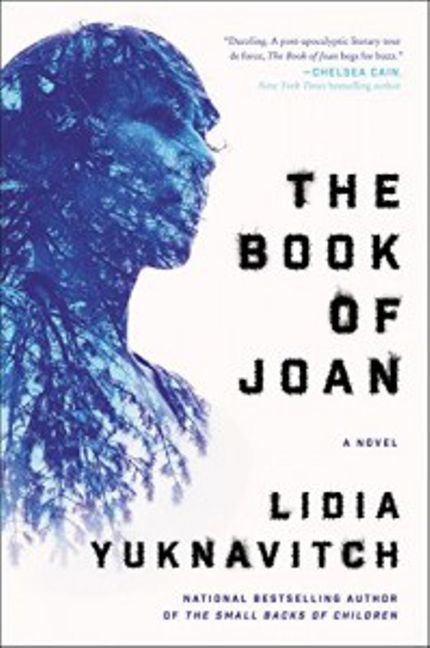
The Book of Joan
After wars devastate Earth, the wealthy retreat to CIEL, a floating platform ruled by Jean de Men.
About
Spoiler notice: Spoilers for the opening premise and the broad setup of Christine’s account of Joan. Later confrontations, outcomes and the ending are not described.
The Book of Joan is set after a series of wars has left Earth ravaged. The wealthy have withdrawn to CIEL, a floating platform above the planet, where distance offers shelter but not security. The station is short of resources, its inhabitants cannot reproduce, and Jean de Men rules through strict prohibitions. Sex and sexuality are criminalised, and no one may live beyond fifty. This society has escaped the immediate conditions below while building a new order that tightly governs bodies and speech. Into that brittle arrangement, Lidia Yuknavitch brings a reimagining of Joan of Arc and the medieval writers Christine de Pizan and Jean de Meun. In the novel's opening year of 2049, CIEL has been home to its inhabitants for decades; the platform is assembled from remnants of older space stations.
Christine is an artist nearing her fiftieth birthday, the point at which CIEL’s residents are killed under the station’s rules. Her specialty is grafting: burning or otherwise altering skin to create images and texts. This practice has become the community’s principal art form, and Christine has mastered its difficult technique. As her time runs short, she begins inscribing the forbidden story of Joan on her own body. The project gives her remaining days a purpose, but it also makes her work visible within a culture where the ruler controls what may be said. Writing becomes a physical act, carried on the person who makes it. The people on CIEL have also undergone striking physical changes during their time away from Earth: they have lost hair, skin pigmentation and genitalia. Altering the skin through grafting is therefore not an incidental craft but a visible part of life in the station.
The Joan Christine records is a child warrior whose unusual power is tied to the natural world. She is a future counterpart to the medieval Joan of Arc, but Yuknavitch places her in a landscape shaped by environmental damage and human conflict. Her account appears alongside Christine’s, giving the novel more than one voice and making the act of telling part of the action. Christine is not simply preserving a finished legend: she is choosing what to inscribe and how to carry Joan’s story into a world that has outlawed it. The result connects a familiar historical figure with questions about who can claim a body, a language or a future. In Christine's telling, Joan sets out to use her gifts to end war. The aim places her in conflict with a world where violence has become ordinary, and ties her extraordinary ability to the damaged natural environment rather than to CIEL's technology.
Jean de Men’s rule links private life to political control. On CIEL, restrictions on sex, reproduction and lifespan reach into how residents understand themselves and one another. Christine’s art offers a way to keep forbidden knowledge in circulation, while her longtime friend Trinculo joins her in beginning to plot revolt. The two are not outside the station’s constraints; their plans take shape inside the system that limits them. Their opposition gives the story a present-tense conflict alongside Christine’s account of Joan. The ruler’s authority is challenged through both collective action and the preservation of a narrative he would suppress. De Men is also a writer of romances, a detail that places literary creation close to the authority he exercises over others. The station's political struggle is thus bound to language as well as law: Christine makes a narrative the ruler has prohibited, and the people around her weigh whether they can act against his power.
CIEL and Earth form connected parts of the novel’s setting. The station houses those who fled the wars, while a separate opposition gathers on the planet’s surface. That parallel activity prevents CIEL from becoming a complete escape from Earth: its residents’ survival remains bound to the damaged world below. Joan’s relationship to nature gives her story a place in that tension. Christine’s skin text can move a memory across the divide between the station and the surface, even as the differing conditions of each setting shape what resistance can mean. The question is not only who governs CIEL, but what remains possible for people on a wounded planet. The conditions that produced this division are not confined to a single battle. The postwar world has returned to forms of brutality, with children fighting, religious crusades and land seized by force. CIEL's inhabitants remain linked to that history even while removed from its immediate violence.
Yuknavitch brings together a speculative future, medieval literary figures and an art form made from the body. Christine’s work gives the novel its frame: she writes Joan’s story as her own life approaches its imposed limit, while the planned revolt develops around her. The layered narration keeps the remembered Joan and the present-day Christine in conversation without making them the same person. Their connection rests on the story Christine chooses to preserve and the risks of carrying it. In this way, the novel’s conflicts over authority, embodiment and memory converge in the act of telling a story that the station forbids. The names also carry a deliberate historical echo: Christine de Pizan wrote about Joan of Arc, while Jean de Meun is associated with medieval romance. Yuknavitch reimagines these figures rather than presenting a historical account, setting their literary and political opposition in an altered future.
Book details
- Author
- Lidia Yuknavitch
- First published
- 2017
- Series
- No series listed
- Subgenre
- Dystopian, Post-apocalyptic
- Primary genre
- Sci-Fi, Literary Fiction
- Tags
- No tags for this book.
Review
Editor profile
Baby Bat
Goodreads and social links will be added soon.
- Goodreads — link coming soon
- Social media — link coming soon