
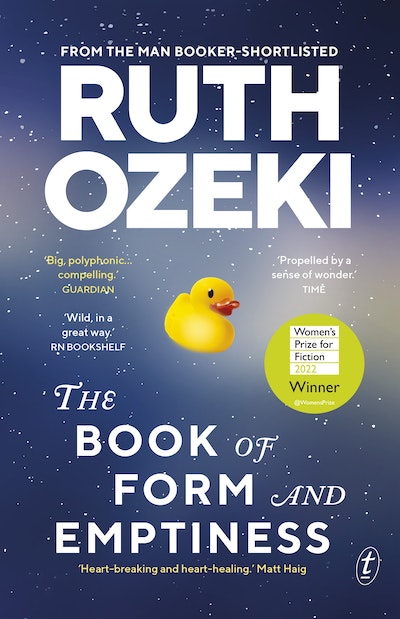
The Book of Form and Emptiness
After his father dies, thirteen-year-old Benny Oh begins hearing the voices of objects around him.
About
Spoiler notice: This discussion covers the opening premise, Benny’s bereavement, his mother’s hoarding, his changing perceptions and the novel’s central narrative device. It avoids the novel’s later revelations and ending.
The Book of Form and Emptiness starts with a family altered by sudden loss. Benny Oh is thirteen when his father dies, and in the aftermath he begins to hear voices belonging to ordinary things in the house. The objects do not all speak in the same emotional register: some seem gentle, while others sound angry or distressed. Benny cannot simply dismiss what he hears, yet the voices leave him without an easy way to understand what is happening. His mother, Annabelle, is also struggling, and as her possessions accumulate the chorus around Benny grows louder. Ruth Ozeki makes the domestic setting carry both grief and sensory pressure. The home is full of familiar objects, but familiarity offers little comfort when those objects appear to address a child who is already trying to make sense of his father’s absence.
The novel’s opening situation links bereavement with attention. Benny hears the things around him at a moment when his family’s routines have been broken, and his mother’s hoarding means there are more objects in the house and more voices for him to encounter. Ozeki’s premise gives material possessions an unusual presence without making them a simple fantasy spectacle. They are part of the same everyday world as a boy’s school life, his family relationships and the difficult work of growing up. Their voices can be pleasant, hurt or angry, so listening does not supply Benny with a single clear message. Instead, he must live among competing signals and learn how to distinguish his own thoughts from the demands he perceives around him. The uncanny element grows directly from a recognizable experience of being overwhelmed.
Annabelle’s hoarding is central to the household’s changing atmosphere. The possessions are not treated as background decoration: their increasing number affects how Benny experiences his home and how crowded his world feels. The publisher describes the mother and son as trying to live amid a sea of things, news, substances and technological pressures. That wider description places a private family difficulty beside the clutter of contemporary life. The story does not reduce Annabelle to a label or present the objects as a problem Benny can solve through one clever decision. Her condition is part of the family’s grief and of the practical space they share. Benny’s unusual hearing makes this material overload immediate to him, while Annabelle’s struggle gives the novel a second center of attention alongside his adolescence.
When the noise becomes too much, Benny seeks the relative quiet of a large public library. In the library, objects speak only in whispers, a contrast that offers him a different way to occupy space and pay attention. The setting also introduces people beyond his immediate family: a young performance artist and a homeless poet become part of the company he encounters there. These figures widen the story from a boy’s private distress toward questions of community and connection. The library is not only a refuge from the house; it is a place where books and readers can meet, and where Benny’s relation to language begins to matter in a new way. Ozeki’s premise makes quiet valuable without suggesting that withdrawal alone resolves the pressures surrounding him.
The most distinctive formal choice is that a Book becomes a narrator and speaks with Benny about the story being told. It is his own book, not merely an object he happens to find, and its voice makes the act of narration part of the novel’s subject. The Book relates Benny’s life while trying to teach him to listen to what matters. That arrangement lets the novel consider the relationship between a person and the stories that hold a life together. Benny is a character whose experience already includes voices from objects; a speaking Book extends that premise while also giving the narrative a self-aware presence. The result is a conversation about who gets to tell a story, what can be heard amid distraction, and how a reader might find meaning without expecting every difficult experience to become orderly.
The title points toward a tension the novel sustains: the things that occupy space and the absences that shape a life. Benny’s family is surrounded by possessions, yet it is also living with the loss of his father. The voices that fill his surroundings sit beside the silence he seeks in the library. Ozeki connects these contrasts to broader concerns named in the book’s publisher descriptions, including consumer culture, climate change, jazz, creativity and the power of reading. Those subjects share the novel’s attention to how people respond to a world that can feel crowded, noisy and difficult to interpret. The book moves between intimate family experience and wider questions about human attachments to things. Its concern with listening is both literal in Benny’s experience and a way of framing attention to other people, stories and the living world.
Ozeki’s work brings together the domestic, the philosophical and the fantastical while keeping Benny’s growth at its center. The premise begins with a child trying to make sense of an experience he cannot easily explain, but its scope includes the mother who is grieving alongside him, the people he meets beyond home and the Book that addresses him directly. The novel’s 2022 Women’s Prize for Fiction win is a bibliographic milestone, not a guide to what a reader must think of it. Its particular interest lies in how it gives narrative form to competing voices and material abundance, then asks what kinds of attention help a person live among them. The story remains grounded in loss and family even as objects speak and a book participates in its own telling. This combination makes reading, listening and connection part of the action rather than subjects held at a distance.
Book details
- Author
- Ruth Ozeki
- First published
- 2021
- Series
- No series listed
- Subgenre
- Magical realism, Coming-of-age
- Primary genre
- Literary Fiction, Fantasy
- Tags
- No tags for this book.
Review
Editor profile
Baby Bat
Goodreads and social links will be added soon.
- Goodreads — link coming soon
- Social media — link coming soon