
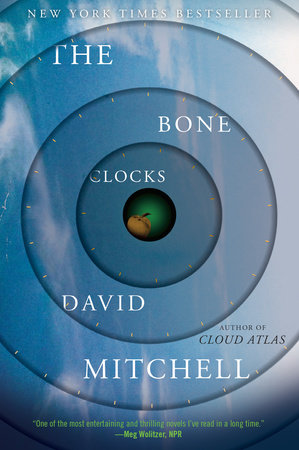
The Bone Clocks
In 1984, fifteen-year-old Holly Sykes leaves home after a family argument and encounters an unsettling presence in the English countryside.
About
Spoiler notice: This overview discusses the opening setup, the novel’s six-part structure, its changing narrators, and broad thematic concerns. It avoids the later explanations of the mystics’ conflict, the full significance of Holly’s disappearance, and the resolution.
The Bone Clocks opens in 1984, when fifteen-year-old Holly Sykes leaves home after a bitter argument with her mother. Her attempt to make her own way through the English countryside becomes entangled with a mystery that reaches beyond ordinary experience. The story then follows consequences that extend far past that first episode, returning to Holly at different stages of a life and showing how one unresolved disappearance continues to matter. David Mitchell gives the book a central character whose importance becomes clearer over time: people may meet Holly only briefly, yet their own stories can become part of the pattern surrounding her.
That pattern takes shape through six sections set across several decades. Holly narrates the opening, while the intervening sections shift to people whose paths cross hers: a Cambridge student, a father working as a war correspondent, a novelist facing a career crisis, and Marinus, a figure linked to the novel’s stranger dimension. Holly’s point of view returns at the close. This arrangement changes the reader’s distance from her. At first, she is a young person trying to understand a confusing world; elsewhere, she is encountered through other people’s ambitions, loyalties, and recollections. The result asks readers to hold a life together from partial views rather than a single continuous account.
The narrators also bring distinct social worlds and styles. Holly’s early story is shaped by adolescent independence, family friction, and the geography of rural England. Later voices carry different pressures: professional self-invention, the experience of reporting from war, and the vanity and vulnerability of literary life. Mitchell uses these shifts to let each section feel like a story with its own immediate concerns, even as details echo across the book. Movement between voices can make a minor-seeming person or event acquire a new weight later. The structure rewards attention to recurrence while leaving room for uncertainty about which connections will prove central.
As the sections accumulate, the novel moves between recognisable social observation and supernatural fantasy. The publisher’s description introduces dangerous mystics and their enemies, while the novel’s broader frame places their hidden struggle at the edge of everyday life. That element does not erase the ordinary dimensions of the characters: money, family, ambition, affection, and aging continue to matter. Instead, the fantastical conflict gives private decisions a larger shadow. A character may be living through a local crisis without understanding that the forces around it extend across generations. The reader’s knowledge grows unevenly, because the book reveals its wider frame through changing narrators rather than pausing to explain everything at once.
The movement through time gives Mitchell room to contrast how different decades understand themselves. A person’s youthful confidence can look different when remembered years later; public events leave marks on private lives, and personal motives rarely remain isolated from the era around them. The book’s future-facing sections widen that perspective again, inviting questions about what people preserve and what they neglect. These shifts make time part of the novel’s form as well as its subject. Readers see a life in intervals, with gaps where change has happened and consequences that continue after the original choices are out of view.
Mitchell has described the work as a portrait of a life built from six novellas, and that design helps explain its combination of narrative independence and accumulating links. The sections have room to develop different registers, from grounded character drama to speculative elements, without losing Holly as a point of reference. The book also belongs to the network of recurring people and motifs across Mitchell’s novels. Those connections can add resonance for returning readers, but the publisher and Mitchell describe the books as capable of working independently; familiarity with earlier titles is not a prerequisite for following this one. The arrangement also makes recognition a pleasure rather than a test: a returning face may deepen a reader’s sense of a shared fictional world, while a newcomer can follow the character’s immediate role in this story. That balance suits a novel built from separate perspectives, since each section must work in its own setting before its relation to the larger design becomes clear. The book’s architecture is therefore part of its subject: memory preserves only some details, and later experience can change how an earlier encounter is understood.
Under its shifting perspectives, The Bone Clocks considers mortality, memory, selfishness, and human solidarity. These concerns emerge through contrasts between people who take advantage of others and those who accept obligations beyond immediate self-interest. Holly’s long arc gives such ideas a scale that a single episode could not provide: what seems decisive at one age may become only one strand in a much longer story. The novel’s speculative premise makes questions of life and death unusually visible, but its emotional ground remains recognisable—how people change, how they are remembered, and how their choices affect lives they may never fully see. Its breadth comes from bringing those intimate concerns into contact with a hidden world.
Book details
- Author
- David Mitchell
- First published
- 2014
- Series
- No series listed
- Subgenre
- Literary fiction, Science fantasy
- Primary genre
- Literary Fiction, Fantasy, Sci-Fi
- Tags
- No tags for this book.
Review
Editor profile
Baby Bat
Goodreads and social links will be added soon.
- Goodreads — link coming soon
- Social media — link coming soon