
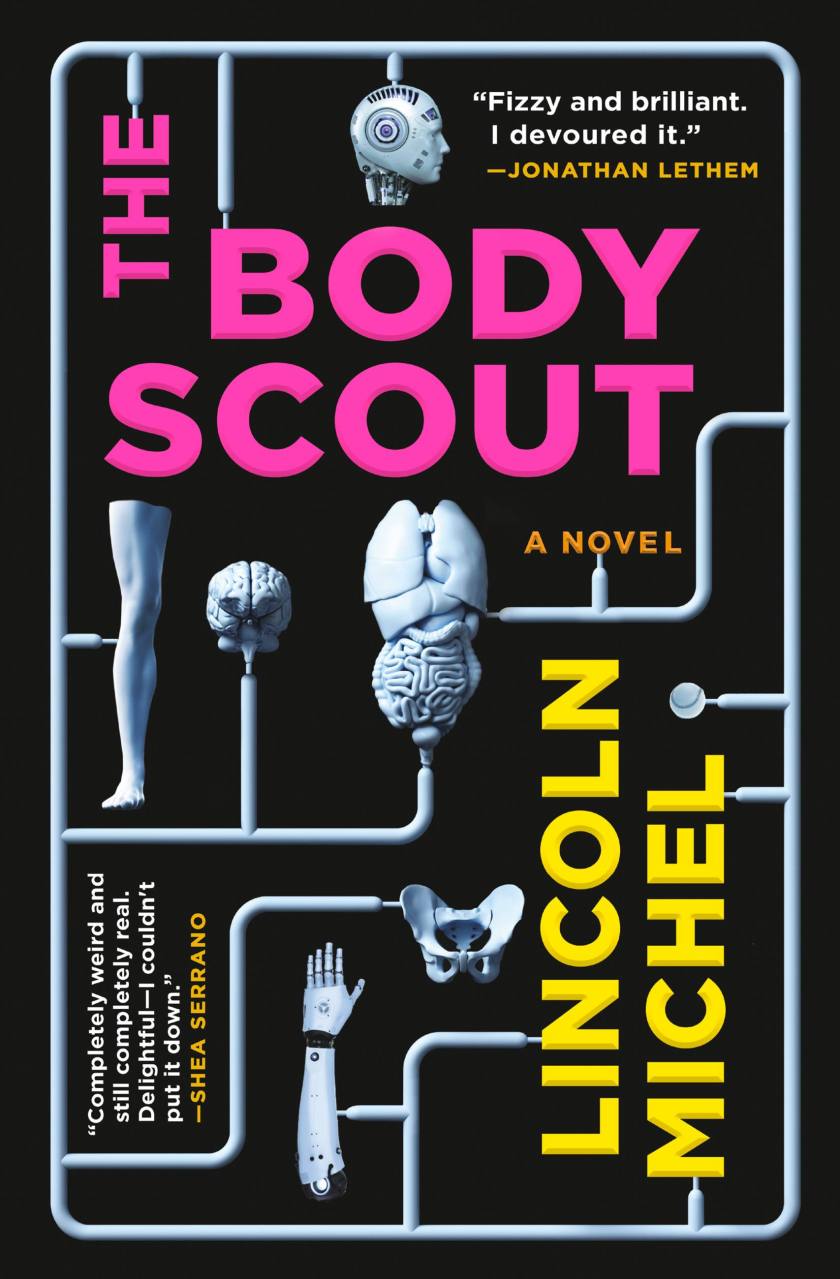
The Body Scout
In a climate-damaged future New York, Kobo scouts genetically modified baseball talent for pharmaceutical corporations while struggling with debt from the cybernetic upgrades he received as a player.
About
Spoiler notice: Spoilers for the opening murder, Kobo’s investigation and several supporting-character revelations; the final resolution is not described.
Lincoln Michel’s The Body Scout builds a science-fiction mystery around a question that reaches beyond its baseball premise: what happens when the body becomes both a consumer product and a source of debt? The novel’s New York is recognisable in outline but altered by rising water, recurring pandemics, dense pollution and a city reorganised for corporate wealth. Medical technologies can replace organs, alter genes and add cybernetic parts, yet access depends on money and credit. The book treats these changes as ordinary features of daily life. They are not distant marvels set apart from the present; they shape employment, health, sport and the terms on which people can move through the city. By tying speculative technology to familiar financial pressures, Michel makes bodily enhancement part of the social infrastructure rather than a simple superpower.
Kobo works as a scout for a professional baseball league owned by pharmaceutical corporations. He once played in a cybernetic league, and the upgrades that supported that career remain attached to him as medical debt. His equipment is outdated, his finances are precarious, and collectors are pursuing repayment. Kobo is therefore both a professional who evaluates other people’s bodies for athletic promise and a debtor whose own body has been altered through systems he cannot fully control. That position gives the book a practical entry into its larger world. The people with the most advanced modifications are not necessarily free; their enhancements can tie them more firmly to lenders, employers and businesses that profit from keeping bodies productive.
The central case begins when Kobo’s adopted brother, J. J. Zunz, a star slugger for the Monsanto Mets, dies during a game. The event appears connected to an engineered illness, and Kobo turns from scouting to investigating how and why his brother was killed. His work brings him into contact with the team’s corporate leadership and with a range of people whose lives touch the body-modification economy. The plot uses the familiar shape of hard-boiled detection: a working investigator follows a death through a world where the powerful control information and have reasons to conceal what they know. Yet Kobo’s situation complicates the usual image of the independent private detective. He has debts, damaged equipment and obligations, and those vulnerabilities make it difficult to stand outside the systems he is trying to understand.
Baseball gives the story a public stage where biological engineering is visible and celebrated. Teams depend on athletes whose bodies have been altered to meet the demands of a commercial spectacle, while owners and pharmaceutical interests turn performance into a business. Kobo’s scouting background makes him fluent in the language of talent and physical potential, but the investigation exposes what that language leaves out: the costs borne by the players and the companies positioned to profit from those costs. The sport also grounds the book’s stranger inventions in recognisable competition. The game still has teams, careers and fans, but the conditions around it have changed as corporations consolidate ownership and scientific intervention becomes part of professional advantage.
Michel extends this logic through details that are simultaneously comic, unsettling and connected to the plot. The setting includes genetically modified executives, resurrected Neanderthals, flying transport and technologies that alter bodies in organic as well as mechanical ways. Some details are extravagant by design, but their extravagance does not make them separate from the book’s concerns. Each asks who benefits from innovation, who bears its risks and what happens when people cannot afford to refuse it. A person may modify their body for survival, work or status, while another may reject modification for philosophical reasons. The novel allows these responses to coexist, so technology does not have one uniform meaning for everyone. It can promise repair or competitive advantage, carry a price, and create new forms of social pressure at the same time.
The future city also gives the investigation a noir atmosphere. New York’s geography has been reshaped by climate change: water has risen, green space has diminished, and places associated with poorer residents can be repackaged as amenities for the wealthy. Kobo moves through a landscape where the language of improvement often disguises displacement. The city’s inequality is not presented only through grand declarations about corporate rule; it appears in housing, transport, medical access and the ordinary negotiations people make to get by. In an interview, Michel describes his approach to worldbuilding as expressionistic and satirical, drawing on contemporary New York and exaggerating existing conditions. That method helps explain why the setting can be bizarre without losing its social recognisability.
The novel’s tonal range follows from that mixture. Kobo’s case proceeds as a thriller, while the body technologies and corporate baseball invite satire and moments of grotesque humour. Beneath the pace and oddity sits a persistent concern with what it means to inhabit a body when health care, enhancement and even physical capability are filtered through markets. The story does not reduce every question to a simple argument for or against technology. Instead, its characters face different constraints and make different choices inside a world where access is unequal and refusing an upgrade may carry consequences too. The result is a science-fiction detective story in which the mystery links personal loss to larger institutions, and the speculative inventions keep returning to the costs of being human in a system that can price nearly everything.
Book details
- Author
- Lincoln Michel
- First published
- 2021
- Series
- No series listed
- Subgenre
- Cyberpunk, Dystopian, Noir
- Primary genre
- Sci-Fi
- Tags
- No tags for this book.
Review
Editor profile
Baby Bat
Goodreads and social links will be added soon.
- Goodreads — link coming soon
- Social media — link coming soon