
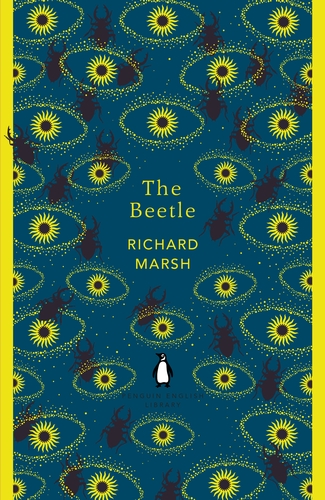
The Beetle
After a ragged stranger smashes a workhouse window, destitute clerk Robert Holt leaves and later enters a house in Hammersmith through an open window.
About
Spoiler notice: Spoilers for the four narrators, Lessingham's account of Egypt, the Beetle's influence over Holt and Marjorie, the railway wreck, and the closing account of Marjorie's recovery.
Richard Marsh’s The Beetle: A Mystery is a late-Victorian supernatural novel arranged in four books and forty-eight chapters. It opens with Robert Holt, a clerk out of work and without a place to sleep, turned away from a Hammersmith casual ward. A ragged man beside him says the ward is not really full and then smashes two panes himself to force the attendants to respond. Holt leaves rather than join him. The encounter establishes Holt’s poverty and reluctance before the story draws him into a different kind of trespass: later that wet night, in an unfinished part of Hammersmith, he comes upon a modest house with an open window and climbs inside.
Inside, an enormous insect-like creature crawls over Holt while he stands unable to flee. A light then reveals a human figure in a bed, whose commands he finds himself compelled to obey. The figure sends him across London to Paul Lessingham’s house in Lowndes Square. There Holt breaks a window, forces open a bureau and shoots the lock of a drawer to reach a packet of letters. Lessingham arrives as he takes them. The celebrated politician’s composure gives way when Holt speaks the warning his tormentor has instructed him to deliver. The stolen packet bears Marjorie Lindon’s name. The theft brings Lessingham’s private life into the mystery, while Holt’s awareness of his own actions makes his inability to resist particularly disturbing. He can describe the burglary precisely without being able to explain the force directing him.
The second book changes to Sydney Atherton, a scientist and friend of Lessingham, and moves among London drawing rooms, the House of Commons and Atherton’s laboratory. Marjorie tells Atherton that she and Lessingham are engaged, while her father opposes the match and Lessingham wants to keep it private until Parliament’s session ends. Atherton’s own unreturned love for Marjorie colours his account. In his laboratory he demonstrates small glass balls containing a deadly vapour, part of a weapon he is developing for his country; one breaks and incapacitates Percy Woodville. When Atherton later confronts the mysterious visitor, he uses an electrical machine and chemicals to challenge him, but the events leave Atherton unsure whether he saw a transformation or an illusion.
Marjorie’s account forms the third book. Her diary-like narration first records her love for Lessingham and the strain of hiding their engagement from her father. The Beetle’s threat reaches her household when a sick, disoriented man is brought in from the street. He speaks Lessingham’s name and warns of the Beetle; Marjorie also describes a later frightening episode in which Atherton and Holt hear a buzzing presence that neither can clearly see. Atherton believes Holt is hypnotised, but the evidence does not settle whether suggestion, trickery or a supernatural creature explains his behaviour. With Marjorie narrating, the mystery is no longer confined to Holt’s burglary: its effects enter her rooms and disrupt the family’s ordinary conflicts.
The final book belongs to Augustus Champnell, a confidential agent whom Lessingham hires. Lessingham tells him that years earlier, in Cairo, he was lured into a house in the Rue de Rabagas, drugged and held under the influence of a woman associated with a secret cult. He says that he witnessed a young Englishwoman’s sacrifice and eventually escaped when the woman’s hypnotic hold weakened. Even as he recounts this experience, he allows that it may have been a dream. Champnell then follows present-day clues through a derelict house and its hidden spaces, consulting people who have seen the Beetle or the people around it. His orderly inquiry contrasts with the fear and conjecture in the earlier narrations.
The investigation turns urgent when Marjorie disappears. Champnell questions Miss Coleman, who has watched the house, and hears that the Arab-dressed stranger left carrying an enormous bundle. Lessingham and Atherton fear that Marjorie is inside it; Champnell says he doubts that conclusion, though he continues the search. The trace leads to railway tickets and the pursuit of a train. This section keeps uncertainty alive through competing interpretations: police evidence establishes the stranger’s movements, while the characters’ explanations of what the bundle contained remain conjectural until the pursuit ends.
The pursuing special train brakes in time to avoid the wrecked express, which has been struck by runaway goods trucks. Marjorie is found among the debris in the clothing of a tramp, alive but gravely injured; Champnell’s later account says she recovers over several years, marries Lessingham and does not remember the day she was carried through London. The Beetle itself is not captured or explained. Champnell closes by preserving disagreements over a stain found in the carriage and uncertainty about the creature’s identity, sex and origin. The four-book structure thus brings its separate accounts together without giving the reader an all-knowing explanation: the mystery’s human consequences are partly resolved, while the supernatural question remains open.
Book details
- Author
- Richard Marsh
- First published
- 1897
- Series
- No series listed
- Subgenre
- Gothic horror, Classic horror, Detective fiction
- Primary genre
- Horror, Mystery & Thriller
- Tags
- No tags for this book.
Review
Editor profile
Baby Bat
Goodreads and social links will be added soon.
- Goodreads — link coming soon
- Social media — link coming soon