
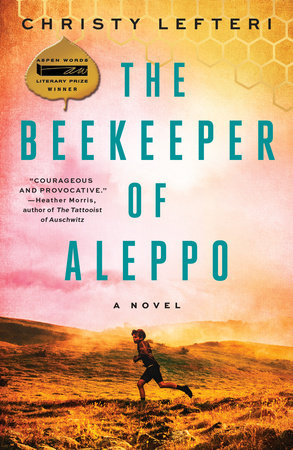
The Beekeeper of Aleppo
Nuri is a beekeeper in Aleppo, and his wife Afra is an artist.
About
Spoiler notice: Spoilers cover the premise, asylum-waiting frame, and encounters during Nuri and Afra’s journey through Turkey and Greece. The ending and later revelations are not disclosed.
The Beekeeper of Aleppo opens with Nuri Ibrahim and his wife Afra in England, waiting to learn whether their asylum applications will be granted. Nuri narrates from this uncertain present, where the couple are physically together but struggling to reach one another. Afra, once a painter who sold landscapes in Aleppo, has lost her sight; Nuri tries to make sense of their changed life while recalling how they came to leave Syria. This frame gives the novel a clear tension from the beginning: the couple have reached a place where they may be allowed to stay, but their journey is unfinished in memory and in the relationship they are trying to rebuild.
Nuri’s recollections move back through his life in Syria, including his boyhood and the beekeeping enterprise he shared with his cousin Mustafa. Before war forces a departure, the hives and the daily work around them give Nuri a trade and a settled rhythm. Mustafa’s later presence in England is more than a promise of practical help: he has begun an apiary in Yorkshire and is teaching other refugees to keep bees. The link between the cousins connects the opening in England to Nuri’s earlier life, carrying his skill across the separation between home and destination. The bees are part of the story’s actual work and history, not only an emblem attached to the title.
Afra’s art gives the couple another point of connection to the life they have lost. Her paintings begin as part of the ordinary economy of Aleppo: she makes landscapes and sells them at the open-air market. After she loses her sight, Nuri’s memories and present-day care for her take on added weight, while grief affects how each of them responds to the other. Because the account is told by Nuri, readers encounter Afra through his attention and recollection, rather than through an equal second narration. That choice makes the couple’s changing closeness central to the book’s form. He can describe what he sees, but his narration also reveals the limits of his understanding of what Afra is experiencing.
The past timeline follows Nuri and Afra out of Aleppo and along a route through Turkey and Greece toward England. Their movement is not a clean passage from danger to resolution: the couple meet other people fleeing for different reasons, and each encounter enlarges Nuri’s sense of what has been lost or endured. In Athens, while waiting in a refugee camp, he hears music and approaches a man playing a rebab, a stringed instrument. The man’s account of leaving Afghanistan comes in stages, as trust develops between strangers. This brief meeting gives the journey one of its particular human encounters, showing how Nuri’s own flight intersects with lives that are distinct from his and Afra’s.
One of these encounters begins with music: in an Athens camp, Nuri hears a man playing the rebab and goes over to him. The man first describes leaving Afghanistan because the Taliban would not allow him to play; later, he tells Nuri that he was forced into the Ministry of Defense and made to kill civilians. The sequence turns a short conversation into a difficult portrait of someone whose past cannot be sorted into a simple category. Nuri does not meet the man as an emblem or a lesson. He meets him while both are displaced, and hears a history that unsettles any easy distinction between victim, witness and perpetrator. The rebab gives this exchange its point of entry, while the gradual disclosure makes trust part of what the scene is about.
The two timelines alternate between the couple’s precarious wait in England and Nuri’s more nearly chronological recollection of the route that brought them there. That structure lets the present gather meaning as the past is disclosed: the reader knows Nuri and Afra have reached England, while the details of their passage and the condition of their relationship emerge gradually. The novel also lets remembered Syria remain present beside the camp and travel scenes. Nuri’s account includes Mustafa’s letter about a man who rocks through the night singing a lullaby; Mustafa offers him cigarettes when he cannot find words that would ease the man’s pain. The detail is small, but it gives the cousin a life and a way of responding beyond his role as a destination for Nuri.
In the Athens camp, Afra befriends a young mother whose infant was taken while she slept. Nuri’s narration is still the lens through which readers learn this, but the encounter prevents Afra from being only someone he guides. She forms a bond with another woman facing a different loss. Alongside the musician’s disclosures and Mustafa’s letter, this scene shows how the couple’s route intersects with lives that cannot be folded into theirs. The book does not present their flight as a straight line from Aleppo to an answer in England. By the time the asylum decision hangs over them, work, art, kinship and these encounters are all part of what Nuri remembers, while he and Afra must find a way to live together with those memories.
Book details
- Author
- Christy Lefteri
- First published
- 2020
- Series
- No series listed
- Subgenre
- Literary fiction, Immigrant fiction
- Primary genre
- Literary Fiction
- Tags
- No tags for this book.
Review
Editor profile
Baby Bat
Goodreads and social links will be added soon.
- Goodreads — link coming soon
- Social media — link coming soon