
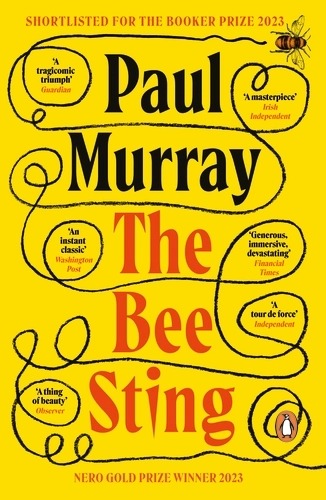
The Bee Sting
The Barnes family is under pressure as Dickie’s once-profitable car business fails.
About
Spoiler notice: Spoilers for the opening family crisis and the novel’s central questions about its causes; the ending and later outcomes are not summarized.
Paul Murray’s The Bee Sting follows the Barnes family in contemporary Ireland as several kinds of trouble gather around their household. Dickie’s once-profitable car business is failing; his wife, Imelda, is selling jewellery online; their daughter Cass is approaching her final exams while drinking heavily; and twelve-year-old PJ is planning to run away. The novel begins with these pressures already in motion, then asks how far back their causes might reach. A bee beneath a bridal veil, an earlier car crash and Dickie’s childhood all appear as possible turning points. The book’s design links present strain with remembered events, making the family’s crisis a question of history as well as circumstance. Its central concern is not simply what happens next, but how people explain the path that brought them here.
The four family members occupy different positions within the same decline. Dickie responds to the failing dealership by spending time in the woods building a bunker with a handyman, an act that turns an economic problem into preparation for a larger imagined emergency. Imelda tries to raise money by putting her jewellery on eBay and fends off the attentions of Big Mike, a cattle farmer. Cass, once near the top of her class, is trying to get through her final exams while binge drinking. PJ, the youngest, is in debt to a local boy known as Ears Moran and is preparing an escape. These choices are distinct, but they take place inside one family, where each person’s private response affects the others. Their problems cannot be neatly divided into separate plots.
Cass’s story supplies a more particular view of life inside this household. The Booker extract begins with her friendship with Elaine, which starts in Chemistry class after an accidental spill of iodine leads Elaine to accompany Cass to the nurse. The girls walk to school together, study at each other’s homes and message late into the night. They are both bright, come from well-known families and imagine leaving town one day, but their closeness does not mean Cass feels entirely at ease. Elaine is comfortable talking with Imelda about clothes and beauty products, while Cass can become a bystander in those exchanges with her own mother. This friendship gives the family story a second centre: Cass’s attachment to Elaine is also a way of seeing the distance between how she imagines belonging and how she experiences it.
The town around the Barnes family is drawn through the small routines that make a place familiar and confining at once. In the extract, Elaine complains that people know one another’s business, that local shops ask after their parents and that conversations return to farming, the microchip factory and Gaelic games. Cass shares some of Elaine’s dislike of the town’s limited options, yet Elaine’s presence changes how she feels about it. Murray has said he built the Midlands setting from details and stories gathered through friends, including local layout and expressions, rather than transferring real people wholesale into the novel. That account helps explain why the setting is specific without turning into a guidebook: the town is shown through what its young residents notice, reject and rely on.
Murray balances the seriousness of the situation with a tragicomic mode. That combination matters to the book’s treatment of people who behave badly, make poor decisions or avoid difficult truths. The publisher describes the story as a struggle to be good while the world falls apart; the Barnes family’s varied responses give that question a domestic scale. Dickie’s bunker, Imelda’s online sales and the children’s separate crises can look absurd beside the larger family trouble, yet they also show how people try to act when they feel cornered. Comedy can expose the gap between a plan and its consequences, while tragedy gives those consequences weight. The tone lets the characters remain flawed without reducing them to examples or punchlines.
The family’s changing viewpoints also have a literary context that clarifies the book’s structure. Murray has named William Faulkner’s As I Lay Dying as an important influence, particularly its use of different family members taking turns to tell a story. He has also said Lorrie Moore’s Who Will Run the Frog Hospital? informed the Cass chapters, especially its portrait of friendship and the pull of looking back toward an easier time. These are influences Murray himself identifies, rather than labels imposed from outside. They point to a narrative that treats the Barnes family as several related but distinct perspectives. Cass’s friendship with Elaine, Imelda’s strained household role and Dickie’s response to the business crisis do not collapse into one shared explanation; the reader has to hold those angles together.
Murray has described climate change as the subject he most wanted to address, and said he was interested in the anxieties of the present as much as in the persistence of the past. That context widens the meaning of Dickie’s bunker and the family’s sense of impending trouble: preparation for disaster belongs to the same contemporary atmosphere as financial insecurity, but the novel remains grounded in the choices of this household. The setting is post-crash Ireland, and the present is not treated as a simple result of earlier family events. In the interview, Murray also connects the current moment with political and media pressures, while cautioning that looking only to origins does not help people meet what is ahead. The family’s private crisis therefore sits beside a broader uncertainty about what kind of future can still be made.
Book details
- Author
- Paul Murray
- First published
- 2023
- Series
- No series listed
- Subgenre
- Family saga, Literary fiction
- Primary genre
- Literary Fiction
- Tags
- No tags for this book.
Review
Editor profile
Baby Bat
Goodreads and social links will be added soon.
- Goodreads — link coming soon
- Social media — link coming soon