
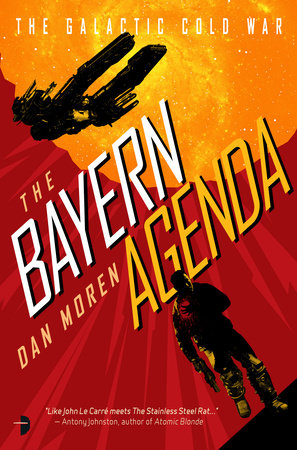
The Bayern Agenda
When Commonwealth intelligence operative Simon Kovalic returns injured from a mission with information about the Illyrican Empire and the planet-sized Bayern Corporation, his undercover team passes to his ex-wife, Natalie Taylor.
About
Spoiler notice: This overview discusses the opening mission, Kovalic’s injury, the change in team leadership, and the political investigation’s premise. It avoids later discoveries about the Bayern arrangement, the mission’s full course, and the novel’s resolution.
The Bayern Agenda sets an espionage story inside a standoff large enough to involve whole star systems. Dan Moren’s first Galactic Cold War novel follows Commonwealth operative Simon Kovalic after a mission leaves him injured and carrying intelligence about a possible connection between the Illyrican Empire and Bayern, a planet-sized banking institution. The assignment is not simply to discover what the Empire wants. Kovalic’s team has to work across competing political interests while the prospect of a financial arrangement threatens to alter the balance between rival powers. By giving a spy thriller the scale and machinery of space opera, the novel makes quiet negotiations and undercover work feel consequential without losing sight of the agents who must carry them out.
Kovalic is a professional whose habits are shaped by years inside intelligence work. The injury that removes him from the field creates an unusual problem for someone accustomed to managing uncertainty by staying close to it: he must rely on other people to continue a mission whose risks he understands. The book’s attention to his earlier career adds context to the present operation and frames experience as both an asset and a source of expectation. His authority comes from knowledge of the work and the people around him, but that authority cannot substitute for being present when circumstances change. The tension between command and participation gives the central spy plot a personal dimension that is more specific than a simple race to uncover a secret.
Natalie Taylor’s role makes that tension visible inside the team. As Kovalic’s ex-wife and a capable intelligence officer, she takes charge of the undercover group while he is sidelined. Their shared history means the handover carries more than procedural friction: the characters must work through professional responsibility in a relationship already shaped by private knowledge. The arrangement also shifts attention away from the familiar lone-agent model. The mission depends on a team, and each member brings a different relationship to its risks and methods. The result is a story where trust is operational as well as emotional. People have to decide whose judgment to follow, what information to share, and how to keep a group functioning when its established leader is suddenly at a distance.
The Bayern Corporation offers the investigation a distinctive political pressure point. A financial institution with the reach of a planet becomes part of the strategic landscape between the Commonwealth and the Illyrican Empire. That premise lets Moren connect espionage to economic influence: a bank’s apparent neutrality can matter greatly when rival powers seek access to the systems that support commerce and government. The plot therefore operates through relationships and information as much as through direct confrontation. A covert team must interpret what a possible arrangement means, whom it benefits, and what its existence signals to the opposing side. These questions give the Cold War setting a practical texture, with power expressed through access, alliances, and the threat of escalation.
A second perspective broadens the book’s view of the operation. Publishers Weekly identifies Elijah Brody, an Illyrican defector and pilot, as a new member of Kovalic’s team making an uncertain first move into covert work. His position connects him to the opposing society while placing him among people whose professional habits and loyalties have already been tested. That makes him a useful counterpoint to an experienced operative: the work may be familiar to the team, but its codes are not automatically legible to a newcomer. Alongside chapters that look back at Kovalic’s early career, this viewpoint gives the narrative room to consider how people enter institutions, acquire expertise, and learn which rules are flexible only in theory.
The science-fiction setting changes the scale of spy-fiction conventions while keeping their human requirements recognizable. Interstellar travel and distant political blocs enlarge the map, but an undercover operation still depends on observation, timing, credible identities, and imperfect information. The book’s dry humor, noted in its publisher description, sits beside those pressures and can make the cast’s professional composure part of the characterization. Humor does not erase the stakes; it gives the characters another way to negotiate them. Similarly, the speculative hardware does not replace tradecraft. It supplies a wider arena in which intelligence work, military power, and economic influence can intersect, while the immediate decisions remain with the people conducting the mission.
As the opening novel in the Galactic Cold War sequence, The Bayern Agenda establishes a setting through an investigation that can be followed on its own terms: a recovering operative, a team under new leadership, and suspicions around a politically important corporation. Its main interest lies in how an organization responds when knowledge is incomplete and the person expected to direct events cannot simply take control. Kovalic’s experience, Taylor’s command, and Brody’s outsider position create different vantage points on the same uncertain assignment. Around them, the conflict between the Commonwealth and the Illyrican Empire turns one intelligence question into a wider test of cooperation and judgment. The scope reaches across the galaxy, but the story’s central pressures remain grounded in trust, responsibility, and the cost of getting a decision wrong.
Book details
- Author
- Dan Moren
- First published
- 2019
- Series
- The Galactic Cold War, book 1
- Subgenre
- Military science fiction, Spy thriller, Espionage
- Primary genre
- Sci-Fi, Mystery & Thriller, Adventure
- Tags
- No tags for this book.
- Reading order
- This is the only The Galactic Cold War title on the shelf right now.
Review
Editor profile
Baby Bat
Goodreads and social links will be added soon.
- Goodreads — link coming soon
- Social media — link coming soon