
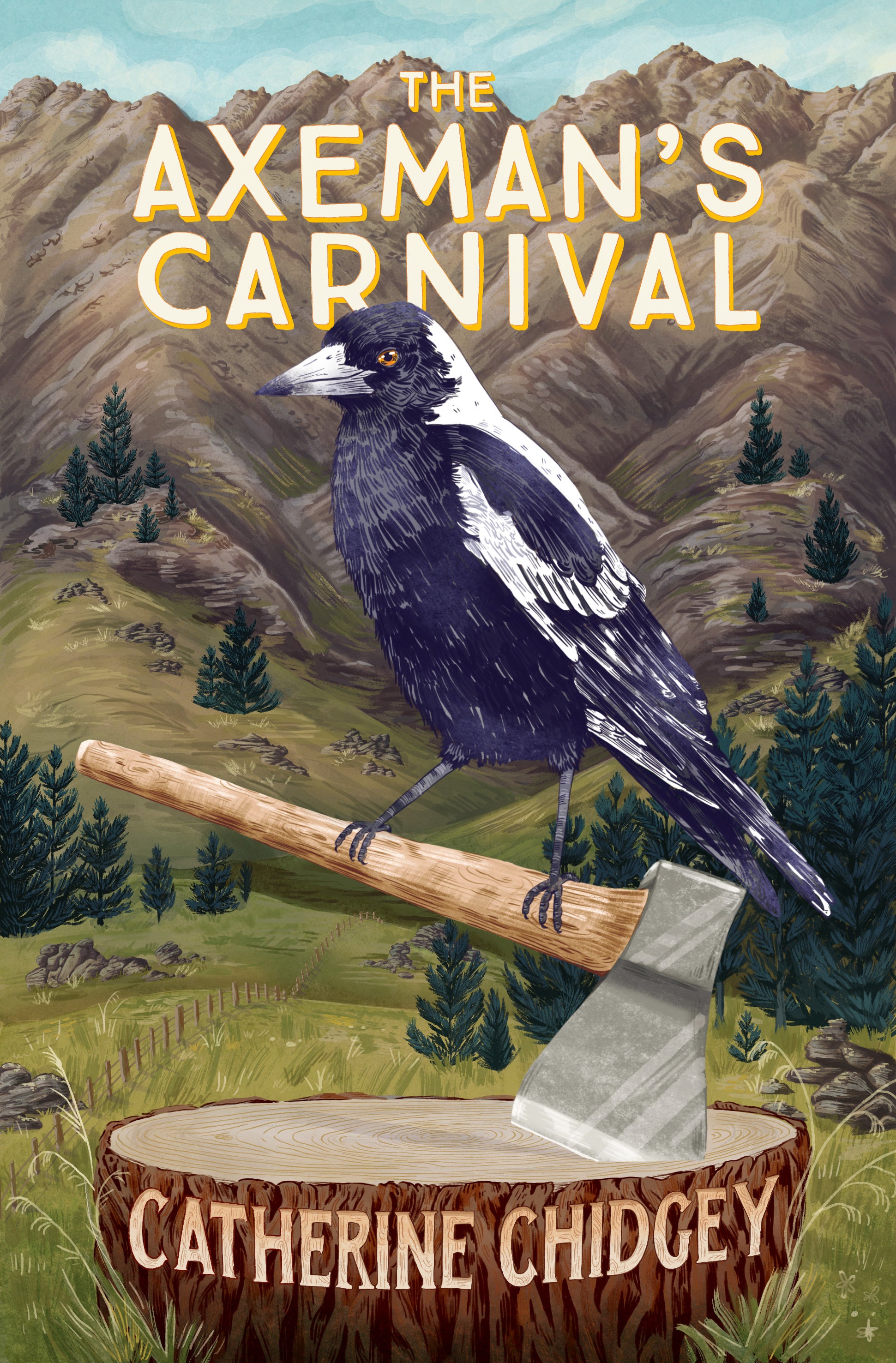
The Axeman's Carnival
Marnie rescues a magpie chick and names him Tama.
About
Spoiler notice: Spoilers for the premise and opening setup, including Tama's rescue, Marnie and Rob's strained marriage, and the magpie's growing fame. Later developments and the ending are not summarized.
The Axeman's Carnival begins with a young magpie whose life changes when Marnie rescues him. She names him Tama and brings him into the world of her farm, where his survival becomes entangled with the condition of the people around him. Rob, Marnie's husband and a farmer, initially regards the bird as a nuisance. Yet Tama can speak, and his unusual ability gradually gives him a place in the household and beyond it. The novel uses a bird at the centre of a rural drama to bring human behaviour into view from an oblique angle. Tama is neither simply a pet nor a conventional narrator: he is an animal living among people, dependent on their care, attentive to their habits and capable of repeating what he hears. His presence makes the farm's private tensions part of a wider story about attention, performance and survival.
Chidgey places the story in a New Zealand high-country farming landscape and gives it a distinctly communal soundscape. The novel's opening evokes many kinds of birds, but magpies dominate through their insistence and territorial calls. Their voices establish a world that existed before Tama's rescue and continues beyond the human household. In this setting, the farm is both a working place and a boundary between human routines and wild lives. The magpie's point of view shifts that boundary: human speech becomes material he can mimic, while the birds beyond the house have their own warnings and claims. The narrative can therefore move between domestic conversation and the larger presence of the surrounding land without treating nature as mere scenery. Tama's story stays close to the farm while making its sounds and inhabitants part of how readers understand it.
Tama's talent for speech draws attention to the difference between saying words and understanding them. To the humans who hear him, his utterances can be comic or nonsensical; for the reader, his narration gives shape to events that people may struggle to name. Mimicry lets him reproduce the voices around him, but it also makes him a witness to the gaps between what people say publicly and what they confide in private. That double position gives the novel an unusual narrative instrument. Tama is close enough to the household to observe its daily life, while remaining outside human explanations of marriage, work and responsibility. The result is not that the bird magically resolves those questions. Instead, his presence makes familiar words sound strange and exposes how much of human meaning depends on context, power and who is listening.
Marnie's relationship with Rob gives the farm a serious domestic conflict. She confides in Tama about the violence in her marriage, while Rob's response to the bird reveals his own impatience and capacity for threat. Chidgey sets moments of humour beside this harm, allowing Tama's mimicry and growing attention to provoke laughter without erasing the danger Marnie describes. The contrast matters because the novel does not make the farm's difficulties picturesque. Farming, weather and household life are connected, but hardship does not excuse cruelty or make it harmless. Through Tama, private speech gains a listener who does not answer in the expected human way. He cannot provide an easy solution, yet his role as confidant changes how Marnie's isolation is represented: what she says has been heard, and the story can carry it beyond the room in which she speaks.
As Tama's fame grows, his place changes from a rescued chick within one household to a figure who attracts attention from outside the farm. His capacity to speak makes him remarkable to people who encounter him, and recognition brings practical as well as personal consequences for those around him. The movement from private animal companion to public attraction introduces questions about ownership and performance: who controls the story of a creature whose words are repeated by others, and what happens when attention becomes valuable? These questions connect the domestic narrative to the wider social world without shifting the book away from the people and animals on the farm. Tama's visibility can offer new possibilities, but it also makes him more exposed. The qualities that make him a source of wonder can be interpreted, circulated and used by people with different interests.
The title's Axeman's Carnival gives the story a destination that is visible from early on, lending the narrative an accumulating sense of anticipation. The event belongs to the novel's rural world, but it also gathers several of its concerns: spectacle, competition, violence and the ways people turn skill into public entertainment. Chidgey uses that setting to connect the ordinary routines of the farm with an occasion that draws a crowd and places performance at its centre. The carnival is not only a plot marker; it reflects the book's attention to audiences and to the difference between watching an event and living with its consequences. The novel's tension grows through the relationships and expectations that lead toward it. This structure lets suspense coexist with the close observation of daily life, so that what seems local and familiar can take on a more unsettling weight.
The Axeman's Carnival combines animal narration, rural fiction and dark comedy to examine vulnerability across the boundary between species. Tama's unusual voice can make a scene funny, but his dependence on human decisions keeps the story grounded in unequal relationships. Marnie's position on the farm, Rob's authority within the household, and the magpie's status as both wild creature and public attraction create different forms of exposure. The book does not flatten these experiences into one allegory; instead, it lets them echo through a shared setting. Its humour works alongside, rather than in place of, the threat and uncertainty present in the household. By allowing a magpie to watch human life closely, Chidgey makes familiar behaviour newly visible and asks readers to consider who gets heard, who is treated as useful, and who remains at risk when others control the terms of attention.
Book details
- Author
- Catherine Chidgey
- First published
- 2022
- Series
- No series listed
- Subgenre
- Literary fiction, Family novel
- Primary genre
- Literary Fiction
- Tags
- No tags for this book.
Review
Editor profile
Baby Bat
Goodreads and social links will be added soon.
- Goodreads — link coming soon
- Social media — link coming soon