
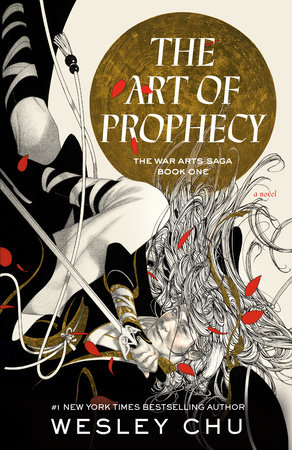
The Art of Prophecy
A prophecy names Jian as the child destined to defeat the Eternal Khan and save the kingdom.
About
Spoiler notice: This overview discusses the prophecy concerning Jian, the main characters, and the premise that events unsettle the expected course of his destiny. It avoids detailing later plot turns, character fates, and the ending.
The Art of Prophecy begins with a familiar fantasy promise: a child has been named as the one who will defeat the Eternal Khan and save the kingdom. Jian grows up inside that expectation, surrounded by comfort, instruction, and public honor. His identity has been shaped before he has met the danger he is supposed to overcome. The novel’s central question emerges when the certainty built around the prophecy proves unreliable. What becomes of a person prepared for a single appointed future when events remove that future’s apparent foundation? Wesley Chu uses this disruption to move the story away from a straightforward march toward a foretold victory and toward a wider account of responsibility, choice, and adaptation.
The person who first sees the gap between Jian’s reputation and readiness is Ling Taishi, an experienced war artist whose judgment carries the weight of a life spent mastering magical martial arts. She finds a young man ill-prepared for the demands placed on him, and takes responsibility for training him herself. Their relationship gives the book a mentor-and-student structure, but the roles are not simple. Jian has been protected and praised; Taishi brings discipline, candor, and experience, yet she is not merely a device for correcting him. The author has described the two as approaching life from opposite ends: Jian is discovering himself as he matures, while Taishi confronts the accumulated consequences of a long life. Their differences make instruction a two-way pressure, as each must act in circumstances that test what they believe about themselves.
The story’s other central figures widen its view beyond Jian’s private crisis. Sali is a warrior whose loyalties and sense of duty are unsettled by the loss of the leader to whom she pledged herself. Qisami is an assassin, dangerous and difficult to predict. These characters enter the same unstable political landscape from distinct positions: trained service, personal grief, professional violence, and inherited expectation do not point toward one shared idea of what should happen next. Their separate aims create a story with several centres of attention, rather than treating the prophesied hero as the only person whose choices matter. Each character’s response to disruption helps reveal how authority and allegiance work in this world.
Chu calls the novel a tribute to wuxia, and has described its form as a combination of Asian influences and Western-style storytelling. That background is relevant to the book’s war artists, whose physical disciplines extend into magical techniques, and to its emphasis on skill developed through practice. Combat is not merely a decorative interruption to the plot: training and martial ability are among the means by which characters negotiate danger, status, and personal limits. The setting draws on several periods of Chinese history, with the author identifying the Three Kingdoms era as a particular inspiration. The result is a secondary-world fantasy with political conflict and martial spectacle, informed by historical and genre traditions without presenting itself as a direct retelling of one historical episode.
Prophecy gives the book a way to examine the relationship between fate and agency. A prediction can organize institutions and private lives long before its promised event arrives. Jian has been treated as a champion in advance of any achievement, and that treatment has shaped his education and self-image. When the prediction loses its authority, the resulting problem is both political and personal: people who have invested in a destiny must decide what to do without its guarantees. In his interview with The Fantasy Hive, Chu described the novel’s view of destiny through the choices people make and the experiences that prepare them to make those choices. The story therefore places belief beside action. Its characters inherit traditions and expectations, but still have to choose how to respond when circumstances shift.
The novel also contrasts different stages of life. Jian faces the work of growing beyond an identity assigned to him, while Taishi carries memories and judgments accumulated over decades. The author has framed their arcs as discovery on one side and redefinition on the other. This pairing gives the coming-of-age thread a broader counterpoint: change is not reserved for the young, and experience does not remove the need to reconsider one’s role. Sali’s altered loyalties add another dimension, asking what duty means when the person or structure that gave it direction is gone. Across these characters, faith, tradition, family, and obligation appear as forces that can steady people but can also leave them disoriented when their assumptions fail.
The Art of Prophecy is the opening book of The War Arts Saga, and its expansive fantasy framework leaves room for more than one kind of conflict. It connects training and combat with questions of legitimacy, mentorship, service, and the stories a society tells about its future. Its premise invites readers to consider what happens after the chosen-one label stops explaining what a character should do. Jian must contend with the distance between being celebrated as a hero and becoming capable of acting for himself, while Taishi and the others pursue concerns that cannot be reduced to his destiny. The book’s focus on magical martial arts and wuxia conventions sits alongside a character-driven interest in changing loyalties and uncertain futures. Its central tension rests in that combination: a prophecy may announce an outcome, but people still have to live through the decisions, pressures, and relationships that shape what follows.
Book details
- Author
- Wesley Chu
- First published
- 2022
- Series
- The War Arts Saga, book 1
- Subgenre
- Epic fantasy
- Primary genre
- Fantasy
- Tags
- No tags for this book.
- Reading order
- This is the only The War Arts Saga title on the shelf right now.
Review
Editor profile
Baby Bat
Goodreads and social links will be added soon.
- Goodreads — link coming soon
- Social media — link coming soon