
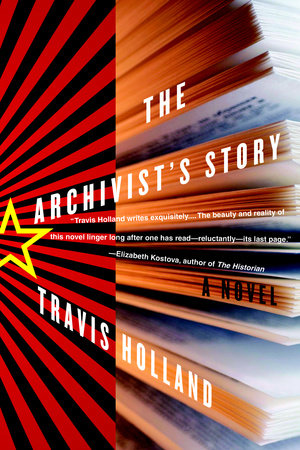
The Archivist's Story
Moscow, 1939: Pavel Dubrov works in the Lubyanka prison archive, where documents taken from political prisoners are catalogued and destroyed.
About
Spoiler notice: This overview discusses Pavel Dubrov's work at Lubyanka, his meeting with Isaac Babel, and his decision to protect the writer's manuscripts. It avoids later developments in Pavel's personal relationships, the consequences of his choices, and the novel's ending.
The Archivist's Story places an invented life inside one of the most dangerous institutions of Stalin-era Moscow. In 1939, Pavel Dubrov works in the archive at Lubyanka prison, sorting writing taken from political prisoners. His task is not to preserve these papers for history: manuscripts are treated as evidence, and the writing is ultimately marked for destruction. When Pavel is asked to authenticate an unsigned story, the assignment brings him face to face with its author, Isaac Babel. The meeting unsettles the careful distance he has maintained between his old literary interests and the work that now occupies him. Holland makes that conflict the novel's point of entry. A question of handwriting becomes a question of complicity, and the fate of a page becomes bound to the choices of the person handling it.
Pavel is not presented as a fearless dissident waiting for the right occasion. He has already made compromises to survive, and the habits that help him function in the archive also narrow his sense of what remains possible. He knows the rules because he works inside them; he understands the risks because his work depends on reading other people's words as potential evidence against them. The novel follows the strain of that position rather than turning him into a symbol detached from ordinary needs. His decision to protect Babel's writing is significant partly because it does not erase the choices that came before. Holland's fiction asks what a small act of conscience can mean when power is organised to make each person responsible for someone else's vulnerability.
The prison's archive gives the story a setting where language has been forced into an official use. A manuscript can be catalogued, attributed, and used to strengthen a case against its author; its artistic life is secondary to its value as a record. Pavel's attention to the writing pushes against that reduction. Babel is not simply a famous name whose pages deserve rescue because they may become important literature. He is a living prisoner, and the work in question is the product of a person being prevented from writing freely. The distinction matters. Preservation does not undo the violence around the text or guarantee that art can protect its maker. The novel keeps those limits in view, so that Pavel's work with paper remains morally charged rather than magically redemptive.
Holland's portrait also rests on the pressure of the surrounding bureaucracy. Fear travels through routine: a request to verify a story, a file passed between desks, a colleague's cautious language. The system does not need every participant to believe in it; it depends on people carrying out small duties while anticipating what refusal might cost. This makes Pavel's private decision legible as both personal and political. He acts in a world where silence can look like prudence and cooperation can be disguised as ordinary work. The novel's tension grows from that uncertainty. Each gesture may be read in more than one way, and the effort to conceal a manuscript creates suspense without turning the story into a chase or a puzzle. Its central question remains how a person behaves when even modest choices can expose others and oneself.
The book's historical frame comes from Isaac Babel's real persecution and the seizure of his papers, while Pavel and the specific acts of preservation belong to Holland's novel. In an interview, Holland described the research behind the book as drawing on both primary and secondary material and spoke about meeting people who could recall the purges. He also connected Babel's writing with the sense that literature can stand as evidence that a life existed. That context helps explain why the novel gives close attention to objects, memory, and the survival of voices. It does not make the fictional story a substitute for the experiences of those whose testimony informed the author. Instead, the invented archivist becomes a way to examine the responsibilities and limits involved in carrying traces of the past forward.
The Archivist's Story is a historical novel shaped by literary questions and quiet suspense. Its scale remains close to Pavel: his habits, memories, loyalties, and shifting understanding of the institution around him. The focus on a single archive lets the book consider a larger problem without losing sight of individual consequence. What is saved, who is able to save it, and what risks attach to the act are not abstract questions here; they emerge from work that looks mundane until its purpose becomes clear. Holland's debut keeps the value of literature complicated. A surviving story may resist erasure, but it cannot reverse what has happened to its author or make the person who saves it innocent. That tension gives the novel its emotional shape and distinguishes preservation from rescue. It also leaves readers with a practical measure of courage: actions may matter even when they cannot repair the larger harm surrounding them.
Book details
- Author
- Travis Holland
- First published
- 2007
- Series
- No series listed
- Subgenre
- Historical fiction, Literary historical fiction
- Primary genre
- Historical Fiction, Literary Fiction
- Tags
- No tags for this book.
Review
Editor profile
Baby Bat
Goodreads and social links will be added soon.
- Goodreads — link coming soon
- Social media — link coming soon