
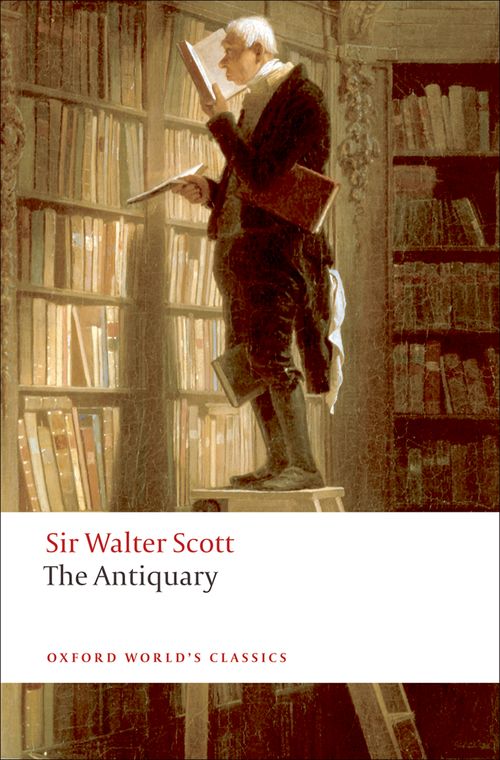
The Antiquary
A young stranger calling himself Lovel follows Isabella Wardour to the Scottish coastal town of Fairport, where he befriends antiquary Jonathan Oldbuck.
About
Spoiler notice: Full-plot spoilers, including the Glenallan family history, Lovel's identity and his marriage.
A delayed coach gives Walter Scott's The Antiquary an appropriately unheroic beginning. The young traveller who calls himself Lovel finds himself waiting alongside Jonathan Oldbuck, a man whose impatience and argumentative energy make an ordinary journey an introduction to a whole personality. Published in 1816 and set in late-eighteenth-century Scotland, the novel moves into the coastal community around Fairport and Oldbuck's home at Monkbarns. There are concealed identities and damaged inheritances waiting to emerge, but Scott first lets us enter through conversation, irritation and the business of getting from one place to another. Lovel's arrival places a stranger among people who already possess their own accounts of the past. Discovering which of those accounts deserve belief becomes as important as discovering who the stranger really is.
Oldbuck's enthusiasm for antiquities supplies both knowledge and opportunities for comedy. He wants remnants, inscriptions and objects to disclose the history around him, yet his confidence can exceed what the evidence will bear. His collections and opinions make Monkbarns a place where the past is continually being handled and argued over. Lovel becomes his guest and companion, gaining access to local society through a host who is generous as well as disputatious. The antiquary's habits also establish a question that runs through the larger plot: what makes an interpretation trustworthy? An impressive explanation can be appealing because it confirms the explainer's interests. Other people may preserve inconvenient information that resists it. Scott's community is full of competing expertise, and its most authoritative voices are not always its most accurate.
Edie Ochiltree brings a different kind of knowledge into that community. A travelling mendicant, he moves among households and social ranks with an access that wealthier characters do not necessarily possess. Memories, encounters and practical observations give him resources that cannot be reduced to ownership of books or estates. The novel's social world becomes larger through figures such as Edie and the Mucklebackit family, whose concerns extend beyond the arrangements of prosperous neighbours. When Saunders Mucklebackit must repair his boat after losing a son, grief does not remove the necessity of earning a living for the children who remain. Oldbuck encounters a suffering that his own circumstances would allow him to experience very differently. The scene gives material weight to the distinctions of rank that elsewhere produce banter or wounded pride.
Lovel's attachment to Isabella Wardour brings him up against those distinctions in another form. Her father, Sir Arthur, values ancestry and position while his financial circumstances make the security of his household increasingly doubtful. A stranger with an uncertain background is not easily admitted as a suitable connection, however strong his feelings may be. Sir Arthur's dependence upon Dousterswivel adds a further danger. The supposed adept offers occult expertise and the prospect of discovering treasure, exploiting a desire for relief that makes implausible promises attractive. Oldbuck challenges that performance, but exposing pretension is more difficult when the person being misled badly wants the promise to be true. The Wardours' predicament joins romantic obstruction to a practical problem of money, showing how family pride can survive long after the means of sustaining it have weakened.
The history of the Glenallan family reveals a far more destructive use of false information. Elspeth confesses that the old Countess enlisted her in a plot against Eveline Neville, whom the Countess opposed as a match for her son. They falsely persuaded Glenallan that Eveline was his father's daughter, concealing the fact that the couple had already married in secret. What appeared to him an intolerable discovery was a manufactured accusation. Eveline's despair led her to leap towards the sea; Elspeth rescued her, but she later died after giving birth prematurely. The newborn boy disappeared with Teresa, the Countess's Spanish servant. Elspeth knows of a murderous command concerning the child, yet she does not know his eventual fate. Her confession therefore reveals the crime without supplying every answer that the surviving father needs.
A false invasion alarm unexpectedly brings the scattered threads together. A beacon is lit, the neighbourhood prepares to resist an imagined French attack, and familiar characters reveal different degrees of courage, confusion and practical competence. The gathering allows Lovel to return as Major Neville and brings him before Glenallan, who sees Eveline's likeness in him. Recognition alone is not left to settle the question. Lovel explains the uncertain story of his upbringing, and a sealed account with corroborating proofs establishes him as William Geraldin, Glenallan's legitimate son and heir. The ending also clears the uncle who raised him of the suspected crime. Earlier suspicions have been powerful, but they do not become facts merely through repetition. The recovery of a family depends upon evidence capable of correcting the story that had destroyed it.
The apparent treasure that helps the Wardours is explained in similarly human terms: it comes from silver plate belonging to Lovel's uncle, with the discovery arranged through practical assistance rather than occult power. Lovel and Isabella marry a month after his identity is established, and Oldbuck contributes an antique ring to the occasion. The conclusion follows generosity into the wider community as well, including assistance administered through Edie, while leaving some supposed future marriages as unconfirmed reports. These varied endings suit a novel whose interests have always exceeded the central courtship. Fairport contains households, livelihoods and memories that continue beyond the solution of a mystery. Oldbuck's passion for understanding the past remains part of that life, chastened by a story in which the decisive discoveries come from listening to people as carefully as examining things.
Book details
- Author
- Walter Scott
- First published
- 1816
- Series
- No series listed
- Subgenre
- Literary fiction, Modern classics
- Primary genre
- Literary Fiction
- Tags
- No tags for this book.
Review
Editor profile
Baby Bat
Goodreads and social links will be added soon.
- Goodreads — link coming soon
- Social media — link coming soon