
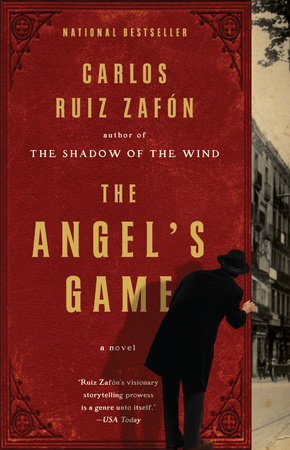
The Angel's Game
In 1920s Barcelona, struggling pulp writer David Martín accepts a lucrative commission from a mysterious publisher to create an extraordinary book.
About
Spoiler notice: Spoilers cover David Martín’s commission, his investigation of Diego Marlasca and the Cemetery of Forgotten Books, and the central mystery premise. Later revelations and the ending are not disclosed.
In the backstreets of early twentieth-century Barcelona, David Martín makes his living writing popular stories under deadline for editors. He is young and ambitious, but the work that pays his bills leaves him dissatisfied and uncertain about his future. He lives in a decaying mansion whose atmosphere mirrors the instability around him. When a mysterious publisher offers an unusually generous commission, David sees a chance to change the direction of his career. The offer promises the literary recognition that has eluded him, yet its strange terms make it difficult to judge. The novel begins with that tension between a writer’s hopes and the costs that may accompany them.
The commissioned work draws David into a story about the power people assign to books. He is asked to create something unlike the commercial fiction he has been producing, and the scale of the promise unsettles the ordinary exchange between writer and patron. The publisher’s interest is personal, persistent and difficult to explain. David’s professional decision becomes a mystery as well as a career turning point: what is this book meant to do, and why has this writer been chosen? Ruiz Zafón builds suspense from questions of motive and belief, keeping the creative act at the centre of the plot. Writing is skilled labour, a source of income and identity, and a practice that can become dangerous when another person tries to control its purpose.
Barcelona has a strong physical presence in the story. David’s mansion, the city’s older streets and hidden spaces beneath them create a setting where public life and private history seem to overlap. The book returns to the Cemetery of Forgotten Books, an underground library that also appears in The Shadow of the Wind. Its presence links David’s investigation to a wider fictional world devoted to books that have vanished from ordinary circulation. The Cemetery is more than a picturesque location: it makes reading and preservation part of the mystery. Its shelves suggest that written works can outlive their makers while carrying traces of those who sought them out. Against this imagined archive, Barcelona’s streets form a maze of histories David cannot understand at a glance.
David’s inquiry reaches into the past of the mansion and its former owner, Diego Marlasca. A book associated with Marlasca becomes a focus for questions about the house, its secrets and whether the accepted account of events is complete. As David follows the clues, the investigation takes on Gothic features: an imposing residence, an unresolved death, hidden records and an atmosphere in which appearances may mislead. The supernatural is part of the novel’s uncertainty, but attention also stays on human motives and the stories people construct to make sense of what they fear. David has to decide how much evidence to trust, including evidence that arrives through texts whose authors and purposes are unclear.
The book combines literary mystery with romance and psychological unease. David’s relationships affect how he understands his choices, while his work keeps drawing him toward questions of authorship, influence and responsibility. The private and professional parts of his life become harder to separate as the commission gathers weight. Rather than standing outside the case, its central character is caught inside the events he tries to interpret. His ambitions, memories and fears shape how he sees Barcelona and the people around him. This point of view keeps the reader close to David while leaving room to wonder whether his explanations are complete. Tension comes both from the external puzzle and from the possibility that his perspective may itself be unstable.
The Angel’s Game is volume two in the Cemetery of Forgotten Books series, though it centres on a different generation and can be approached through its own characters and mystery. Familiar places, especially the Cemetery, connect returning readers to the earlier novel; a new reader can still follow David’s commission, investigation and personal stakes. The book first appeared in Spanish in 2008 as El juego del ángel. The English translation followed in 2009, and the selected US paperback edition in 2010. Those dates mark separate stages in its publication history rather than conflicting records for one release.
At its heart, the novel asks what happens when storytelling is treated as a force capable of shaping belief and behaviour. David earns his living by inventing plots, but the commission places him in a situation where invention and consequence begin to touch. His movement through the mansion, the city and the Cemetery gives the book the form of an investigation, while its focus on writing makes that investigation self-conscious: books within the novel invite scrutiny just as David’s own work does. The atmosphere is dark and ornate, but the questions remain concrete. Who benefits from a story, what does its author owe its readers, and how can a person distinguish a persuasive account from a trustworthy one? The novel follows David into those questions without reducing its mysteries to a simple lesson.
Book details
- Author
- Carlos Ruiz Zafón
- First published
- 2008
- Series
- Cemetery of Forgotten Books, book 2
- Subgenre
- Literary fiction, Historical fiction, Gothic horror
- Primary genre
- Literary Fiction, Mystery & Thriller
- Tags
- No tags for this book.
- Reading order
- This is the only Cemetery of Forgotten Books title on the shelf right now.
Review
Editor profile
Baby Bat
Goodreads and social links will be added soon.
- Goodreads — link coming soon
- Social media — link coming soon