
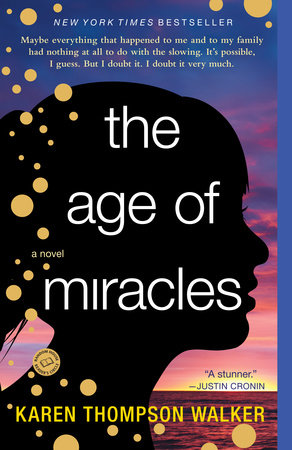
The Age of Miracles
Eleven-year-old Julia is growing up in suburban California when scientists announce that Earth’s rotation is slowing.
About
Spoiler notice: This overview discusses Julia’s family and adolescent life, the worsening slowing of Earth’s rotation, the competing ways people keep time, and the resulting environmental and social upheaval. It avoids later character outcomes and the novel’s ending.
The Age of Miracles begins with an unsettling change announced as news: Earth’s rotation has started to slow. Karen Thompson Walker makes this global premise the weather of one girl’s childhood rather than a puzzle solved by experts. Julia, eleven and living with her parents in suburban California, encounters the event through school, family routines and neighborhood observation. The book looks back through her memory, so the beginning of an extraordinary crisis is also the beginning of an ordinary transition out of childhood. Its two scales remain close together: a planet’s altered rhythms and the small, sometimes bewildering shifts that make up a young person’s life.
As the rotation slows further, days and nights grow longer and the usual relationship between a clock and the sky becomes harder to sustain. The change does not arrive as a single spectacle that leaves ordinary life behind. Instead, it presses into habits people had treated as permanent: when to sleep, when to work or attend school, and what can grow under changing patterns of light and darkness. The publisher’s description also points to disrupted tides, gravity, birds and human behavior. These are elements of the novel’s imagined catastrophe, not a scientific forecast. Walker presents them as part of a fictional world whose underlying event remains unexplained, keeping attention on what it means for people to live without reliable bearings.
The crisis becomes social as well as environmental. Most people try to preserve the twenty-four-hour schedule, even when daylight and darkness no longer fit it. Others reject clock time and attempt to follow the sun, forming a different daily rhythm from their neighbors. Walker’s guide calls these groups clock-timers and real-timers; neither response can restore the old conditions. Their disagreement gives a visible form to a wider uncertainty: people can share the same street and catastrophe yet reach different conclusions about how to endure it. Julia’s attention to the cul-de-sac lets the large event appear in small choices, loyalties and new boundaries between households.
Julia is both a witness to those changes and a child with worries that do not become trivial just because the world is in danger. Her friendships carry the shifting loyalties of middle school; her growing attention to Seth makes the vulnerability of a first crush part of the story’s emotional life. She watches the adults around her closely, including her parents, whose relationship develops its own tensions. A family’s private silences and misunderstandings continue to matter even when the future feels less certain. The contrast is not a contest between a supposedly important catastrophe and supposedly minor adolescence. Walker sets them alongside each other to show how the scale of a person’s life is measured by what that person can know, fear and lose.
The retrospective narration gives Julia’s account another layer. The adult voice remembers the child’s limited understanding while knowing that the familiar past cannot be recovered. Walker has said that this perspective helped her join the loss of childhood to the loss of the world as it once seemed. That structure lends the novel a mood of looking back without turning Julia into an all-knowing guide. She observes, guesses and revises her sense of other people, as children do; the reader sees a widening world through the same uncertain field of vision. The result is a personal story shaped by hindsight but attentive to the confusion of living through events before their meaning is clear.
Walker developed the premise from a short story and changed its one-time alteration into an ongoing, worsening slowdown. In an interview with Publishers Weekly, she described wanting the extraordinary situation to feel convincing while also acknowledging that the fictional universe was made up and that an astrophysicist reviewed a draft. The distinction matters: the book does not supply a physical cause or present a model of what would happen in the real world. Its invented conditions instead create a sustained pressure on daily life. An independent Guardian review likewise describes the slowing as the backdrop and identifies Julia’s family and social concerns as the foreground, though the reviewer disputes aspects of the imagined science. The tension between planetary scale and household detail is part of the book’s design.
That design makes uncertainty the connective thread between the natural crisis and the intimate plot. People around Julia try to hold onto schedules, routines and familiar explanations even as their surroundings become harder to read. She, too, must interpret the shifting behavior of friends and parents while making sense of her own feelings. The slowing does not automatically explain every private disappointment or change; the story leaves room for events that may have more than one cause. The novel is interested in how people search for patterns when certainty is unavailable, and in how adaptation can coexist with attachment to what has been lost.
The Age of Miracles brings speculative fiction and a coming-of-age story into the same frame. Its imagined disaster changes the background conditions of childhood, while the friendships, family tensions and first attachments that occupy Julia’s attention continue to shape her days. The extraordinary premise makes familiar routines newly visible: shared meals, sleep, school, a neighborhood’s sense of time. The book’s focus stays with a young observer rather than a technical explanation of the phenomenon, and its retrospective form holds together wonder and grief without resolving every question. Julia’s world changes beyond her control; her effort to understand the people closest to her remains recognizably human.
Book details
- Author
- Karen Thompson Walker
- First published
- 2012
- Series
- No series listed
- Subgenre
- Dystopian, Coming-of-age
- Primary genre
- Sci-Fi, Literary Fiction
- Tags
- No tags for this book.
Review
Editor profile
Baby Bat
Goodreads and social links will be added soon.
- Goodreads — link coming soon
- Social media — link coming soon