
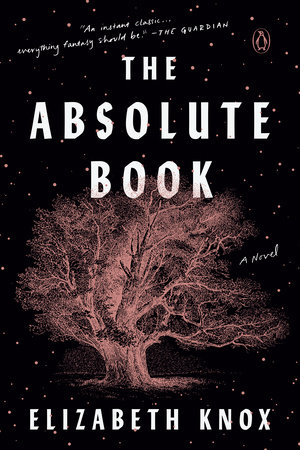
The Absolute Book
Taryn Cornick believes she has left her sister’s violent death and her own revenge behind.
About
Spoiler notice: Spoiler-light discussion of the premise, early mystery, characters and worldbuilding; excludes major later revelations and the ending.
Taryn Cornick thinks she has put her sister’s violent death and her own revenge behind her. She has built a professional life around books, writing a successful guide to the threats that can destroy libraries: damp, insects, fire, light, neglect. Then a policeman named Jacob Berger brings questions about a cold case, and a fire at her grandparents’ house draws attention to a mysterious scroll box called the Firestarter. Elizabeth Knox lets the crime story open a door into something stranger by making Taryn’s work, family history and private guilt part of the same puzzle. The book moves from a familiar investigation toward fantasy without dropping the pressure of the first questions.
Taryn’s library book gives the story an unusually practical centre. She knows that collections can be lost through ordinary neglect as well as spectacular disaster, and her grandparents’ library is not just a store of old volumes: it is a place with its own family history and secrets. The ancient Firestarter complicates that inheritance. It has survived centuries of fires, and its presence makes preservation feel less like a quiet academic concern than a danger that has followed people across generations. Around it, Knox connects the work of keeping, hiding and recovering things to the question of what people owe to the past they would rather leave alone.
The police questions press on Taryn’s own sense of responsibility. She believed her sister was deliberately killed and arranged revenge, an act that has not brought the clean ending she expected. Jacob’s cold-case inquiry means that private certainty and public investigation begin to overlap. Knox gives the mystery more than one kind of uncertainty: there is the question of what happened to Taryn’s sister, the fire in the old library, and the motives of people who have taken an interest in the scroll box. Threatening phone calls and a mysterious illness widen the unease, while Taryn’s guilt makes every new piece of information personal.
Then Shift arrives. He is a shadowy young man whose appearance pulls Taryn and Jacob toward a reckoning that reaches beyond their immediate surroundings. Knox’s own description of him is strikingly plain: he calls everyone ‘people’, from chickens to demons. That small habit hints at a world where the boundaries between ordinary life and the mythical are treated differently. Birds can talk; powerful things resurface; the dead remain an active force in the lives of the living. The novel’s magic enters through the investigation’s accumulating evidence, so each new wonder alters the scale of the mystery rather than replacing it with a separate adventure.
The map keeps expanding. The story travels between contemporary England and Auckland, then into the Island of Apples and the Summer Road of the Sidhe, and onward to Purgatory. These places have distinct identities: the earthly settings are shaped by family, work and police procedure, while the other realms bring their own histories and forms of power. The Sidhe are not simply humans with fairy names. Knox describes them as a communal people without libraries or books, keeping memory through themselves. Their way of life gives the novel a sharp counterpoint to Taryn’s world, where libraries preserve shared records and old objects can become evidence, refuge or temptation.
That contrast helps the book consider what it means to keep something safe. Taryn’s library work is about material threats, but the story also asks what happens when memory is carried in people, when a hidden truth outlasts the person who first concealed it, or when a wrong cannot be undone by punishment alone. Knox has said that she wanted to write about being haunted, culpable and unable to forget. Those concerns take shape in Taryn’s revenge and in the Firestarter’s long passage through time. They also reach outward through the societies and histories that gather around her, making the fantasy world part of the same moral problem as the crime plot.
The Absolute Book is an epic fantasy built with the machinery of a mystery: a bereaved woman, an investigator, a fire, a strange object and people who know more than they say. Its scale grows from the details already in Taryn’s life rather than from a single leap into an unrelated world. Libraries matter because they are places where things are kept and shared; the Sidhe matter because they remember differently; the Firestarter matters because its history has not ended. Knox moves among crime, myth and the everyday, following Taryn and Jacob as the questions around them lead into new places. The result is a story about how far a family secret can travel and how many worlds it can touch.
First published in New Zealand in 2019, The Absolute Book later reached US readers in a 2022 Penguin Books paperback. Its story crosses England, Auckland and imagined territories, but its central threads stay close to Taryn: grief for her sister, the consequences of her revenge, the professional life she has built around preserving books, and the pressure of discovering that a past she considered settled is still moving. The Firestarter, Jacob’s questions and Shift’s arrival bring those strands into contact. As the investigation’s boundaries widen, the personal stakes sharpen: the question of what must be kept becomes inseparable from what Taryn can bear to remember.
Book details
- Author
- Elizabeth Knox
- First published
- 2019
- Series
- No series listed
- Subgenre
- Epic fantasy, Fae and faerie, Portal fantasy
- Primary genre
- Fantasy, Literary Fiction
- Tags
- No tags for this book.
Review
Editor profile
Baby Bat
Goodreads and social links will be added soon.
- Goodreads — link coming soon
- Social media — link coming soon