
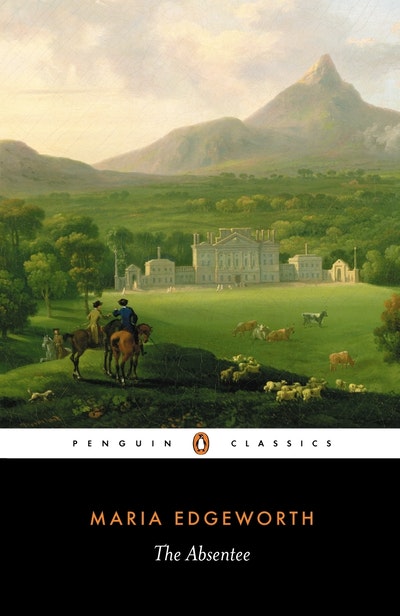
The Absentee
While his mother pursues fashionable acceptance in London, Lord Colambre travels to Ireland to discover how his family's estates are managed.
About
Spoiler notice: Full-plot spoilers, including the estate investigation, Grace's parentage and the family's return to Ireland.
Lady Clonbrony has spent a great deal of money trying to belong to fashionable London, and the people she wants to impress find her efforts ridiculous. She tries to smooth away her Irish identity while filling her house with the objects and entertainments that ought to establish her social position. Her son, Lord Colambre, hears enough of the conversation around her to recognise the humiliation behind the display. He also begins to question what his family's life abroad means for the country they have left. His father owns Irish estates but lives in London, spending the income while knowing little about the people who produce it. Edgeworth draws the connection through domestic embarrassment and financial pressure: the pursuit of fashionable company has consequences well beyond a badly received party.
Colambre's visit to Ireland gives him a chance to discover those consequences for himself, though the journey is vulnerable to the company he keeps. Lady Dashfort wants to draw him towards her daughter, Lady Isabel, and encourages a contemptuous view of the country in which he might otherwise settle. Their influence briefly distracts him from his purpose. Other acquaintances offer a different education. Sir James Brooke becomes a friend, while the Oranmore household shows him improvements supported by proprietors who actually live among their tenants. Eventually Colambre puts aside the privileges that would shape what people tell a recognised heir. Wearing a shabby greatcoat and calling himself Evans, he visits the estates incognito. His disguise makes ordinary conversation available to him, including criticism of his own family that a deferential reception would have concealed.
In the town bearing his name, he finds a reassuring degree of comfort and order. The explanation repeatedly comes back to Mr. Burke, the resident agent. An innkeeper credits Burke with practical assistance that ranges from teaching useful trades to helping tenants improve their land. Fair management has visible results in houses, schooling and the relations between neighbours. Mrs. Burke's school brings Protestant and Catholic children together, and the couple's hospitality extends across religious divisions without turning every encounter into an argument. Yet this successful arrangement is under pressure from Lord Clonbrony's demands for money. Burke fears he may have to surrender the agency because he will not squeeze tenants beyond what their holdings can sustain. Colambre discovers that even good local administration remains vulnerable to an owner who wants remittances without understanding their cost.
The principal Clonbrony estate, managed by Nicholas Garraghty, presents the darker alternative. Garraghty and his brother Dennis benefit from the distance between landlord and tenants, using their position to extract money and exercise petty authority. Colambre hears about burdens that the family's London expenditure has made easy to overlook, and encounters the widow O'Neill's household among those who suffer. Larry Brady, his driver, supplies accounts of the agents and the frustrations of local life, speaking with a mixture of humour, anger and precarious hope. The investigation becomes urgent when Colambre learns that his father is about to sign leases advantageous to Garraghty and damaging to the estate. He races to intervene. The problem is now specific enough to demand a decision: the family cannot remedy its ignorance while continuing to entrust everything to the people who profit from it.
Running through this education is Colambre's love for Grace Nugent, who lives with his parents and is understood to be his cousin. A report about her mother's past makes him believe there is an obstacle to their marriage. The allegation concerns Grace's birth: her mother supposedly had a child by Captain Reynolds without being married to him, before Mr. Nugent married her and adopted Grace. Colambre struggles with the suspicion and withdraws, leaving Grace unable to understand the change in his behaviour. Lady Dashfort's manipulation has helped direct his thoughts towards the scandal, but her conduct and Isabel's calculated cruelty eventually reveal how little he should trust their influence. His distress exposes the damage a story about a woman's reputation can do when it is accepted before the evidence has been recovered.
The missing evidence emerges through Count O'Halloran, who knew Captain Reynolds and heard his dying account of a secret marriage. Papers intended to establish that marriage had been entrusted to an ambassador and subsequently misplaced. Sir James Brooke, the ambassador's executor, searches for the packet, allowing testimony to be joined to documentary proof. Colambre and the count approach Reynolds's estranged father, who must confront what his refusal to recognise his son's marriage has meant for Grace. She is acknowledged as his granddaughter and heir. That discovery restores her mother's honour as well as changing Grace's financial prospects. When the truth reaches the Clonbrony household, Colambre can explain his withdrawal and offer his love openly. He also insists that Grace should have time and freedom to answer, rather than being hurried into gratitude or compliance.
The family's return to Ireland completes the estate story, and Edgeworth gives Larry the closing account in a letter to his brother Pat. Garraghty's authority has ended; Burke now takes charge of the Clonbrony estate, and repairs and improvements accompany the change. The widow O'Neill's family regains its farm at the old rent, while Larry receives security for his father's holding and a reason to urge his brother home. These are the details through which the return becomes meaningful: roofs, rents and prospects alter alongside the family's address. Grace's future marriage is warmly anticipated rather than staged as a final wedding scene. Larry ends by celebrating the prospect that staying in Ireland may become fashionable. The opening anxiety about acceptance in London has given way to another kind of belonging, measured by the people who can now expect their landlord to remain.
Book details
- Author
- Maria Edgeworth
- First published
- 1812
- Series
- No series listed
- Subgenre
- Historical fiction, Literary fiction
- Primary genre
- Historical Fiction, Literary Fiction
- Tags
- No tags for this book.
Review
Editor profile
Baby Bat
Goodreads and social links will be added soon.
- Goodreads — link coming soon
- Social media — link coming soon