
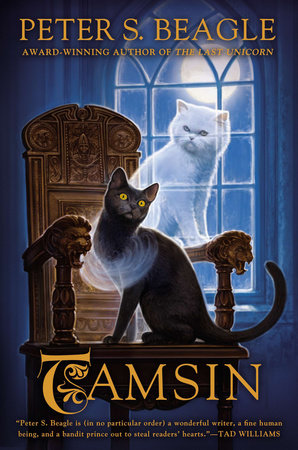
Tamsin
Thirteen-year-old Jenny Gluckstein moves from New York City to a farm in Dorset after her mother remarries an English biologist.
About
Spoiler notice: Spoilers cover Jenny’s move to Dorset, her encounter with Tamsin, and the historical and folklore mystery that brings them together. The later confrontation and its outcome are withheld.
Peter S. Beagle’s Tamsin begins with a move that feels, to thirteen-year-old Jenny Gluckstein, like the loss of her entire familiar world. Her mother has married an English biologist, and Jenny leaves New York City for a farm in Dorset, where she must adjust to a stepfather, two stepbrothers and a country landscape she did not choose. The change is practical as well as emotional: the family is helping restore a derelict farm, so settling in means work, unfamiliar routines and learning the shape of a new household. The novel gives Jenny’s resistance room to be messy. She is not instantly grateful for the picturesque setting, and her irritation forms part of the story’s coming-of-age ground rather than a problem solved by magic.
That magic first enters as something rooted in place. The family home is associated with local ghosts and folklore, and Jenny encounters Tamsin, a young woman who has been dead for centuries. The official publisher description frames Tamsin as a spirit held to the estate by a hidden trauma she cannot remember. An early review by the Mythopoeic Society adds that Tamsin has appeared to other young girls but has spoken only to Jenny. That limited connection gives the central friendship an unusual shape: Jenny is a newcomer trying to find her place among living people, yet she becomes the one person able to listen to a presence that the landscape has carried for generations.
The book’s narrative voice strengthens that link between a changing girl and an old mystery. The Mythopoeic Society review identifies the story as a first-person account told by Jenny several years after the events. That distance allows the narrator to look back on a younger self without pretending she understood everything at the time. The perspective can hold teenage embarrassment, anger and uncertainty alongside the supernatural discoveries that later give those feelings a wider context. Jenny’s growth remains tied to ordinary relationships: she has to get to know her stepbrothers, make friends at school and find a way to live with the changes in her mother’s life. The ghost story develops through those adjustments rather than replacing them.
Dorset is more than a scenic contrast with New York. In the review, Jenny investigates the Willoughby family, the original owners of the estate, and the county’s history and lore as she tries to understand Tamsin’s past. The publisher’s description likewise connects the young ghost’s hidden trauma to the danger Jenny will face. This combination gives the mystery two scales: one intimate, centred on the bond between a living girl and a lonely spirit, and one historical, in which the past still exerts pressure on the present. The novel’s title names Tamsin, but Jenny’s curiosity and decisions provide the route through which the reader encounters the farm, its former occupants and the stories that have gathered around them.
The supernatural population extends beyond Tamsin. The Mythopoeic Society review names a destructive boggart in the manor house, a shape-changing Pooka and the Lady of the Elder Tree among the beings associated with Dorset. It also describes the Wild Hunt as a danger whose night-time cries are dismissed by local people as geese. These details show how the novel treats folklore: not as decorative references placed around a conventional haunting, but as a living part of the countryside’s imagined ecology. The creatures have different temperaments and degrees of threat, so the supernatural world does not reduce to a single ghost or a single explanation. Jenny’s attention to what others overlook becomes an important part of how she navigates her new home.
History gives the haunting its weight. The independent review connects Tamsin’s family to the Monmouth rebellion and the reprisals that followed, and describes Jenny’s effort to discover what in that past continues to bind the ghost to the manor. Those references establish a historical frame for the mystery; they do not turn the book into a straightforward historical novel. Its centre remains Jenny’s present-tense work of understanding: learning who Tamsin was, deciding what to believe about the beings around her and finding the courage to act when curiosity becomes responsibility. The official description keeps the stakes deliberately broad, promising that Jenny will enter a dangerous world and face a life-changing threat without giving away how those events resolve.
First published in 1999, Tamsin sits at the meeting point of a teenage adjustment story, a ghost mystery and fantasy drawn from English folklore. The 2013 Berkley paperback represented here is a later edition, with its own date and ISBN; keeping those publication facts separate helps distinguish the novel’s first appearance from the selected copy. The book’s particular interest lies in the way a new family life and an old haunting become entangled. Jenny is learning how to belong in a place that already has its own memories, inhabitants and rules. Her friendship with Tamsin turns that challenge into a mystery about attention and empathy: what can be recovered when someone listens carefully, and what kind of courage is needed when the past refuses to remain safely past.
Book details
- Author
- Peter S. Beagle
- First published
- 1999
- Series
- No series listed
- Subgenre
- Young adult fantasy, Ghost story, Historical fantasy
- Tags
- No tags for this book.
Review
Editor profile
Baby Bat
Goodreads and social links will be added soon.
- Goodreads — link coming soon
- Social media — link coming soon