
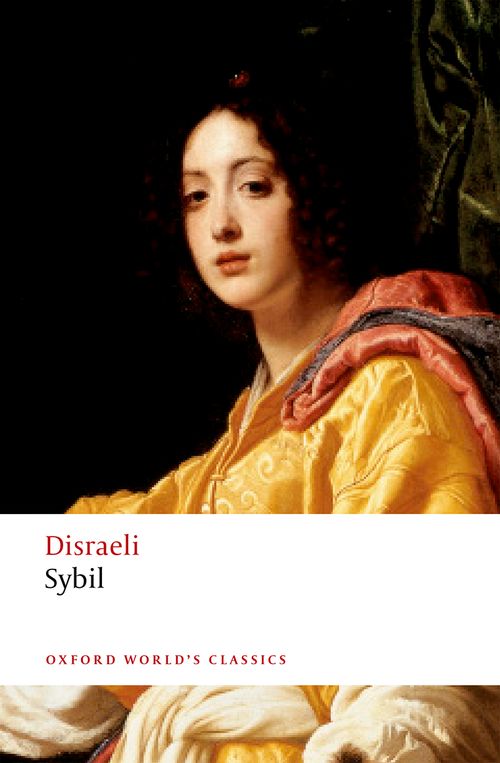
Sybil
Charles Egremont’s encounters with Walter Gerard and his daughter Sybil lead him beyond the aristocratic society he knows into England’s industrial communities.
About
Spoiler notice: Full-plot spoilers, including the deaths at Mowbray, Sybil’s recovered inheritance and her marriage to Egremont.
Sybil opens on the eve of the Derby in 1837, among aristocratic young men whose immediate concerns are horses, wagers and the difficulty of finding fresh amusement. Charles Egremont belongs to that society, but Benjamin Disraeli’s novel, published in 1845, takes him into places its members scarcely understand. The subtitle, The Two Nations, acquires its explanation when a stranger challenges his confidence in the greatness of England. The rich and the poor, the man argues, live with so little shared knowledge or sympathy that they might belong to different countries. The novel develops that division through encounters, households and competing forms of political authority. Egremont’s journey towards Sybil Gerard becomes part of a larger attempt to understand the lives concealed by his own familiar social world.
An encounter among ruined religious buildings connects Egremont with Walter Gerard, Stephen Morley and Sybil. Discussion of the past becomes a disagreement about present society, especially whether people living close together form a genuine community. Sybil’s singing interrupts the argument, introducing her through a religious setting that has shaped her life. She has spent time in a convent and is preparing to keep house for her father, although the possibility of a religious vocation remains important to her. Gerard’s affection is accompanied by his knowledge of the hardships facing women of their class. His concern places ordinary domestic life beside the apparent refuge of the cloister, making her future a question with social consequences as well as personal ones.
Egremont gains access to this circle while calling himself Franklin and presenting himself as connected with the press. His conversation with Gerard includes an account of being a younger son obliged to work, but it is part of the identity he offers them, rather than a straightforward record of a reporter’s career. The concealment allows him to hear opinions he might not encounter in the same form as an acknowledged aristocrat. It also complicates the relationship developing around Sybil. Knowledge is unevenly shared from the start. Gerard can welcome someone he takes to belong among working people while arguing about the power of families rooted in the land, unaware of the particular family position occupied by the man listening to him.
The industrial district gives the division between rich and poor a material setting. Sybil brings assistance to the sick Warner household, and conversations about labour repeatedly return to what workers’ circumstances allow them to retain of home and family. Her concern takes practical form alongside the political arguments advanced by Gerard and Morley. The novel moves between people who experience deprivation and those who discuss how society should be organised, showing how difficult it is to bring their perspectives into contact. Gerard’s claim to lands associated with Mowbray adds another strand: inherited property and the documents establishing a right to it may alter a particular family’s future. That hope develops within unrest involving many people whose immediate concerns reach well beyond the recovery of one estate.
The crisis brings a violent assault on Mowbray Castle. While other participants plunder its rooms, Morley and a smaller group force their way into the muniment room to find the papers connected with Gerard’s claim. He locates a blue box marked with the arms of Valence, but the arrival of armed men cuts off an easy escape. Dandy Mick attempts a hazardous route onto a lower roof, and Morley throws the box after him with instructions to deliver it directly to Sybil. The recovery is therefore inseparable from the disorder that threatens to destroy it. A document capable of securing property leaves the castle through the efforts of people acting within an uprising, while its intended recipient does not yet know what has been found.
The violence also kills the people around whom the earlier disputes have formed. Walter Gerard is shot after Lord Marney’s force attacks a crowd he has been leading for peaceful purposes. The crowd then turns on Marney and stones him to death. At the castle, a trooper shoots Morley as he prepares to resist; he dies after speaking to Egremont. The building catches fire amid the plundering, leaving Sybil exposed to danger in the grounds. Her dog Harold defends her when men surround and seize her, until Egremont arrives with his sword and drives them off. Their reunion offers immediate protection, but the ending does not treat that rescue as cancelling the losses. Sybil still has to learn that her father is dead.
The final chapter follows grief, the delivery of the papers and the legal recovery of Sybil’s inheritance. Egremont succeeds his brother as Earl of Marney, and he and Sybil marry before spending nearly a year in Italy. Mick receives help to establish a business, takes Devilsdust as his partner and marries Julia; Devilsdust adopts the name Mowbray and marries Caroline. These altered circumstances give several characters a place within the prosperity they previously lacked. Disraeli then closes with an explicit appeal about national history, the people and the responsibilities of youth. That authorial conclusion makes the novel’s political ambitions plain, while the narrative leaves their widest fulfilment beyond its pages. Its marriage and inheritance settlements answer individual predicaments within the larger division announced by the two nations.
Book details
- Author
- Benjamin Disraeli
- First published
- 1845
- Series
- No series listed
- Subgenre
- Literary fiction, Modern classics
- Primary genre
- Literary Fiction
- Tags
- No tags for this book.
Review
Editor profile
Baby Bat
Goodreads and social links will be added soon.
- Goodreads — link coming soon
- Social media — link coming soon