
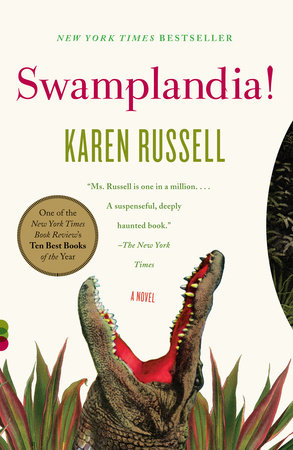
Swamplandia!
After the death of their mother, young Ava Bigtree and her siblings face the collapse of Swamplandia!, their family’s alligator-wrestling attraction in the Florida Everglades.
About
Spoiler notice: This overview discusses the Bigtree family’s losses, the decline of their park, Osceola’s spiritualist pursuits, and Ava’s journey with the Bird Man. It avoids the novel’s later revelations and ending.
On an island in the Florida Everglades, the Bigtree family runs Swamplandia!, a modest attraction built around alligator wrestling. For years, visitors have crossed the water to watch Hilola Bigtree perform in the pit, while her children grow up inside the park’s odd routines and family mythology. Then Hilola dies, and the place that seemed to contain the whole world begins to lose its audience. A newer attraction, the World of Darkness, competes for tourists from the mainland. The family’s financial trouble arrives alongside grief, leaving each Bigtree to respond in isolation. Karen Russell turns that practical crisis into the novel’s imaginative engine: a failing roadside spectacle opens onto a landscape where the family’s private stories, local legends, and the Everglades’ unsettling scale keep changing one another.
The youngest child, Ava, narrates much of the book in the first person. She is still practicing the alligator holds her mother taught her, and she treats the family’s show as both a real livelihood and a kind of inherited wonder. Ava wants the park to endure, but her understanding of its risks remains that of a child who has been raised among performers, reptiles, and adults who are not always present when she needs them. Her account carries the immediacy of a young person making sense of events as they happen. The swamp feels vivid and immense through her attention: an everyday route can turn strange, and a practical problem can acquire the shape of a fable. That perspective gives the book much of its tenderness while also letting unease gather around what Ava cannot yet understand.
Russell pairs Ava’s voice with chapters following her older brother Kiwi in the third person. Kiwi has little patience for the family’s self-made legends and sees the park’s decline as a problem that requires wages, planning, and contact with the mainland. He leaves the island and takes work at the World of Darkness, the very competitor drawing customers away from his family. His new surroundings have their own staged atmosphere and hierarchy, but they also confront him with ordinary demands: a job, a schedule, and the possibility of making money. The alternating viewpoints create a useful friction. While Ava holds fast to the family’s strange world, Kiwi tries to leave it behind and then discovers that distance does not settle what he owes them. Neither sibling’s strategy is sufficient on its own.
Osceola, the middle sibling, occupies a different space in the family’s unraveling. She becomes absorbed in spiritualism after finding a book among the remnants of the island’s past, and begins to believe that the dead can be reached. Her pursuits make grief visible as something more than sorrow: it is also a desire to restore contact, to give absence a voice, and to find a pattern in events that have otherwise become chaotic. The supernatural in the novel is not presented as a tidy system with firm rules. It hovers between belief, performance, and possibility, so that the reader shares some of the uncertainty surrounding Osceola. Her choices place her beyond the comfort of family routines, and Ava becomes increasingly concerned with where that fascination may lead.
The Bigtree children’s father, known as the Chief, is also away for much of the crisis, pursuing plans on the mainland. The absences leave Ava and Osceola with responsibilities they are not equipped to manage, and the island’s familiar protections begin to feel fragile. When a stranger called the Bird Man offers to help Ava travel through the swamp in search of her sister, the journey draws her out of the park’s known boundaries. She must rely on someone whose motives she cannot fully read, and the wetlands stop functioning as a backdrop to the family business. Waterways, vegetation, and distance shape the passage itself. The journey is at once an adventure and an unsettling passage from childhood certainty toward a more difficult awareness of danger and dependence.
Russell’s style moves among comedy, fable, family drama, and Southern Gothic unease. Swamplandia! is full of outsized performances and carefully observed oddities, yet its eccentricity grows from recognizable pressures: bereavement, debt, rivalry, adolescence, and the wish to keep a family intact. The alligator show makes spectacle part of daily life, so the characters have learned to narrate themselves as if they belong to a legend. That habit can sustain them, but it can also distort their view of what is happening. The novel’s changing tones reflect that tension. A comic detail may sharpen the sadness beneath it; an extravagant belief may express a genuine need. The result asks readers to move between amusement and apprehension without reducing either response to a trick.
The Everglades matter as more than a picturesque setting for unusual events. Russell has described the landscape as a fictionalized version of the South Florida where she grew up, and connects the family’s decline to an environment under pressure. In the novel, the swamp is both habitat and imaginative force: a place with its own rhythms that resists easy explanation or control. This makes the family park’s commercial promise feel precarious. The Bigtree children are asked to inherit a show, a home, and their parents’ stories at the same time, but each sibling has a different idea of what should be saved. Ava’s narrative holds those conflicts close to the ground of lived experience, while the book’s broader strangeness lets the swamp seem to answer back. Swamplandia! becomes a story about growing up inside a family myth and learning to question what it asks of you.
Book details
- Author
- Karen Russell
- First published
- 2011
- Series
- No series listed
- Subgenre
- Southern gothic, Coming-of-age, Family novel
- Primary genre
- Literary Fiction
- Tags
- No tags for this book.
Review
Editor profile
Baby Bat
Goodreads and social links will be added soon.
- Goodreads — link coming soon
- Social media — link coming soon