
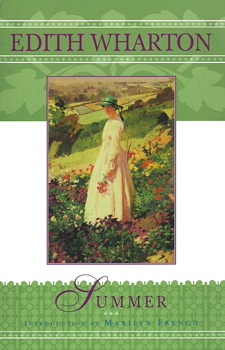
Summer
In the remote New England village of North Dormer, Charity Royall longs for a life beyond the house of the lawyer who raised her.
About
Spoiler notice: This overview discusses Charity’s relationship with Harney, her pregnancy and her marriage at the ending.
Summer begins on a bright June afternoon in North Dormer, a New England village whose apparent tranquillity feels to Charity Royall like being left outside the world. The arrival of a young stranger briefly changes the scale of everything she knows. Edith Wharton describes a place remote from railways, commerce and the ordinary movement of modern life, with a library whose books have scarcely changed in years. Charity works there, but the position has not given her an education equal to her curiosity. She can see the limits of the place without knowing how to reach beyond them. The season promises movement and discovery, while her circumstances make each possible departure depend on resources and permissions she does not possess.
Charity’s position in the village is shaped by her origins on the Mountain, a nearby community which North Dormer treats as a place of poverty and disgrace. Lawyer Royall brought her down as a child, and people repeatedly remind her that she should be grateful. She lives in his house after his wife’s death, with an uneasy mixture of dependence, resentment and practical power over his daily life. An early episode in which he tries to enter her bedroom makes the danger of that arrangement explicit. Her attempt to ask Miss Hatchard for work and help meets evasions rather than an understanding of what she needs. Wharton keeps the material questions visible: earning money, finding another woman to live in the house and having somewhere else to go.
The stranger, Lucius Harney, brings the possibility of a less confined life. His interest in local buildings and his ability to move through the countryside introduce Charity to a different way of looking at familiar surroundings. Their attraction develops through journeys, meetings and places removed from the village’s supervision. To Charity, physical desire and the widening of her world become closely connected; the affair offers an experience she cannot reduce to the moral warnings she has heard. Yet the difference between their circumstances never disappears. Harney can visit, travel and imagine a future elsewhere with a freedom she cannot readily share. Wharton lets the pleasure of their intimacy exist alongside that inequality, so its consequences do not arrive as an unrelated punishment imposed after an innocent summer.
Nettleton’s shops, transport and public amusements give their relationship another setting, one that enlarges Charity’s desires while exposing her to forms of humiliation she cannot control. A brooch Harney gives her becomes a small but lasting connection to their time together. Back in North Dormer, however, Annabel Balch represents the kind of woman whose place beside him is easier for Charity to imagine than her own. When Ally Hawes repeats the talk that Annabel is engaged to Harney, Charity violently tears the garment Ally is working on for her. The anger leaves another vulnerable person to deal with the damage. Her pain does not make all her actions generous, and Wharton allows jealousy and social insecurity to take an ugly practical form.
Discovering that she is pregnant changes the significance of every possible future. Charity visits Dr. Merkle to make sure of her condition and recoils from the intervention the doctor assumes she wants. This is Charity’s response within the story, shaped by her own feelings about the child and the circumstances in which she seeks help. She has little money and leaves the brooch behind, a transaction that will later expose her to further pressure. Harney’s absence and his connection to Annabel leave her facing decisions without the support she had hoped for. The child draws her thoughts back towards the Mountain and the mother from whom she was separated, but that return cannot simply recover an intact family waiting to receive her.
On the Mountain, Charity encounters her mother’s death and a level of deprivation that unsettles her understanding of her own beginnings. A night in a freezing, overcrowded room forces her to imagine the life she might have had there and the future she could offer her child. The people around her belong to her history, yet belonging does not supply warmth, income or safety. Her earlier condemnation of her mother becomes harder to maintain when she sees what bringing up a child in such conditions might mean. Royall’s arrival offers immediate shelter and practical care. Exhausted, she goes with him and marries him in Nettleton. Wharton presents the ceremony through her confusion and dependence, preserving the uncomfortable limits within which this apparent solution becomes possible.
The final chapter does not turn the marriage into an uncomplicated romantic reward. Charity initially fears what her new husband may demand; finding him sitting apart through the night allows her to feel safe enough to sleep. His kindness and restraint alter her response without erasing their history. The next day she spends the money he gives her for clothes to recover Harney’s brooch, which she wants to preserve as a connection between the child and its father. She writes to tell Harney she is married, adding that she will remember him, then returns with Royall to the red house. Their last exchange permits a tentative mutual recognition. The novel ends with a changed household arrangement and immediate shelter, while the future of Charity’s child and the lasting terms of her marriage remain beyond its final scene.
Book details
- Author
- Edith Wharton
- First published
- 1917
- Series
- No series listed
- Subgenre
- Literary fiction, Modern classics
- Primary genre
- Literary Fiction
- Tags
- No tags for this book.
Review
Editor profile
Baby Bat
Goodreads and social links will be added soon.
- Goodreads — link coming soon
- Social media — link coming soon