
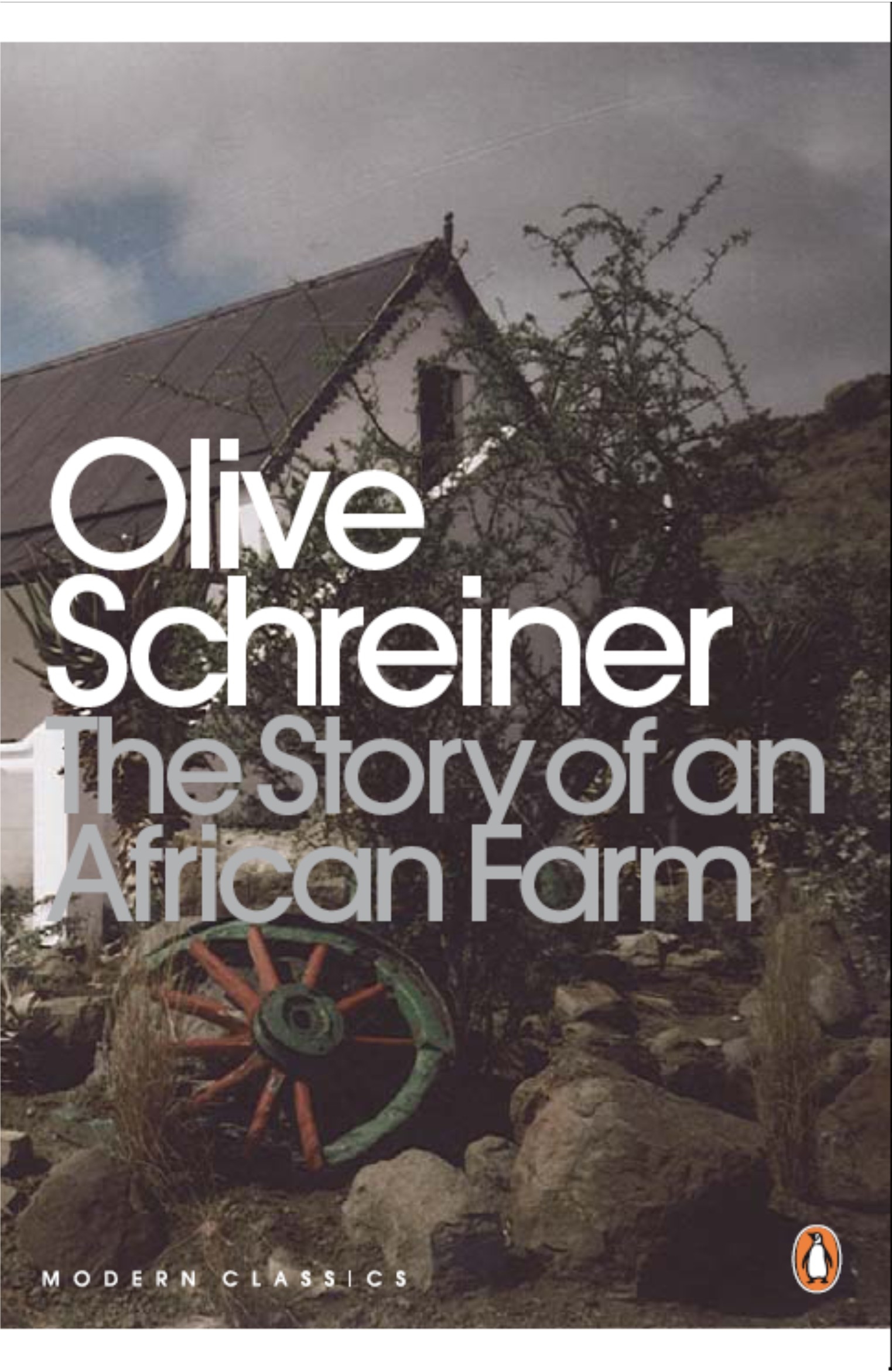
The Story of an African Farm
On an isolated Karoo farm, Lyndall, Em and Waldo grow up with unequal prospects and questions that their household cannot answer.
About
Spoiler notice: Full-plot spoilers, including Otto's death, Lyndall's child and final illness, Gregory's disguise and the implication of Waldo's closing scene.
The farm stands beside a solitary kopje on the Karoo plain, with sheep enclosures, outbuildings and a red-brick house gathered into a small world beneath a vast sky. Within it, three children are beginning to imagine lives that the household cannot readily provide. Em expects to inherit the property; Lyndall knows she will have to find another means of independence; Waldo, the German overseer's son, is already troubled by questions about God and death. The opening lets moonlight fall across the sleeping homestead before entering the boy's sleepless terror at a ticking watch. Every beat seems to mark another human death. Olive Schreiner gives the landscape an expansive beauty while making the children's inner lives crowded and uneasy, full of desires and fears that have little space for expression under adult authority.
That authority proves dangerously easy to manipulate. Bonaparte Blenkins arrives with a supply of impressive stories and religious language, and Otto's generous belief in other people helps give him a foothold. The contrast between them becomes especially sharp when Otto gives food and his coat to a woman expelled from the farm with her baby. Blenkins has been working privately against him, and Tant Sannie turns on the old overseer, ordering him away and claiming his possessions. Otto prepares a small bundle and a tender farewell for the girls, but dies before beginning the journey. Blenkins takes his place and extends his power over Waldo, whose vulnerability has increased with the loss of his father. The fraud's piety supplies cover for cruelty, showing how professions of goodness can serve someone whose actual conduct is governed by advantage.
Lyndall's resistance has begun long before she can leave. As a child she wants schooling, knowledge and things that are her own, recognising that the farm's future belongs to Em. When she returns from school, she can describe more precisely the limits she feels closing around women's lives. Her conversations with Waldo connect work, equality and love: she imagines affection becoming freer when a woman no longer has to make marriage the means of obtaining a livelihood. Yet she does not present herself as someone who has solved the difficulty of living by those ideas. She can see a better life without finding the strength or opportunity to enter it. Her sharpness, weariness and longing coexist, giving her arguments the pressure of a personal predicament rather than the comfortable distance of a completed philosophy.
Waldo's questioning takes a different course. He wants reasons for beauty and existence, and the certainty available in inherited belief grows harder to sustain. Lyndall can admire his carved work while teasing his need to discover the cause behind everything he sees. Their intimacy includes that difference: she is drawn to the world of people and experience, while he can find extraordinary meaning in a little earth, sky and room for thought. Eventually he leaves the farm to seek life elsewhere. His later account of exhausting work describes how mechanical labour can reduce the space in which a person thinks or hopes, and his return does not bring the success a conventional journey might promise. He begins a letter to Lyndall, treating her continued existence as something that makes the world bearable, until Em tells him she is dead.
The account of Lyndall's departure and illness reveals what Waldo has not known. Gregory Rose, initially attached to Em, has become devoted to Lyndall, but the man with whom she leaves is another person. Schreiner's preface expressly warns against turning the novel's separate strangers into a single figure. Lyndall refuses her lover's offer of marriage because she believes it would place her permanently within his power. She proposes going away with him on terms that allow them eventually to part. Attraction has not erased her fear of possession, and choosing an unconventional arrangement does not make her invulnerable. Later, alone and seriously ill, she has lost a baby who lived only a few hours. When another offer of marriage arrives, she still refuses, holding to the need for a life she has not yet found.
Gregory traces her journey and discovers her in a hotel where her nurse is about to leave. He puts on women's clothing, shaves off his beard and presents himself as a replacement nurse, concealing the identity she might otherwise reject. The disguise creates an unusual reversal of his earlier position as suitor: he can remain close through the daily labour of caring for her body, without obtaining the relationship he once wanted. Lyndall's determination periodically flares against her weakness. She calls for books and clothes, tries to stand, and insists that she is getting better, but her strength fails. A final journey carries her towards a distant mountain. At night in the wagon, she looks into a mirror as her life ends. The narrative leaves the question of what she has found beyond that moment open.
Waldo's grief returns the novel to the beliefs that troubled him as a child. Wanting Lyndall back as the particular person he loved, he finds little consolation in promises that transform her into something unrecognisable. His thoughts move towards a sense of belonging within a larger living whole, though the loss remains his own. At the farm, Em and Gregory plan to marry, and ordinary work continues. In the final chapter Waldo sets down his tools and sits in the sunshine, taking pleasure in plants, chickens and the warmth against the wall. Em leaves milk beside him, believing he is asleep and will wake to enjoy it. The chickens settle on his unmoving body, and the last line suggests they understand what she does not. The beauty surrounding him continues as the novel quietly implies his death.
Book details
- Author
- Olive Schreiner
- First published
- 1883
- Series
- No series listed
- Subgenre
- Literary fiction, Historical fiction, Family novel
- Primary genre
- Literary Fiction, Historical Fiction
- Tags
- No tags for this book.
Review
Editor profile
Baby Bat
Goodreads and social links will be added soon.
- Goodreads — link coming soon
- Social media — link coming soon