
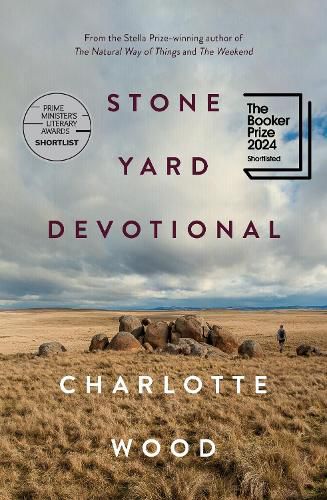
Stone Yard Devotional
Burnt out and uncertain about the life she has left behind, an unnamed woman returns to her childhood region and takes refuge in a small religious community on the New South Wales plains.
About
Spoiler notice: This About discusses the narrator’s retreat, the mouse plague, the recovery of a missing nun’s remains and Helen Parry’s return. It does not disclose the novel’s ending.
Stone Yard Devotional begins with a woman stepping away from the life she has been living in Sydney. She returns to the New South Wales district where she grew up and finds shelter with a small community of nuns. The decision is presented as a retreat, though the narrator does not arrive with a settled spiritual purpose. She is not a believer, has no experience of prayer and enters this enclosed world almost by accident. A temporary stay becomes a more lasting arrangement. That shift gives Charlotte Wood room to examine withdrawal without treating it as a clean break: the narrator has changed her address and routine, but her memories, obligations and questions come with her. The book’s central tension is already present in this move. A quieter life may offer space to pay attention, yet it cannot make the past or the troubled outside world disappear.
The community’s daily life supplies the novel with its pace and texture. The narrator helps with ordinary work and gradually adjusts to the rhythms around her, even while remaining an outsider to the religious practice that shapes the house. Wood builds the story through observation rather than a sequence of dramatic confrontations. Meals, chores, encounters and remembered moments accumulate; what appears small can alter how the narrator understands her place among the others. The Booker Prize’s reading guide describes the structure as almost diary-like, with attention to activities and the narrator’s reflections on them. This form fits a book concerned with the uncertain work of living well. The days do not resolve into a lesson. Instead, repeated tasks give the narrator time to notice how intention and conduct can differ, and how community depends on people whose beliefs and temperaments do not neatly align.
The narrator’s retreat is also a return to a landscape layered with personal history. Her early life in the region, her parents and the death of her mother recur in memory. These recollections make grief part of the present rather than a completed event that can be left behind in the city. They also complicate the narrator’s wish to understand herself: remembering is not a route to a single explanation, and childhood can contain both ordinary incidents and lasting hurt. Wood leaves the narrator unnamed and offers the past in fragments, which keeps the account close to a consciousness still testing its own interpretations. The book is not a conventional mystery about a hidden biography. Its interest lies in the way a person revisits old experiences while trying to decide what responsibility, forgiveness and emotional endurance might ask of her now.
The calm of the convent is interrupted by three arrivals that change the scale of attention. A mouse plague makes the natural world an immediate part of domestic life: the animals are a practical problem to be managed, but their numbers also unsettle any sense that the community controls its surroundings. Then the remains of a nun who disappeared decades earlier are brought back. Her absence connects the present residents to an earlier history and to a life of service beyond the community. Helen Parry, a celebrated nun with ties to the narrator’s childhood town, accompanies this return. Her presence opens another route into the past and gives the narrator new reasons to reconsider what she thought she knew. The episodes do not turn the book into a procedural investigation. They unsettle the boundary between a secluded refuge and the histories, losses and ecological forces that reach it.
The novel’s questions about belief remain open because the narrator does not adopt the community’s faith as an answer. She can take part in its practical life and be affected by its habits without pretending to share its theology. That position lets the book consider devotion as an idea with several meanings: a religious commitment, a repeated act of care, and the sustained attention required to remain with difficult experience. Wood’s own account of the novel describes it as an invented story shaped by elements of her life and childhood, written after pandemic lockdowns and serious illness. The Booker judges also point to the pandemic and the local mouse plague as forces that make large disruptions tangible through particular lives. Here, climate anxiety, mortality and social turmoil are not detached topics for debate; they enter a community through the bodies, work and relationships of its members.
Stone Yard Devotional is therefore concerned less with discovering a perfect moral position than with seeing how imperfect people continue to live beside one another. The narrator may wish to act well, but the book repeatedly tests the gap between wanting goodness and practising it. Kindness can be mixed with impatience; retreat can offer perspective while carrying its own limits; grief can persist without becoming a failure of character. The enclosed setting sharpens these tensions rather than simplifying them. A small group shares space and responsibilities, but no single account of the world can contain all of their experiences. Wood’s restrained approach gives uncertainty room to remain meaningful. The novel asks what it means to pay attention when answers are unavailable, and how a person might keep living with others, with the natural world and with the past without claiming to have settled any of them.
Book details
- Author
- Charlotte Wood
- First published
- 2023
- Series
- No series listed
- Subgenre
- Literary fiction
- Primary genre
- Literary Fiction
- Tags
- No tags for this book.
Review
Editor profile
Baby Bat
Goodreads and social links will be added soon.
- Goodreads — link coming soon
- Social media — link coming soon