
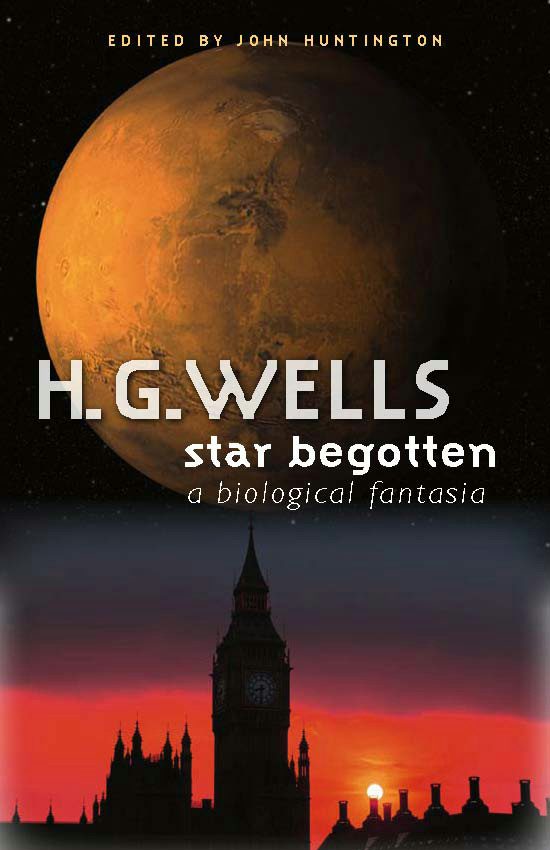
Star-Begotten
A conversation about cosmic rays gives the troubled historian Joseph Davis an extraordinary possibility to consider: human beings might already be changing under the influence of an intelligence beyond Earth.
About
Spoiler notice: This overview discusses the birth of Davis’s son, the abandoned manuscript and the final conversation with Mary.
Joseph Davis makes his living by giving history a heroic shape. His books turn conquerors, seafarers and national achievements into stirring narratives, and his planned history of humanity is supposed to bring that work to a triumphant conclusion. The difficulty is that reading the evidence has begun to disturb the story he wants to tell. Research into the Black Death supplies suffering and panic where he hoped to find spiritual improvement, and the reassuring direction of his great project becomes harder to sustain. Published in 1937, H. G. Wells’s Star-Begotten follows this worried writer as a conversation about cosmic rays offers an extraordinary explanation for a world he no longer understands. The narrator introduces it as the history of an idea, leaving the reader to decide whether anything beyond the idea actually exists.
Davis’s uncertainty reaches into his marriage. Mary, who came from the Outer Hebrides and studied in Glasgow before moving to London, has an independence of mind that unsettles the protective role he once imagined for himself. Her silences become spaces into which he places his own anxieties, and her pregnancy makes his unease more urgent. He questions Dr Holdman Stedding about her health and about the possibility of an unusual child. The doctor repeatedly reassures him that Mary is doing well. Davis even wonders whether a woman might be too intelligent to become a good mother, revealing how readily his fear of change attaches itself to the person closest to him. Mary’s actual condition and the meaning her husband assigns to it remain sharply different things.
The scientific conversation begins at the Planetarium Club, where specialists and interested outsiders exchange ideas. Davis listens to an account of modern physics, then becomes absorbed by the possibility that radiation might influence human inheritance. From there he imagines an intelligence outside Earth directing changes in human beings through their chromosomes. The supposed senders are called Martians for convenience; the discussion itself acknowledges that Mars need not be their home. Within Davis’s hypothesis, extraordinary children and unfamiliar ways of thinking might be signs of a transformation already happening among ordinary families. Wells lets the speculation develop through questions, analogies and provisional agreements. Its biological claims belong to the characters’ conjecture, and the novel supplies no independent confirmation that an extraterrestrial experiment is taking place.
Stedding carries the suggestion to his friend Professor Ernest Keppel, a philosopher whose work also extends into psychotherapy. Both can dismiss the proposition as nonsense and still find themselves drawn to what it would mean. They recognise how little their society knows about the appearance of unusual abilities, and their curiosity gives the idea room to grow without making it demonstrably true. Its journey into the press introduces a much less cautious kind of authority. Harold Rigamey assembles a confident account from distorted speculation, promoted obscurities and invented scientists. Statements that began as possibilities acquire the appearance of established discoveries. The passage from a club conversation to a public sensation becomes part of the story’s substance: people respond to the claim, while the evidence behind it remains uncertain.
For Davis, the birth of his son changes the emotional force of the theory. Beforehand he has imagined a malformed or frightening child, allowing abstract speculation to feed a very immediate terror. The healthy baby placed in his arms brings tenderness instead. His sense that Mary and the child belong to an emerging kind of humanity persists, but the possibility now seems hopeful. His inquiries turn away from abnormalities towards exceptional talent, education and creative achievement. That movement matters because the same conjecture has supported opposite feelings without receiving a decisive new proof. What once threatened to estrange him from his family becomes a way to admire them. The change is visible in his responses to people already there, rather than in any revelation of visitors arriving from space.
Keppel’s later discussion opens the question out into an imagined future. Stedding asks what a world made by these supposedly wiser people would look like, and Keppel begins by admitting the difficulty of imagining minds more capable than their own. He mocks fictional futures that change buildings, machines and clothes while leaving their inhabitants foolish or dull. His own speculation places its hopes in clearer thought, better education, cooperation and an end to destructive collective impulses. These remain arguments spoken around a table, with all the limitations of the speakers who propose them. The novel gives considerable space to their dissatisfaction with the present, but it does not offer a tour of a completed alternative civilisation. The prospect of something better remains entangled with their judgement of the humanity they know.
The ending brings that immense possibility back into Davis’s study and nursery. He tells his literary agent that he will abandon The Pageant of Mankind, despite assurances that its comforting history would sell. Then he tears up the manuscript beside his sleeping son, imagining that the next generation can begin more honestly. Mary challenges his doubts about his own capacity to start again and gently wonders whether he, too, might be one of the Martians. The suggestion gives him the sense of coherence he has been seeking. He embraces her, accepting himself as part of the change he had feared. Her agreement is affectionate rather than a verification of his theory, and the narrator’s initial uncertainty still stands. The story closes with a family newly understood and a child whose future remains his own.
Book details
- Author
- H. G. Wells
- First published
- 1937
- Series
- No series listed
- Subgenre
- Classic science fiction, Literary fiction
- Primary genre
- Sci-Fi, Literary Fiction
- Tags
- No tags for this book.
Review
Editor profile
Baby Bat
Goodreads and social links will be added soon.
- Goodreads — link coming soon
- Social media — link coming soon