
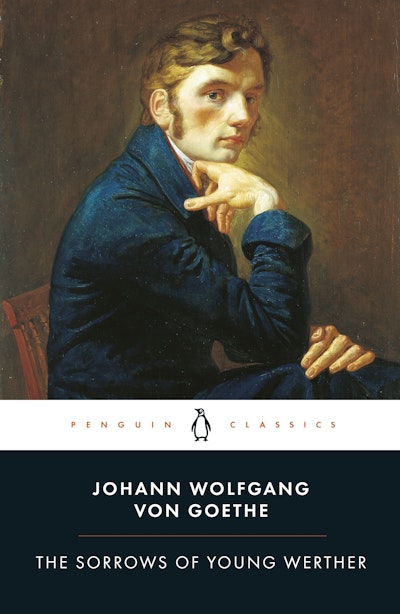
The Sorrows of Young Werther
In letters to his friend Wilhelm, Werther describes the beauty of rural life and his growing love for Charlotte, who is already engaged to Albert.
About
Spoiler notice: Full-plot spoilers, including the final meeting with Charlotte, Werther's suicide and the burial. Includes discussion of coercion and violence.
Werther begins his letters to Wilhelm with the pleasure of having gone away. The country around his new home seems to offer room for a life governed by feeling, and he fills his correspondence with fountains, trees, children and the small occupations of village people. He draws, reads Homer and imagines a closeness to ordinary life that more formal society cannot give him. Yet his delight is already unstable. He describes rapid movements between happiness and sorrow, and often finds that the intensity of an experience exceeds his ability to turn it into art. The letter form makes that volatility immediate: each date preserves the conviction of a particular moment, even when the next letter will put the same world in a different light. Wilhelm receives these accounts, but Werther's voice dominates what the reader hears.
His meeting with Charlotte, often called Lotte, seems to give all that feeling a single object. Before a journey to a dance, he sees her cutting bread for her younger brothers and sisters. Her care for the children, her conversation about books and her enjoyment of dancing become parts of the perfection he believes he has discovered. He has been warned that she is engaged to Albert, but the knowledge does little to contain his attachment. At the ball, shared dancing and a moment of recognition over poetry make their connection feel extraordinary to him. The scene is important because it contains both Charlotte's independent life and Werther's interpretation of it. She has family responsibilities, preferences and an existing commitment; he increasingly reads everything she does through the force of his own admiration.
Albert's return complicates that attachment without giving Werther an uncomplicated villain to oppose. He can esteem Albert and still resent the place Albert occupies in Charlotte's life. Visits that appear friendly also keep alive a hope Werther cannot resolve into any possible arrangement. He decides to stay away and then finds another reason to return. His letters can register happiness at a small kindness before turning towards despair at the limits surrounding it. Discussions with Albert reveal differences in their understanding of conduct and suffering, but the reader is also watching Werther's capacity to judge narrow under emotional pressure. Later, the editor's account includes the views of Albert's friends, who reject Werther's suspicion that Albert has become cruel or indifferent. The novel preserves competing perspectives on a household Werther increasingly sees as the scene of his exclusion.
Leaving offers another possible direction, and Werther takes employment in a diplomatic setting. Work, however, brings its own frustrations. His superior objects to his style, and the rules of rank make personal talent a poor substitute for the right social standing. At a noble gathering, Werther remains after dinner without considering that the assembled company will resent the presence of someone outside its circle. The count asks him to withdraw, and the embarrassment grows worse as he learns how widely the incident has been discussed. His anger at hierarchy is inseparable from the pain of public humiliation. He leaves the post, spends time with a prince and eventually returns towards Charlotte. Distance has not created a durable occupation or another centre for his life, and Charlotte is now married to Albert.
The countryside itself no longer reliably supplies the consolation of the early letters. Werther encounters losses and frustrations in places he had associated with peace, while his reading moves towards Ossian's lamentations. Other people's suffering becomes increasingly bound up with his own. A servant's attachment to a widow first interests him as an example of powerful feeling, but the story develops through rejection, coercion and dismissal into the murder of the man's replacement. Werther identifies with the prisoner and tries to persuade the judge to spare him. The judge refuses to let sympathy displace the law. That refusal exposes a dangerous limit in Werther's outlook: understanding another person's distress does not make the resulting violence harmless. His effort to turn feeling into a sufficient defence fails in the world beyond his letters.
Near the end, the correspondence gives way to an editor's reconstruction, assembled from testimony, letters and fragments. The change allows Charlotte's anxiety and the household's difficulties to emerge outside Werther's immediate narration. She asks him to limit his visits, but he comes before the time she has allowed. During their final meeting, he reads Ossian aloud, and the grief in the poetry overwhelms them both. He kisses her; she pushes him away and ends the meeting, shutting herself in another room. His later insistence that she is his belongs to his desperate interpretation of that encounter, not to a promise she has made. The scene holds her emotional conflict alongside her refusal, while showing how completely his language of devotion has begun to disregard the boundaries she tries to establish.
Werther then requests Albert's pistols under the pretext of a journey. Charlotte hands them to his servant at Albert's direction, an action Werther gives a meaning that she has not chosen. His final writing imagines reunion and consolation beyond death, but the editor's report brings the narrative back to the people left with the consequences. Werther is found gravely wounded and dies at noon; the account does not turn his death into an effortless disappearance. Charlotte is dangerously ill, Albert is distressed, and the steward and his sons follow the burial that night. Labourers carry the body, and no priest attends. Those closing details pull away from Werther's grand expectations to show a damaged community of living people. The book ends with their grief and the stark circumstances of burial, leaving his final certainty unanswered.
Book details
- Author
- Johann Wolfgang von Goethe
- First published
- 1774
- Series
- No series listed
- Subgenre
- Literary fiction, Translated literary fiction, Epistolary novel
- Primary genre
- Literary Fiction
- Tags
- No tags for this book.
Review
Editor profile
Baby Bat
Goodreads and social links will be added soon.
- Goodreads — link coming soon
- Social media — link coming soon