
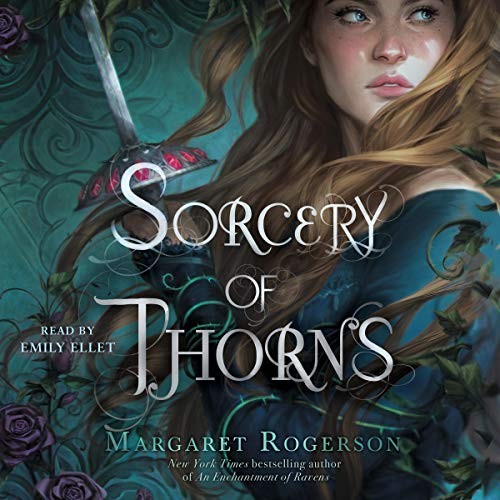
Sorcery of Thorns
Elisabeth was left at one of Austermeer's Great Libraries as a foundling and has grown up among the grimoires kept there, books that whisper on the shelves, rattle their chains and turn into monsters of ink and leather when something provokes them.
About
Spoiler notice: Spoilers for the full novel, including the climax and epilogue.
Austermeer’s Great Libraries are more than collections: they are fortresses built to contain books that can answer back. Grimoires whisper from their shelves and strain against iron chains; when provoked, a book can become a Malefict, a creature of ink and leather. Elisabeth Scrivener has lived among these dangers since the Director of Summershall found her as an infant on the library steps. She has grown up believing that sorcerers are evil and that wardens protect the kingdom from the grimoires those sorcerers created. Her ambition is to join the wardens, and she treats their rules as a map of how the world works. The opening brings that belief into contact with the vault itself: Elisabeth helps handle a dangerous volume and discovers both the fear and fascination the books can stir. Her life follows the library’s routines until sabotage forces her outside its walls.
Elisabeth’s apprenticeship changes abruptly after the Book of Eyes escapes its vault and the Director is killed. Elisabeth destroys the Malefict before it can reach the nearby town, but that choice costs the library an irreplaceable grimoire and leaves her under suspicion. The new Director, Finch, will not accept her account that sorcery was used to release the monster. She is taken for questioning by Nathaniel Thorn, a young magister she already regards as an enemy, and his quiet servant Silas. Nathaniel’s actions complicate the image Elisabeth has inherited: he restrains her escape, yet also treats her as a witness whose innocence matters. The journey away from Summershall turns into an uneasy alliance as Elisabeth tries to understand what happened and Nathaniel searches for the cause of attacks on the libraries. The novel keeps the mystery close to her limited knowledge, letting new facts arrive through encounters, books and the consequences of her choices.
Silas is not simply a servant accompanying Nathaniel. He is a demon bound to the sorcerer by a contract, and Nathaniel gave him twenty years of his life as a child. Silas had killed Nathaniel’s father to stop a necromantic ritual that would have killed the boy; Nathaniel then bound the demon because he could not bear being alone. The arrangement exposes the cost of sorcery in this world: demons draw on human life force, while the sorcerer’s control over magic comes with danger and debt. Silas is composed, observant and often more willing than Nathaniel to say what he sees; his loyalty does not erase his own guilt or his fear of what he might do if freed. At Thorn Manor, Elisabeth encounters Nathaniel’s guarded habits and the grief behind them, while the three begin to rely on one another. Her familiarity with grimoires also proves unusual. Books respond to her in ways that challenge the library’s picture of them as objects to be contained, and her capacity to perceive or withstand magic points toward a connection she does not yet understand.
The attacks lead Elisabeth toward Oberon Ashcroft, Austermeer’s Chancellor of Magic, whose public promises to reform sorcery conceal a private campaign. After he initially offers to clear her name, Elisabeth learns that he is behind the library sabotage and is using demons and enchanted servants to eliminate witnesses. Ashcroft confines her at his manor, probes her memories and sends her to Leadgate Hospital when she resists. Elisabeth escapes with help from Mercy, a nurse, and eventually finds her way back to Nathaniel and Silas. She cannot expect the kingdom to believe an apprentice librarian over its most respected official, so she and her allies search for evidence in the Codex Daemonicus, an elusive grimoire connected to the scholar Aldous Prendergast. Its knowledge is difficult to reach and carries its own risk. The investigation draws together the old history of Austermeer’s libraries, Ashcroft’s attacks and the power Nathaniel’s family has guarded.
As the danger spreads, Elisabeth’s place between library and sorcery becomes central to the plot. Her return to the Royal Library is not a simple homecoming: its leaders do not immediately trust her, and the institutions she once hoped to serve have been compromised from within. Prendergast reveals that the libraries form a pentagram: destroying their Maleficts supplies the ritual that will summon the Archon, ruler of the Otherworld. Ashcroft believes its power can end sickness and poverty, but summoning it will tear open the veil and expose humanity to demons. The climax brings Elisabeth, Nathaniel and Silas into the Royal Library as fiends pour through breaches between worlds. Elisabeth frees the chained books, understanding that her instinct to protect them cannot be reduced to becoming a warden. Some grimoires fight the demons and sacrifice themselves to help close the breach. When Elisabeth believes she and Nathaniel are about to die, she releases Silas from his contract. He faces the Archon and stops the ritual, apparently giving his life in the struggle, while the survivors are rescued from the wreckage.
The epilogue follows the consequences rather than treating the battle as a clean reset. Ashcroft is imprisoned, Leadgate is closed, and the Great Libraries face reform after their use in his scheme is exposed. Elisabeth is welcomed back but is uncertain that the warden’s path she once wanted still fits her; the greatkey she receives leaves that door open. Nathaniel survives injured and decides not to summon another demon, which means he can no longer channel sorcery. He and Elisabeth return to Thorn Manor carrying grief for Silas, whom they believe died saving them. Their attempts to call him back by his Enochian name fail. At last Elisabeth calls him Silas, the name tied to his loyal self, and a breeze sweeps through the room, extinguishing the candles. The novel ends on that sign rather than showing Silas appear, so his return remains an implication. Rogerson’s close stays with Elisabeth’s point of view and her changed understanding of books, institutions and the people she once thought she knew.
Book details
- Author
- Margaret Rogerson
- Published
- 2019 (earliest confirmed edition)
- Series
- No series listed
- Subgenre
- Witch and magic, Dark fantasy
- Tags
- Romantasy
Review
Editor profile
Baby Bat
Goodreads and social links will be added soon.
- Goodreads — link coming soon
- Social media — link coming soon