
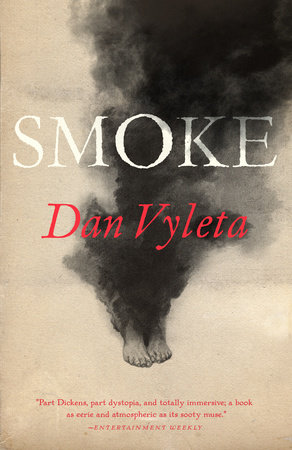
Smoke
In an alternate Victorian England, smoke rising from people is treated as visible proof of wickedness, while the aristocracy’s apparent cleanliness supports its claim to rule.
About
Spoiler notice: This overview discusses the smoke-based moral order, Thomas and Charlie’s boarding-school friendship, Livia’s role in their investigation, and the questions their discoveries raise about class and authority. It avoids the later revelations and ending.
Smoke opens onto a Victorian England that resembles the nineteenth century in its institutions and soot-darkened atmosphere, but rests on one impossible social fact: people are believed to emit smoke when they are wicked. In this world, the visible trace is treated as evidence about a person’s character. The clean aristocracy presents its apparent freedom from smoke as proof of virtue and as a justification for ruling; the lower classes are cast as morally stained. Dan Vyleta turns an imagined phenomenon into the basis of everyday hierarchy. The result is historical fantasy with a speculative premise that immediately asks who gets to define goodness and whose supposed failings become public evidence.
At the centre are Thomas Argyle and Charlie Cooper, friends at an elite boarding school where boys are being prepared for positions of influence. Thomas is the son of an aristocrat whose conduct has left him at odds with the expectations attached to his family. Charlie is his closest friend, and their bond gives the early story a human scale amid the school’s strict order. The institution teaches its pupils how to understand smoke and their place in society; its rules shape not only lessons but also discipline, status and the boys’ assumptions about themselves. When a sadistic headboy makes school life dangerous, Thomas and Charlie have reason to question the authority around them, though questioning it carries consequences.
The school is one part of a larger political arrangement. Its education of the elite sits within a society where inherited status is defended through claims of virtue. The book does not present the system as a neutral backdrop. It shows how beliefs about purity can become practical tools: they sort people, defend privilege and make inequality appear natural. Smoke operates at once as a physical mark in the imagined setting and as an idea society uses to police conduct. Its presence invites readers to consider the distance between a sign and the interpretation placed upon it, and between moral judgment and political convenience.
Livia enters the boys’ story from a different position. She is the daughter of a wealthy and powerful family, and her involvement draws Thomas and Charlie beyond the school’s familiar boundaries. The publisher’s account places a secret laboratory at the hinge of this change: Livia leads them there, and what they encounter suggests that smoke may not mean what the accepted order says it means. The trio then set out to uncover more about their world. This is enough to establish the novel’s engine without giving away its answers. Their investigation develops from a personal challenge to school authority into a wider inquiry about the knowledge that holds a society together.
That inquiry lets the book connect suspense with questions of class and social training. In an interview, Vyleta described the novel as concerned with how people are trained to function in society and with the distinctions societies draw between those considered worthy and unworthy. He also spoke of the story as taking place in a society organized around a phenomenon no one can quite explain. Those comments help illuminate the central tension: an entire order can seem settled even when the meaning of its most visible evidence is uncertain. The characters’ search therefore has stakes beyond solving a puzzle. It challenges the categories through which people understand power, character and belonging.
Vyleta’s choice of smoke draws on the textures associated with nineteenth-century London as well as on its symbolic reach. In the same interview, he connected his idea to Dickens, Victorian theories of disease, and the period’s fog and soot. He described smoke as something immediate and difficult to suppress, a mark that can spread and linger. In the novel, that material quality gives an abstract moral idea a presence in the air and on the body. The image is unsettling because it blurs boundaries: the supposedly private becomes visible, and a person’s surroundings can seem to carry judgment. The premise remains fantastical, but the social effects it enables feel legible as questions about stigma and control.
The boarding-school setting gives the story an adventure’s forward movement, while the subject matter reaches into adult systems of authority. Vyleta has called it a historical novel partly set in London and described its concerns as more conceptual than his previous work. The publisher frames it as a blend of historical fiction and fantasy in which three young friends encounter dangerous secrets. These descriptions point toward the book’s combination of momentum and argument: characters move through a perilous investigation, while the world’s rules keep raising doubts about what counts as truth. The tone draws on a recognizably Victorian landscape without claiming to reconstruct actual history; this is an alternate England shaped by an invented moral physics.
The novel’s central question is not simply whether smoke exists, but what people do with the meanings attached to it. Thomas, Charlie and Livia begin from different relationships to the order around them, and their discoveries press them to reconsider lessons that once seemed inevitable. By linking friendship and danger to a broader struggle over interpretation, Smoke makes its speculative device carry both plot and theme. It asks how visible signs become judgments, how judgments protect institutions, and what might happen when people test the explanations they have inherited. The book’s imagined Victorian world is grimy, strange and politically charged, with its mystery rooted in the everyday consequences of deciding who is clean, who is tainted and who has the authority to say so.
Book details
- Author
- Dan Vyleta
- First published
- 2016
- Series
- No series listed
- Subgenre
- Historical fantasy
- Primary genre
- Literary Fiction, Fantasy
- Tags
- No tags for this book.
Review
Editor profile
Baby Bat
Goodreads and social links will be added soon.
- Goodreads — link coming soon
- Social media — link coming soon