
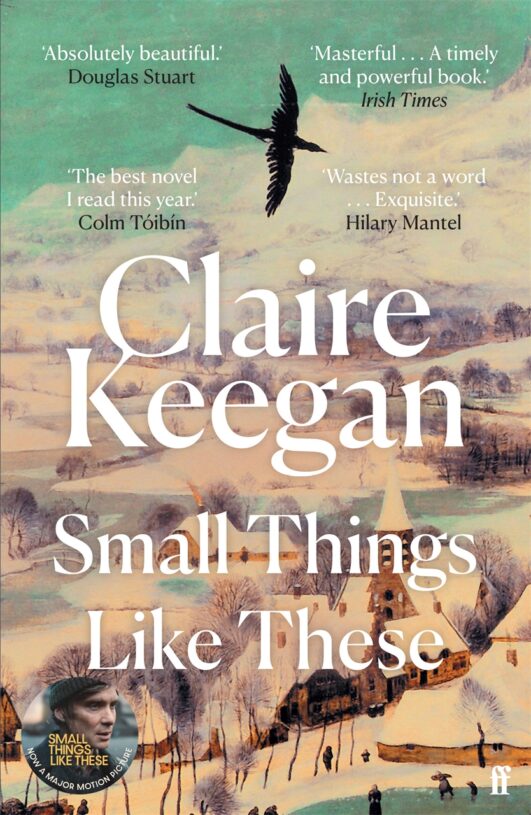
Small Things Like These
In New Ross, Ireland, during the weeks before Christmas in 1985, coal and timber merchant Bill Furlong is busy keeping his business and family going.
About
Spoiler notice: Full-story spoilers below, including the ending.
Claire Keegan sets Small Things Like These in New Ross in December 1985, when the weather has turned cold and Bill Furlong's coal and timber business is at its busiest. The story begins by looking outward: rain swells the River Barrow, smoke moves across the quays, and shopkeepers and workers measure the season through wet clothes, cold knees and another day's trade. Furlong belongs to this working town. He sells coal, turf, briquettes, logs and gas, and spends much of his time making deliveries himself. The detail gives the story a material rhythm. Loads must be weighed, tyres wear down, hands need washing, and men pause for hot food before returning to the cold. The town is not a backdrop that can be set aside once the central moral problem arrives; its routines are the conditions in which that problem has to be faced.
Furlong's rounds bring him to a convent whose authority reaches well beyond its walls. The Church has power throughout the town, and Furlong gradually understands how the convent treats unmarried mothers and their babies. Keegan keeps the perspective close to Furlong, a man who does not readily speak or turn his thoughts into arguments. That reserve shapes how information reaches the reader. Encounters accumulate, his unease grows, and ordinary exchanges acquire weight because he must decide what he can acknowledge and what he will do with what he has seen. The story's tension comes less from a mystery to solve than from watching recognition become difficult to avoid.
The trouble at the convent presses against Furlong's own history. He was born to a young unmarried mother who lost the support of her family. Mrs Wilson, the woman for whom his mother worked, allowed them to stay and helped him grow up. Such generosity was rare in a society where many children born outside marriage were unwanted. Keegan has said that being loved in his youth matters to the way Furlong responds to another person's suffering. The connection is not a simple lesson in which a fortunate childhood guarantees a brave adult. Furlong is tired, uncertain about his identity and conscious of his responsibilities as a husband and father. His past supplies a reason to care, while his present gives him concrete reasons to hesitate.
Those responsibilities are made specific through his wife, Eileen, and their five daughters. Furlong's business supports the household, and his choices may put both the work and his family's prospects at risk. Keegan has said that she wanted to follow the coalman's knowledge through his days and ask whether he could still regard himself as a good father. That question complicates any uncomplicated portrait of heroism. His family is not an abstract obstacle standing between him and a noble act; they are people whose security depends on him. The book therefore places care in more than one direction. A man can feel responsible for those nearest to him and still recognise that looking away from the girls at the convent protects the arrangements that endanger them. The conflict becomes harder because both duties feel immediate.
The small town magnifies that pressure. People know one another, institutions organise daily life, and warnings about what should not be discussed show how silence can operate without every neighbour being equally powerful. The book examines the cruelty inside the institution and the shared acquiescence that lets it continue. Keegan chose 1985, before the Ferns Report and before the Church's influence had substantially collapsed. She wanted the setting to belong to a society of her own generation rather than to a remote past. The historical setting consequently resists the comforting idea that abuse survives only through a few villains. Furlong has to decide what knowledge asks of someone who earns a living and raises children within the same community that benefits from not asking questions.
Keegan's restraint is part of the book's method. She has described Furlong as an unwilling narrator and said a longer novel would not suit his personality. The short form stays close to his limited speech and lets pauses, repeated work and small gestures carry what he cannot easily say. This quietness does not soften the harm the story addresses. It makes the gap between what people know and what they admit especially visible. Furlong's attention moves between the cold, the yard, his family and the convent, so that the institutional cruelty remains tied to everyday life rather than separated into a distant historical lesson. The title's emphasis on small things can be read beside this method: acts of care may look modest, but the story asks what they mean when a person must choose whether to repeat a kindness once received.
The final movement brings that choice into action without turning it into a clean resolution. Furlong takes Sarah from the laundry and walks with her through the town toward home, afraid of what the choice could mean for his family and business. Keegan has also said she is unsure whether he can consider himself a good father after the book ends, since he may have jeopardised his daughters' education and his ability to provide. The narrative stops while the consequences remain open. That ending keeps courage connected to uncertainty: Furlong has acted, but the story does not promise safety, public vindication or a settled future. Small Things Like These leaves its central question with the reader, asking what responsibility means when doing the decent thing may expose the people one loves to real costs.
Book details
- Author
- Claire Keegan
- First published
- 2021
- Series
- No series listed
- Subgenre
- Literary historical fiction, Social realism
- Primary genre
- Historical Fiction, Literary Fiction
- Tags
- No tags for this book.
Review
Editor profile
Baby Bat
Goodreads and social links will be added soon.
- Goodreads — link coming soon
- Social media — link coming soon