
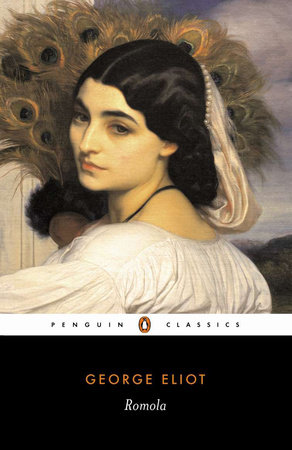
Romola
In Renaissance Florence, Romola’s marriage to the charming scholar Tito Melema appears to offer companionship within the learned world she shares with her blind father.
About
Spoiler notice: Full-plot spoilers, including Tito’s betrayals and death, Savonarola’s execution and Romola’s later household.
Romola opens in Florence in 1492, bringing the reader into a city of scholars, artists, traders and religious voices whose ambitions continually meet in its streets. The arrival of Tito Melema gives this world a stranger through whom its opportunities can be explored. Shipwreck has left him with little beyond his learning, attractive manners and a few valuable objects, but these are enough to begin winning assistance and introductions. George Eliot makes his ability to please people important from the start. He does not need to appear threatening to enter their confidence. His prospects grow because others can imagine a useful, affectionate or accomplished person in him, while the obligations he has brought from his earlier life remain largely outside their knowledge.
Romola’s household is organised around a very different relationship with learning. Her father, the blind scholar Bardo de’ Bardi, depends on her assistance and invests his ambitions in the books and antiquities he has assembled. She has an intellectual life shaped by this work, but also duties that limit how far she can imagine a separate future. Tito’s arrival seems to offer companionship inside that familiar world, because his abilities appeal to Bardo as well as his daughter. The marriage promises to bring affection and shared interests together. Its failure will therefore damage more than Romola’s romantic hopes: it will call into question the trust through which she has understood her father’s legacy, her own responsibilities and the person she has chosen to join her life to.
Tito’s past contains a debt that his new prospects make increasingly inconvenient. Baldassarre rescued him as a child and raised him with a father’s care, yet Tito prefers uncertainty about the older man’s fate to the risks of searching for him. Believing Baldassarre may be dead would allow him to keep his resources and continue the life opening before him. That preference gradually becomes a reason to avoid anything that could disturb it. Romola encounters a related habit when Tito sells her father’s library after Bardo’s death. He supplies plausible arguments about the usefulness of dispersing the collection, while she sees a broken trust. The difference is not merely between sentiment and practicality; his fluent explanations repeatedly make fidelity to other people seem an unnecessary burden.
Their marriage unfolds within the novel’s changing Florence, as political struggle and Savonarola’s religious influence alter the terms of public loyalty. Romola initially tries to leave the city and the marriage that has become intolerable to her. Savonarola interrupts her flight, presenting the decision as an abandonment of duties she cannot simply escape by changing her name and place. His authority challenges her at a moment when she has lost confidence in the bond that previously governed her life. She returns, accepting a larger claim of service than the private happiness she had expected from marriage. The return does not mean that Tito has become trustworthy again. It gives her a reason to act within a damaged world while leaving the source of that damage unresolved.
Tito’s concealed relationship with Tessa deepens the division between his reassuring outward presence and the life Romola does not know. Tessa and their children form another household dependent on a man whose different commitments cannot all be honestly maintained. Romola eventually comes to understand this betrayal, yet the knowledge does not lead her to treat Tessa as a rival who deserves punishment. The younger woman has been kept ignorant too. That distinction will become central to the choices Romola makes after the marriage has broken beyond repair. At the same time, her reliance on Savonarola becomes harder to separate from the city’s political conflicts. Neither a husband’s charm nor a religious leader’s commanding certainty can provide an authority that removes the need for her own judgment.
The two men’s endings place different kinds of unresolved trust before her. Tito escapes immediate violence into the Arno, only to reach the bank where Baldassarre finds him and kills him. The older man dies still clutching his body, bringing the abandoned relationship to a terrible physical conclusion. Savonarola’s imprisonment and torture produce conflicting confessions that leave Romola uncertain how to understand the man who once directed her back towards service. She hopes his execution will permit a final declaration capable of answering those doubts. Instead, Eliot brings her to the public spectacle on 23 May 1498 and lets the awaited moment pass without the assurance she seeks. Neither death supplies a simple explanation that can undo the loyalties and decisions formed while the men were alive.
Romola’s continuing life takes shape through people who need care rather than people who promise certainty. She seeks out Tessa and the children, refusing to make their connection with Tito a reason to reject them. The epilogue, set in 1509, shows them within the same household, with Monna Brigida also present. As Lillo asks what he should become, Romola speaks about integrity, concern for others and the danger of making comfort the measure of every choice. Tito’s history gives that conversation a painful weight, although she cannot yet tell the boy everything. Her remembrance of Savonarola survives without requiring everyone around her to share it. The ending leaves her teaching and caring amid differences, carrying lessons from her losses into relationships whose value does not depend on recovering her first hopes.
Book details
- Author
- George Eliot
- First published
- 1863
- Series
- No series listed
- Subgenre
- Historical fiction, Literary historical fiction, Modern classics
- Primary genre
- Historical Fiction, Literary Fiction
- Tags
- No tags for this book.
Review
Editor profile
Baby Bat
Goodreads and social links will be added soon.
- Goodreads — link coming soon
- Social media — link coming soon