
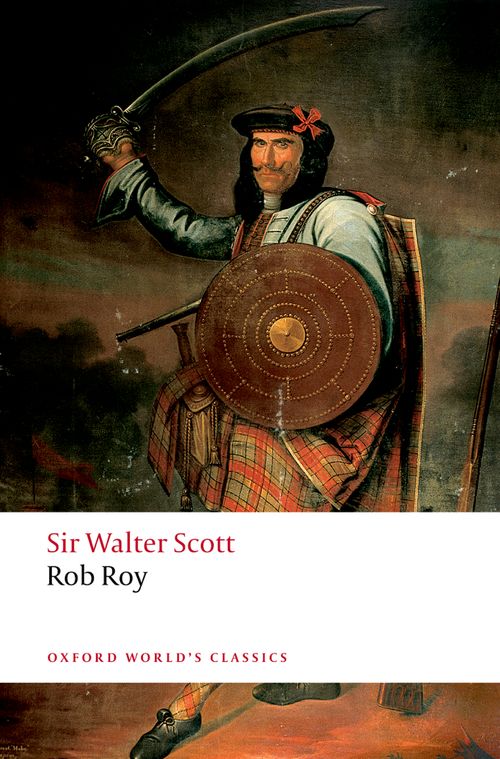
Rob Roy
Frank Osbaldistone resists his father’s plans for a commercial career, only to be drawn north into a crisis threatening the family firm.
About
Spoiler notice: Full-plot spoilers, including Rashleigh’s death, Diana’s escape and Frank’s eventual marriage.
Rob Roy is told by Frank Osbaldistone as an older man looking back on the hazards of his youth. He addresses a friend who already knows much of his later life, allowing the account to move between remembered adventure and the judgement of someone who has survived it. The young Frank begins in conflict with his father, a merchant who expects him to enter the family business. Frank has devoted more attention to literature and other interests than to learning commercial work, and he resists the future prepared for him. Walter Scott sends that disagreement northwards into family intrigue and the world surrounding the Jacobite rising of 1715. The novel appeared at the end of 1817, although the first edition’s title page bears the year 1818.
At Osbaldistone Hall, Frank meets relatives whose household is far removed from his father’s counting-house. Diana Vernon becomes its most compelling presence for him, but her confidence does not mean she is free from family arrangements or political danger. Rashleigh Osbaldistone has been her tutor, knows more than Frank does about her circumstances and occupies an uneasy position in the relationships around her. Frank’s attraction to Diana develops among conversations in which knowledge is unevenly distributed. He must judge people while recognising that their histories and purposes are partly concealed from him. The retrospective narration keeps that youthful uncertainty alive, even though the man telling the story knows where it led. Diana repeatedly shows a composure and practical intelligence that Frank admires precisely because he cannot always match it.
The commercial career Frank rejected returns as a responsibility he can no longer dismiss. During his father’s absence, Rashleigh has taken charge of affairs and travelled to Scotland with funds intended to meet substantial bills. He has not been heard from, and the firm’s credit is in danger. A letter asks Frank to join the clerk Owen in Glasgow and help find him. Diana helps Frank grasp the immediate problem, including the deadline by which adequate funds must be available. She also gives him a sealed packet to use if ordinary efforts fail. Frank’s distress is directed towards his father’s probable suffering as much as towards money itself: he understands that commercial dishonour could devastate a man whose work and identity are so closely bound together.
Glasgow introduces another way of thinking about money, authority and obligation through Bailie Nicol Jarvie. A merchant and magistrate, Jarvie combines practical concern with a strongly expressed view of his own civic world. His connection with Rob Roy gives Frank access to someone who is neither simply a representative of lawful order nor an uncomplicated enemy of it. Jarvie’s comments on Rob’s character qualify praise with doubts about the kind of honesty practised in the Highlands. Those distinctions belong to the characters’ understanding of the places they inhabit, and the novel gives them room to be comic as well as serious. Frank’s journey therefore moves across different systems of protection and influence. The habits that make sense in a commercial city are not sufficient preparation for every encounter beyond it.
Rob Roy MacGregor occupies the centre of that uncertain territory without becoming the narrator of the book named after him. Frank encounters him as a resourceful and forceful ally whose methods can depart sharply from the procedures of officials and courts. The novel’s appeal depends partly on that difficulty of classification: assistance may come from someone whose authority is maintained by means that respectable institutions condemn. Frank’s relationship with Diana is equally caught between private feeling and commitments larger than the couple themselves. Her father, Sir Frederick Vernon, is entangled in the Stuart cause, and his Catholic convictions affect the future he imagines for his daughter. Frank’s Protestant background becomes another obstacle. Diana’s care for her father is an active obligation, influencing what she can promise and what she is prepared to leave behind.
The final danger brings these relationships together at Osbaldistone Hall. Officials arrive with warrants, and Rashleigh captures Diana and her father after their attempted escape. Frank is also taken into custody. Outside the house, Rob Roy’s party intercepts the carriage and its escort, turning the removal of the prisoners into a rescue. Rashleigh fights MacGregor, is mortally wounded and dies without abandoning his hatred of Frank. His death removes the remaining challenge to Frank’s inheritance, while the legal charge against Frank is exposed as a device serving Rashleigh’s interests. Diana and Sir Frederick escape under MacGregor’s protection and reach France. Their rescue is not an accidental coincidence: the closing account explains that others concerned for Sir Frederick’s safety had arranged for Rob Roy to help him get away.
Frank eventually tells his father of his love for Diana. The older man hesitates over her religion but acknowledges his son’s service in the business and accepts that he should choose his wife. The narrator then compresses the marriage into a recollection of long happiness and later bereavement, reminding the reader that this adventure is being told from a much later life. He never sees MacGregor again, though he hears reports of his continuing influence and eventual peaceful death. A separate postscript turns from Frank’s fictional narrative to documents relating to the historical Rob Roy, and should be understood as distinct material. The novel itself closes with a reputation that resists a simple verdict, leaving the outlaw remembered through courage, questionable methods and the decisive help he gave to people in danger.
Book details
- Author
- Walter Scott
- First published
- 1817
- Series
- No series listed
- Subgenre
- Literary fiction, Modern classics
- Primary genre
- Literary Fiction
- Tags
- No tags for this book.
Review
Editor profile
Baby Bat
Goodreads and social links will be added soon.
- Goodreads — link coming soon
- Social media — link coming soon