
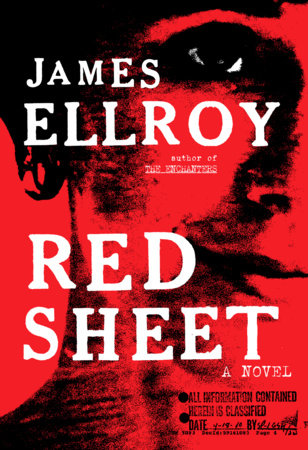
Red Sheet
In late October 1962, after the Cuban Missile Crisis, Freddy Otash is named lead investigator of an anti-communist probe in Los Angeles.
About
Spoiler notice: Spoilers cover the opening setup, investigation and Halloween-night murder premise only; later developments and the solution are withheld.
Red Sheet places James Ellroy’s latest Freddy Otash novel in Los Angeles in late October 1962, just after the Cuban Missile Crisis. The publisher’s description gives the story a deliberately volatile starting point: Attorney General Robert Kennedy orders an investigation into alleged communist influence, and Freddy is named its lead investigator. The operation is presented as a red probe, an anti-communist inquiry with the Los Angeles Police Department involved. Ellroy’s premise joins national Cold War alarm to local police power and political maneuvering. The crisis supplies a real historical pressure in the background; the probe and the tangled investigation belong to the novel’s fiction. That distinction matters in a book that brings actual public figures into an invented crime plot.
Freddy Otash is the centre of that plot, a compromised former policeman and private investigator whom the book casts as an instrument of official authority. The publisher describes him as a criminal with police sanction and a severe drug habit, an investigator whose appointment is itself a provocation. Rather than offer a clean detective working outside the system, the novel begins with a man whose methods and loyalties are already compromised. Freddy is assigned to investigate a red-front trade union. A Halloween-night murder then threatens to connect the inquiry to Richard Nixon, then a former vice president and California gubernatorial candidate, and to two deaths from eight years earlier. The opening situation sets investigation, political protection and possible scandal on overlapping tracks without revealing how they resolve.
The historical Freddy’s name is Fred Otash. A 1992 Los Angeles Times obituary describes him as a former Los Angeles police officer who became a Hollywood private investigator, and recounts his later work as a celebrity fixer. That real career gives Ellroy a documented point of departure, but the novel’s Freddy is a fictional character built from that material. The lead-investigator assignment, his alleged criminal conduct under police sanction, and his involvement in the events of Red Sheet should be read as elements of Ellroy’s constructed story, not as a factual biography of Otash. Keeping the two levels distinct lets the historical name add resonance without treating the novel’s conspiracy or characterization as evidence about the real man.
Ellroy widens Freddy’s workload when Nixon’s political advisers Bob Haldeman and John Ehrlichman hire him to keep the candidate away from a press corps described as eager to smear him. The book therefore places Freddy between two jobs: pursuing a politically charged police investigation and managing threats to a candidate’s public image. The publisher’s synopsis also brings in Tom Bradley, identified as an ex-cop and lawyer running for a Los Angeles City Council seat while pressing for the Rumford Fair Housing Act, and Hugh Hefner, whose magazine business is positioned to exploit racial tension. These figures and public issues give the city’s political life a prominent place in the setup. Ellroy’s use of named historical people remains part of a work explicitly presented as fiction.
The setting is a Los Angeles rendered through competing claims on power and attention. Police, political operators, a union, the press and a mass-market publisher all appear in the publisher’s account as institutions or interests able to shape what becomes visible. The title’s red sheet suggests the investigation’s anti-communist frame, while the story’s other pressures include electoral ambition and housing discrimination. The real Cuban Missile Crisis had reached its thirteen-day confrontation in October 1962; the U.S. State Department’s historical overview records the crisis as running through October and notes that the U.S. naval quarantine continued after the immediate confrontation. Ellroy places his fictional events in the uneasy period immediately after that crisis, turning public fear into atmosphere for a local thriller rather than claiming that the novel’s plot is an archival account.
This setup makes Red Sheet a historical crime novel shaped by noir conventions: an investigator with compromised ethics, a murder that may implicate powerful people, and institutions whose public purposes overlap with private interests. The crime elements are concrete, but the publisher also frames the novel as a daring work of fiction in which history and invention meet. The result is a story poised between documented names and imagined events. Readers can follow the opening case as a case, while recognizing that the real Fred Otash and the real political figures are not interchangeable with Ellroy’s dramatic versions of them. The book’s central tension is already visible in Freddy’s double assignment: he must investigate a threat to the state while working to protect a candidate from damaging publicity. Later developments and the solution to the murder are left open here. Its opening arrangement also makes publicity part of the investigative machinery: the same people who want information can benefit from controlling what reaches the public. That pressure connects the title's political inquiry to the candidate's campaign and Hefner's commercial interest in racial conflict. These points are reported as the publisher's stated fictional setup, not as claims that these people coordinated in real life. By holding the explanation at the level of premise, the account leaves the book's competing motives and eventual outcomes for the novel itself.
Book details
- Author
- James Ellroy
- First published
- 2026
- Series
- No series listed
- Subgenre
- Noir, Crime thriller
- Primary genre
- Mystery & Thriller
- Tags
- No tags for this book.
Review
Editor profile
Baby Bat
Goodreads and social links will be added soon.
- Goodreads — link coming soon
- Social media — link coming soon