
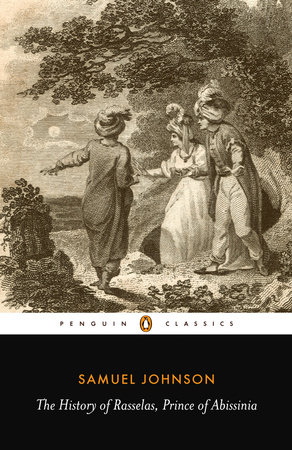
Rasselas, Prince of Abyssinia
Confined in the luxurious Happy Valley, Prince Rasselas finds that comfort and entertainment cannot satisfy his restless mind.
About
Spoiler notice: Full-plot spoilers, including the escape from the Happy Valley, Pekuah's abduction and ransom, the astronomer's belief and the unresolved final plans.
Rasselas begins in a place designed to remove every ordinary reason for unhappiness. The prince and the other royal children live in a fertile valley enclosed by mountains, with a palace, abundant food, music and carefully arranged pleasures. The same barriers that keep danger outside also keep the inhabitants inside. Rasselas is not hungry, poor or physically threatened, yet he finds that satisfaction of his bodily needs leaves long hours of restlessness. Samuel Johnson makes that contradiction the beginning of a philosophical journey. The young man wants to know what human beings need beyond comfort, and whether another way of living might supply it. The Happy Valley's name expresses the certainty of those who organise his life, while his dissatisfaction exposes how little that certainty can do for someone who does not share it.
The poet Imlac offers both knowledge of the wider world and companionship within the valley. His account of travelling, learning and returning home disappoints the prince's expectation that experience must lead to contentment, but it also makes escape seem worth attempting. Together they begin cutting a passage through the mountain, taking encouragement from the burrows of animals and continuing through exhaustion and failed searches for a suitable opening. Rasselas's sister Nekayah discovers their work and asks to join them. When they leave, she brings her companion Pekuah, while jewels hidden in their clothes provide resources for life beyond the palace. Freedom immediately feels less comfortable than they imagined: the open landscape frightens them, and they must learn that strangers will not automatically offer the obedience or reverence they have always received.
Cairo becomes their base for examining possible lives. Imlac presents himself as a merchant, sells some of the jewels and establishes a household whose wealth gives the travellers access to different social circles. The prince initially takes other people's cheerfulness as evidence that they have found the happiness missing from his own experience. Yet he also recognises that his own public gaiety can conceal private unease. The inquiry therefore requires more than looking at faces or listening to confident professions. A teacher who has eloquently explained how reason can master suffering seems to promise an answer, until Rasselas visits after the death of the man's only daughter. The philosopher cannot find consolation in the principles he has taught. Rather than continuing to rebuke him with his own arguments, the prince withdraws, recognising that polished speech has not made grief disappear.
Other encounters test the appeal of retreat, prosperity and social position. Shepherds whose lives might seem simple and peaceful are resentful of labour performed for the comfort of the rich. A wealthy host welcomes the travellers into a beautiful estate but fears that his possessions will attract a powerful enemy. A hermit appears to offer a more complete escape from those dangers, living in an orderly cave with books and instruments. He admits, however, that the novelty of solitude has passed and that his thoughts have become troublesome without conversation or diversion. He joins them on their return to Cairo. Nekayah and Rasselas then divide their observations between domestic households and the world of high office. No occupation can be judged solely by the attractive picture an outsider makes of it; its daily circumstances repeatedly complicate the hoped-for solution.
The loss of Pekuah interrupts the inquiry with suffering that cannot be kept at the level of discussion. She remains outside while the others explore a pyramid and is carried off with her two maids by a troop of raiders. Nekayah reproaches herself for allowing her companion to stay behind, while official promises and paid inquiries initially fail to recover her. The princess considers withdrawing permanently from society, but agrees to postpone an irreversible decision while the search continues. Her grief gradually admits intervals of ordinary activity without extinguishing her affection. News finally arrives that an Arab chief will release the captives for a ransom. Imlac negotiates an exchange at the monastery of St Anthony, and Pekuah returns to her friends. Their reunion restores something precious, but the episode has shown how attachment exposes happiness to events beyond anyone's careful planning.
The learned astronomer brings a different danger into view. His knowledge and virtue have earned Imlac's regard, but he secretly believes that he controls the weather and the movement of the seasons. What began as imaginative speculation about doing good has become, for him, a burdensome responsibility for the world's welfare. He wishes to pass that supposed authority to Imlac, fearing that an unworthy successor could misuse it. Nekayah and Pekuah initially respond with amusement when they hear his story, and Imlac insists that his affliction deserves compassion. The distinction between intellectual achievement and reliable judgment is consequently more troubling than a simple contrast between wisdom and ignorance. Someone can possess extensive knowledge, act with benevolent intentions and still mistake the creations of his own mind for powers that operate upon the world.
The final visit to the catacombs turns their conversation toward death, the soul and the limits of a life spent deciding how to live. Back in Cairo, the Nile's inundation confines them indoors, where each imagines a future arrangement. Pekuah would like the stability of presiding over a religious community; Nekayah hopes to learn every science and establish a college for women; Rasselas pictures a small kingdom governed through his own direct attention, although its imagined boundaries keep expanding. Imlac and the astronomer are less determined to prescribe their course. None of these wishes becomes a narrated achievement. The companions recognise that the schemes cannot be obtained and resolve to return to Abyssinia when the flooding subsides. Johnson closes before that return occurs, leaving the search without a final recipe for contentment, even as the travellers understand much more about what such recipes fail to include.
Book details
- Author
- Samuel Johnson
- First published
- 1759
- Series
- No series listed
- Subgenre
- Literary fiction, Modern classics
- Primary genre
- Literary Fiction
- Tags
- No tags for this book.
Review
Editor profile
Baby Bat
Goodreads and social links will be added soon.
- Goodreads — link coming soon
- Social media — link coming soon