
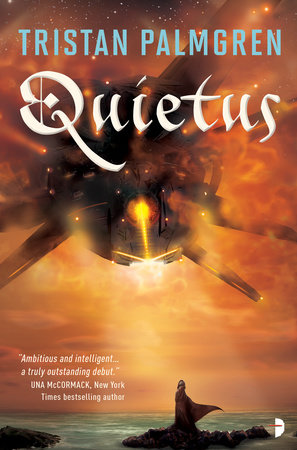
Quietus
In plague-stricken fourteenth-century Florence, Carthusian monk Niccolucio has lost his brothers and the certainty that once sustained him.
About
Spoiler notice: This overview discusses the early setup, the protagonists’ circumstances, and the novel’s broad questions about observation, intervention, faith, and power. It avoids later discoveries about Habidah’s assignment, the conspiracy’s precise shape, and the resolution of the conflict.
Quietus begins with two crises that appear to belong to different scales. In fourteenth-century Florence, the Black Death devastates a Carthusian monastery and leaves the young monk Niccolucio isolated in the wreckage of the life he understood. Far beyond his world, Habidah, an anthropologist from another universe, studies a plague threatening her own civilization. Tristan Palmgren brings these strands together through a decision that is both intimate and consequential: Habidah saves Niccolucio, even though her work depends on observing people without changing their course. From that first breach, the novel turns a meeting between strangers into a way of examining what an observer owes to the people being observed.
Niccolucio’s story is grounded in the material and spiritual pressures of plague-era Italy. His religious life has offered a structure for interpreting suffering, duty, and death; the loss of his brothers places that structure under strain. The book does not present him simply as a representative of medieval belief awaiting a lesson from advanced visitors. His questions arise from a particular vocation and a community that has been broken apart. As he confronts life outside the monastery, he must decide what remains meaningful when familiar answers no longer settle what he sees. That human-scale uncertainty gives the historical setting weight beyond atmosphere: catastrophe changes the relationships and obligations through which a person makes sense of the world.
Habidah arrives with a different framework. She and her colleagues have come to study how societies respond to mass death because their own civilization has lost practical knowledge about facing a lethal pandemic. In an interview, Palmgren describes their restraint as a matter of avoiding biased observations, rather than a moral principle that they consider universally binding. Habidah’s choice therefore unsettles the assumptions behind her research as well as its procedure. She is not a time traveller correcting history; she belongs to another plane of existence, and her work concerns how cultures survive. The distinction matters because it shifts the dilemma away from familiar paradoxes and toward the ethics of gathering knowledge from people in danger.
The novel’s speculative scale expands from this encounter. Habidah’s society, the Unity, spans multiple planes and is governed by powerful intelligences known as amalgamates, which began as artificial intelligences. The institution’s reach makes the characters’ choices part of a system much larger than any single world. Yet the crisis remains legible through the contrast between a monk facing immediate bereavement and a researcher trained to make suffering into evidence. As more of Habidah’s assignment comes into question, the book asks how a vast political order justifies its interventions and whose lives count in its calculations. The concern is not only whether power can prevent catastrophe, but whether protection becomes another name for control.
Palmgren blends historical fiction with science fiction by letting the two modes alter one another. The Florentine chapters attend to local institutions, religious practice, and the bodily reality of epidemic loss; the interdimensional frame then places those experiences inside a conflict with much wider reach. The movement does not make the historical material disposable once the larger machinery appears. Instead, Niccolucio’s perspective gives the cosmic conflict a human measure, while Habidah’s research reveals how outsiders might misread a society when they treat it only as a case study. The plague-era Italian setting gives readers a familiar ground from which to approach the more complex worlds beyond it.
Faith and scientific explanation meet through the protagonists’ different accounts of what can be known. Niccolucio’s religious language and Habidah’s empirical habits do not map neatly onto ignorance and enlightenment. Each character has limits; each must reconsider the categories that once seemed sufficient. The plot’s questions about the nature of reality grow out of that encounter without reducing it to a contest with an easy winner. The book also considers free will and mortality against an immense multiverse, where individual existence can seem both fragile and significant. Its philosophical reach remains tied to choices made by people facing grief, uncertainty, and the consequences of acting on partial knowledge.
Quietus is the first novel in Palmgren’s Unity sequence, followed by Terminus, but it gives this opening story its own central tension: whether understanding suffering can be separated from responsibility toward those who suffer. Habidah's decision to save Niccolucio defines their relationship and places that question inside the action, where neither of them can treat it as a remote exercise. Around that relationship, the book builds from a historical catastrophe toward questions of power, cultural survival, and the possibility of moral action inside enormous systems. The historical and speculative strands also give the same crisis two vantage points: one shaped by immediate loss, the other by research intended to inform a civilization's survival. The result is a genre-blending work whose scope broadens while its most pressing concerns remain close to its two central characters and the consequences of one intervention.
Book details
- Author
- Tristan Palmgren
- First published
- 2018
- Series
- The Unity, book 1
- Subgenre
- First contact, Historical fiction
- Primary genre
- Sci-Fi, Historical Fiction
- Tags
- No tags for this book.
- Reading order
- This is the only The Unity title on the shelf right now.
Review
Editor profile
Baby Bat
Goodreads and social links will be added soon.
- Goodreads — link coming soon
- Social media — link coming soon