
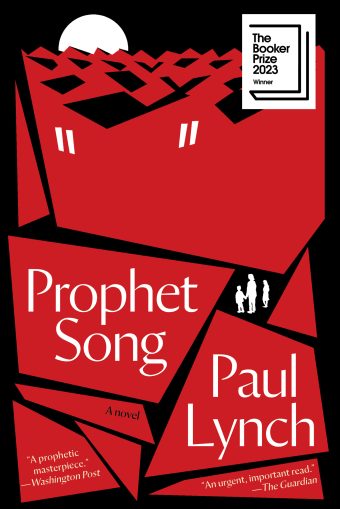
Prophet Song
In Dublin, scientist and mother of four Eilish Stack answers the door to two officers from Ireland's newly formed secret police, who want to question her trade-unionist husband.
About
Spoiler notice: Spoilers for the opening encounter with the secret police and the novel's central political and family conflict; the ending and final outcomes are not summarized.
Paul Lynch sets Prophet Song in a version of Ireland where democratic institutions are dismantled in increments. The novel begins in Dublin, at the home of Eilish Stack, a scientist and mother of four. Two officers from the newly formed secret police arrive seeking her husband Larry, a trade unionist. Their visit brings state power directly to the front door, but the danger is not presented as a single spectacular event. It grows through official procedures, new restrictions and uncertainty about what the authorities may do next. Eilish must interpret each change while still managing the ordinary demands of work and family. Political crisis is therefore encountered at household scale: state decisions become questions about safety, privacy, movement and what can be inferred from official silence. Lynch’s speculative premise asks how an authoritarian turn becomes part of daily life before anyone can identify a clear point of no return.
Eilish’s viewpoint keeps the widening crisis attached to specific relationships. Larry’s disappearance leaves her responsible for the children and for decisions that once could be discussed as a couple. Her four children do not occupy the same position: their ages and needs give them different degrees of understanding and independence as conditions worsen. The family’s conversations and routines become a way of measuring change, because decisions about school, communication and travel acquire political consequences. Eilish is a microbiologist, but her professional identity cannot insulate her from the pressure gathering around her. The central problem is practical and moral at once: how to protect people who depend on her when information is incomplete, and when each response may expose someone to a different danger. Lynch keeps the focus on that burden rather than turning Eilish into a detached commentator on national politics.
The family's eldest son, Mark, faces a danger different from his younger siblings'. Mandatory conscription gives him a choice between serving the state and trying to escape its reach. Eilish wants to get him over the border, but she cannot decide his future for him. His growing independence complicates her instinct to keep everyone close. Meanwhile, Larry's disappearance after a protest leaves no clear account of what has happened to him or what the family can expect next. A missing person, a summons and a new rule each arrive with practical consequences before anyone has time to absorb the last. The setting needs no unfamiliar technology to make its danger legible. A recognisable Dublin becomes threatening through institutions that ordinary people once expected to protect them, and through the uncertainty those institutions now create.
Eilish's sister Áine watches from Toronto and urges the family to leave Ireland. Distance lets her see the country's deterioration differently, but it also means she cannot bear the daily cost of the choices she proposes. Even an offer of help cannot make departure simple: Eilish has children at different stages of life, a missing husband and a home she is being asked to abandon. A route out may close while she weighs the risks, and family members do not necessarily want the same future. Lynch gives the question of leaving a particular shape through these relationships. Staying can feel like loyalty or denial; going can mean safety for some and separation from others. Eilish must act without a reliable account of how far the crisis will spread, so waiting for certainty becomes a decision with consequences of its own.
The narrative’s scale moves between intimate attention and national upheaval. Public events matter because they alter the circumstances in which Eilish must care for her family, while family life prevents the political crisis from becoming an abstract account of institutions alone. The novel tracks the erosion of freedom through its effects on relationships, movement and the ability to plan. Its treatment of fear is tied to uncertainty: Eilish cannot know exactly how far the country will fall or which warning deserves the most weight. People around her offer competing interpretations, and waiting for certainty also carries a cost. Lynch keeps the reader close to a character who must act without the perspective available to historians looking back. That limited horizon supports the book’s central pressure: ordinary people encounter authoritarianism as a series of demands that keep arriving before they can fully assess the last one.
Prophet Song was first published in 2023 and won the Booker Prize that year. Those facts place it in a literary context, but its subject is not confined to a headline about political crisis. Lynch uses a family’s struggle to stay together as the measure of how a society changes, and makes civic freedoms tangible through the ordinary choices they enable. The title invokes a prophetic register, though the story’s force comes from the human present of its characters rather than an explanatory forecast. Eilish’s position links motherhood, work and citizenship without making any one role a complete answer to the crisis. She remains a person making difficult choices with partial knowledge. The novel’s dystopian Ireland invites attention to warning signs and gradual shifts in power, while its family story keeps the consequences particular: every broad political change reaches someone through a relationship, a responsibility or a decision about what to do next.
Book details
- Author
- Paul Lynch
- First published
- 2023
- Series
- No series listed
- Subgenre
- Dystopian, Literary fiction
- Primary genre
- Literary Fiction
- Tags
- No tags for this book.
Review
Editor profile
Baby Bat
Goodreads and social links will be added soon.
- Goodreads — link coming soon
- Social media — link coming soon