
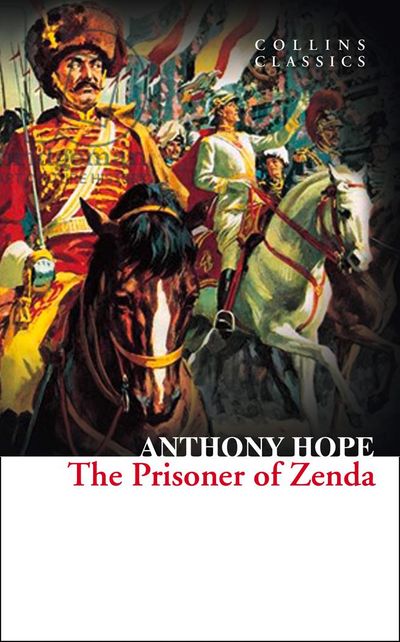
The Prisoner of Zenda
English gentleman Rudolf Rassendyll travels to Ruritania and discovers that his family resemblance to its new king makes him the king’s double.
About
Spoiler notice: Full-plot spoilers, including Rudolf Rassendyll’s substitution for King Rudolf, the king’s imprisonment at Zenda, the rescue and the lovers’ separation.
Rudolf Rassendyll travels to Ruritania as a wealthy, idle English gentleman. A family link to the Elphbergs gives him the red hair and long nose that make him the new King Rudolf’s double. At Zenda, local talk introduces the political tension before Rudolf understands it: the innkeeper wishes that Duke Michael, rather than the King, had the throne, while her younger daughter favours the red-haired Elphberg. Walking near the castle, Rudolf meets Colonel Sapt and Fritz von Tarlenheim; the King then steps from the trees and is startled by his own likeness. He invites Rudolf to dinner at Michael’s hunting lodge, reached after a walk of more than half an hour through the forest. There the King drains a bottle sent in his brother’s name, lays his head on the table, and cannot be roused the next morning.
By five the next morning, Sapt and Fritz have spent half an hour trying to wake the King. Rudolf wonders whether the last bottle was drugged; neither man can prove it, but Sapt fears Michael will take the throne if the King misses the coronation in Strelsau. Sapt proposes that Rudolf shave and impersonate him, while he and Fritz arrange for the real King to be brought to the capital after the ceremony. Rudolf accepts despite the risk that recognition would cost all three men their lives. The public performance works: Rudolf reaches Strelsau, appears before the court and is crowned. When he and Sapt return to the hunting lodge, however, they find Josef dead and the King gone. Sapt concludes that Michael’s men have taken him, though his location is still unknown. Rudolf remains in public as King while the real king is missing.
In Strelsau, Rudolf learns how exhausting the performance is. Sapt coaches him in the king’s habits and court protocol; a day of audiences and paperwork leaves little space to plan the rescue. Princess Flavia, the king’s cousin, is among the people he must face. She notices changes in the man she believes to be Rudolf, but interprets them as signs of a more attentive and courageous king. Rudolf’s growing love for her sharpens the cost of the deception: he cannot tell her who he is without endangering the real king and the succession. Meanwhile Michael presents himself as loyal, and introduces his formidable associates as devoted servants. The court’s formal courtesies conceal an active contest, so every audience and polite exchange asks Rudolf to sustain two roles at once: sovereign in public, stranger in private.
One night a letter summons Rudolf alone to a summer-house with the promise of information about his life and throne. He goes while Sapt waits outside, and Antoinette de Mauban begins to explain that the King is across the drawbridge, behind a heavy door. Before she can finish, three of Michael’s men arrive and offer to talk through the door; Antoinette warns Rudolf they mean to rush him. He lifts the small iron table and holds it out as a shield, keeping his promise not to fire until they do. The three men shoot, and Rudolf uses the table to protect himself as he forces a way out. He later jokes about the ordinary tea-table that scattered his attackers. The encounter gives him the first clue to the castle’s guarded route to the captive and shows how quickly a private meeting can become a fight.
Flavia’s feelings deepen because she believes she is seeing a changed King Rudolf. When she confesses that she loves him, the revelation gives Rudolf the intimacy he wants and makes his deception harder to bear. He tries to tell her the truth, but danger interrupts before he can complete the confession. Later, Antoinette de Mauban, Michael’s mistress, becomes an uneasy source of warning and assistance. Her attachment to Michael and her knowledge of his plans pull her in opposing directions, while Rupert of Hentzau, one of the most dangerous of the Six, pursues his own appetites and bargains. He offers Rudolf the throne and Flavia if they conspire against Michael, treating loyalty as a negotiable obstacle. Rudolf rejects the offer, but Rupert’s audacity exposes how fragile the political loyalties around the castle have become.
Fearing the King may die, Rudolf joins Sapt and Fritz in a plan using Antoinette’s staged cry to draw Michael and his guards from the cell. He waits in the moat beside the castle’s large pipe and a small ladder, ready to block Rupert Hentzau if he crosses. But Rupert enters Antoinette’s room before the signal; Michael confronts him, and Rupert kills the duke with a sword thrust before fighting past the servants. Rudolf reaches the cell, kills Bersonin, and follows Detchard into the King’s room. The King, delirious and weakened by illness, can barely move; he tries to help Rudolf with a chair, but Detchard wounds him before Rudolf kills the guard. Rudolf pursues Rupert through the moat and into the forest. Sapt and Fritz’s party later breaks in and carries the living King out; Fritz catches up with Rudolf while Rupert escapes on horseback.
The ending refuses the reward a conventional impersonation plot might promise. Flavia learns the truth and recognises the wounded man as Rudolf Rassendyll, not the cousin she thought she loved. Her response confirms their private bond, but neither can turn it into a shared life: she must remain with the restored king and her public responsibilities, while Rudolf must leave Ruritania. The king offers gratitude and friendship, yet agrees that the secret should remain hidden. Rudolf returns to England under his old identity. At the moment he leaves Zenda, he says that he has been king for three months and hears Flavia calling his name from the castle towers. Hope’s brisk adventure closes on an emotional consequence rather than a coronation triumph: the masquerade succeeds politically, but the life it briefly made possible cannot continue.
Book details
- Author
- Anthony Hope
- First published
- 1894
- Series
- No series listed
- Subgenre
- Classic adventure, Literary fiction
- Primary genre
- Adventure, Literary Fiction
- Tags
- No tags for this book.
Review
Editor profile
Baby Bat
Goodreads and social links will be added soon.
- Goodreads — link coming soon
- Social media — link coming soon