
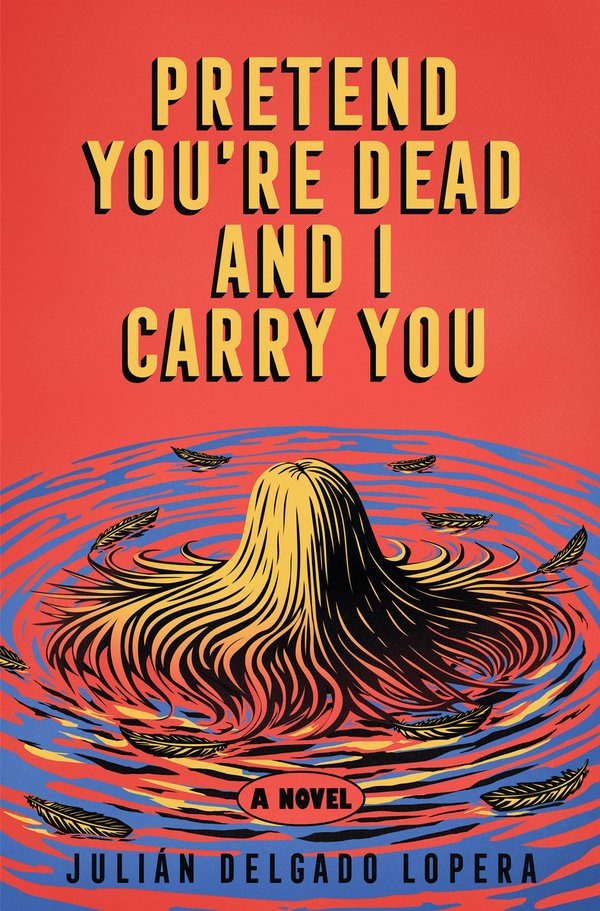
Pretend You’re Dead and I Carry You
After her mother Alma’s death, teenage Valentina tries to understand the drowning and bring her withdrawn father, Ignacio, back into family life.
About
Spoiler notice: This overview discusses the novel’s central setup and relationships without revealing its ending.
Julián Delgado Lopera’s novel moves between a father and daughter whose lives have been shaped by grief, secrecy and the demands placed on people who do not fit conventional ideas of gender. In contemporary Bogotá, teenager Valentina is left to manage much of her own life while her father, Ignacio, retreats into depression after the death of her mother, Alma. The story also returns to Ignacio’s earlier years, when he was a shy boy in the countryside and encountered a different way of living through Bogotá’s queer underground. These interwoven periods make family history an active presence: the past is not simply recalled but continues to affect how Valentina understands her home, her parents and the loss around which her childhood is organized.
Valentina wants her father to become present again, but her questions about the family’s past are not easily answered. Alma died by drowning, and Valentina wants to know more about what happened. In the apartment she shares with Ignacio, neglect and silence make the loss part of ordinary domestic life. Her father spends long afternoons smoking in blonde wigs while telenovelas play, and the contrast between his withdrawal and her need for care places the parent-child relationship under strain. Valentina is not only asking for a clearer account of her mother’s death; she is also trying to find a dependable adult in the household. The novel’s family story takes shape through that double need, as curiosity about the past becomes inseparable from the practical question of who will look after her now.
The backward chapters follow Ignacio from a rural upbringing marked by harsh rules about masculinity toward the queer spaces of Bogotá. His youth includes a relationship with Felipe, a young man whose openness exposes Ignacio to forms of attraction and self-expression he has not been able to imagine safely. Felipe opens a new world for Ignacio in his body and desire, but fear and social pressure keep him from fully inhabiting that possibility. Years later, Ignacio remembers a man he loved and betrayed. The present-day father is therefore connected to a younger self whose choices were made under constraint, though the novel does not turn that history into an excuse for the harm he causes those around him.
Mamadora Eléctrica links these parts of Ignacio’s life to Valentina’s present. A travesti figure from Bogotá’s queer underground, Mamadora met Ignacio at Club Aquario when he was young; after Alma’s death, she steps into a maternal role for Valentina. Her travesti identity carries a particular history within Colombian queer life, rather than standing as a label for every character who enters that community. Her presence gives the family a source of care that does not depend on biological parenthood. She also carries knowledge of a community and its histories that Ignacio has struggled to accept. Through her, the novel treats kinship as something people build through shared responsibility as well as something inherited.
The Magdalena River connects intimate bereavement with Colombia’s larger history of violence. Alma’s death in a river that feeds into the Magdalena is one strand of Valentina’s family story, while the river also appears in the novel’s wider imaginative and historical frame. The river also carries the memory of people disappeared amid Colombia’s violence, including gender-expansive people whose deaths can receive less public attention. This historical weight sits beside the novel’s fictional and mythic uses of water. In the book’s narrative, water gathers different kinds of grief and memory, letting a local family loss echo without reducing Colombia’s history to metaphor.
Language is part of how the book builds that community and its memory. The prose moves among English, Spanish and Spanglish, including forms shaped by queer language in Colombia. The movement between languages follows sound and feeling as much as formal rules, drawing on Colombian queer speech and histories often carried orally. This bilingual texture helps distinguish the novel’s voices and social worlds; it also refuses the idea that a reader must encounter one standardized language to enter a story set in Colombia. The language is a crafted part of the fiction, not a decorative marker of place.
The result is a nonlinear family novel and coming-of-age story built from three perspectives—Valentina’s, Ignacio’s and Mamadora Eléctrica’s—and movement between Bogotá and Ignacio’s past. Its elements of Travesti Lore bring mythic ideas into a story about recognizable pressures: grief, machismo, fear, desire and the need to be loved. The novel’s concern is not simply whether Ignacio can recover an earlier possibility, but what his silence and decisions mean for Valentina, who must make sense of a family history she did not choose. By moving between generations and forms of kinship, the book asks how care can survive where shame and social violence have narrowed the choices available to a family. The resolution remains part of the novel’s own unfolding story.
Book details
- Author
- Julián Delgado Lopera
- First published
- 2026
- Series
- No series listed
- Subgenre
- Literary fiction, Family novel, Coming-of-age
- Primary genre
- Literary Fiction
- Tags
- No tags for this book.
Review
Editor profile
Baby Bat
Goodreads and social links will be added soon.
- Goodreads — link coming soon
- Social media — link coming soon