
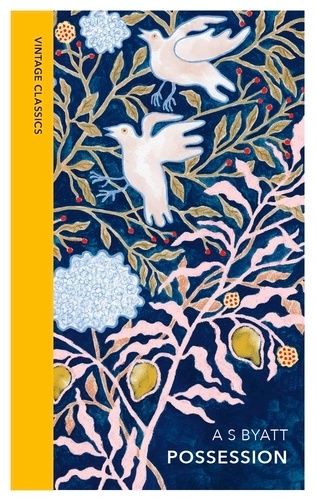
Possession
When scholar Roland Michell finds drafts of a private letter by Victorian poet Randolph Henry Ash, his research points to Christabel LaMotte, a poet studied by Maud Bailey.
About
Spoiler notice: This overview describes the discovery that starts the inquiry, the principal scholars and poets, and the developing investigation. It avoids the final discoveries and ending.
Possession begins with an act of archival discovery. Roland Michell, a junior scholar working on the Victorian poet Randolph Henry Ash, finds draft letters in a book associated with Ash. Their contents unsettle the familiar picture of the celebrated poet’s private life and point toward a correspondent who has been left out of the record. Roland’s curiosity becomes an investigation: the papers offer clues, but not a complete account, and every new document requires him to decide what it can actually prove. The novel’s mystery grows from this gap between a trace and the life it may represent.
Roland’s search leads him to Maud Bailey, a scholar whose work centres on Christabel LaMotte, a Victorian poet with a smaller public reputation than Ash. Maud is not simply a source of expertise recruited to solve Roland’s puzzle. She has her own intellectual commitments and reasons to be wary of how women’s writing is interpreted or absorbed into the stories of more famous men. Her knowledge of LaMotte’s work changes the direction of the inquiry, while Roland’s discoveries challenge assumptions attached to Ash. Their collaboration brings together two partial archives and two different habits of reading. As the pair work through the evidence, their professional interest also becomes a personal relationship, developed alongside rather than in place of the historical mystery.
The Victorian figures emerge through both the scholars’ research and the novel’s imaginative reconstruction. Ash is an established poet whose public identity seems legible, while LaMotte’s work and life invite a different kind of attention. The contrast asks how literary fame is made and whose papers, poems, and attachments are preserved. Byatt gives both poets an interior life through writing attributed to them, so the nineteenth-century strand is not only summarized by present-day observers. Their letters and poems let the imagined past answer back, though the scholars must still interpret what survives. This tension between document and interpretation gives the plot its forward motion and keeps its central relationship from being reduced to a single solved fact.
The form is one of the book’s central pleasures and complications. Alongside conventional narration, Possession includes letters, journal entries, poems, and other invented literary documents. These shifts ask the reader to move between a scene and an artifact, between what a character experiences and what another person later infers from the record. The poems are not decorative inserts: they carry motifs and clues, establish distinct voices, and show how a text can change meaning as it passes between readers. Byatt makes the work of literary scholarship part of the drama. Reading, cataloguing, comparing, and sometimes competing over interpretation are actions with consequences for the people doing them.
The hunt also gives Byatt room for academic comedy and suspense. Roland and Maud are not alone in caring about Ash and LaMotte; other scholars have reputations, theories, and ambitions invested in the poets. The possibility that a new discovery could alter the accepted account of a canonical writer makes private papers feel like public property. The novel observes the mixture of genuine intellectual attention and self-interest that can gather around an archive. Its characters may approach evidence with care, desire, defensiveness, or rivalry, and the same item can look different depending on who hopes to claim it. This campus strand lends energy to the inquiry while sharpening the novel’s questions about ownership: who may possess a text, a story, or another person’s past?
The title reaches beyond the literal custody of letters and manuscripts. The scholars’ search turns on the urge to know another life, while the Victorian relationship raises its own questions about attachment, autonomy, and the limits of what lovers can claim from one another. In the contemporary strand, Roland and Maud have to negotiate closeness as people rather than as interpreters of historical figures. Their developing bond echoes the inquiry without simply repeating it. Byatt allows parallels to emerge across the two periods, then complicates them through differences in circumstance and knowledge. No archive grants complete possession of another person; the documents can illuminate, mislead, or leave silence where a reader most wants certainty.
Possession is at once a literary detective story, a romance, a work of historical imagination, and a reflection on the acts of reading that join those forms. Its invented nineteenth-century writing sits beside the modern scholars’ research, making the reader participate in the process of assembling a past from fragments. That design gives the novel both intellectual play and emotional stakes: the mystery concerns a possible hidden chapter in literary history, but it also asks what people owe to the dead, to one another, and to the words they leave behind. The result is a layered account of how stories are recovered and reshaped, with the pleasures of discovery balanced by the recognition that interpretation never removes every uncertainty.
Book details
- Author
- A. S. Byatt
- First published
- 1990
- Series
- No series listed
- Subgenre
- Literary historical fiction, Epistolary novel, Historical fiction
- Primary genre
- Literary Fiction, Historical Fiction
- Tags
- No tags for this book.
Review
Editor profile
Baby Bat
Goodreads and social links will be added soon.
- Goodreads — link coming soon
- Social media — link coming soon