
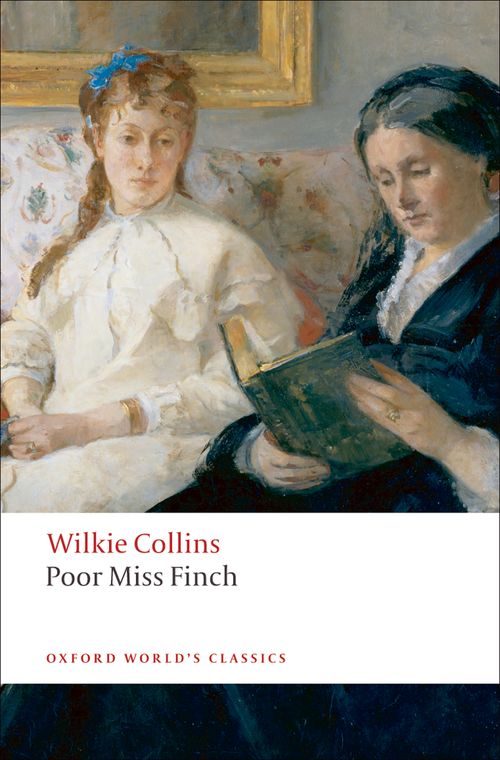
Poor Miss Finch
Madame Pratolungo becomes companion to Lucilla Finch, a blind young woman in love with Oscar Dubourg.
About
Spoiler notice: Full-plot spoilers, including Nugent’s impersonation, Lucilla’s marriage and the Arctic expedition’s fate.
Madame Pratolungo comes to the South Downs as a musical companion and becomes involved in a household whose troubles will occupy far more than her working hours. The young woman she has been engaged to assist, Lucilla Finch, is blind and lives within the crowded family of the Reverend Tertius Finch. Wilkie Collins’s Poor Miss Finch, published in book form in 1872, gives its account through the companion’s lively, opinionated recollections. Her affection for Lucilla grows alongside her involvement in the decisions being made around her. The title repeats the pity attached to Lucilla by other people, while the narrative repeatedly confronts those people with wishes and judgements that do not fit their assumptions about what her life must lack.
Lucilla’s attachment to Oscar Dubourg brings the narrator into another complicated family relationship. Oscar has an identical twin, Nugent, whose importance to him extends beyond their resemblance. A murder charge once threatened Oscar’s life, and Nugent’s efforts helped save him. That history supports Oscar’s confidence in his brother and helps explain why later betrayal becomes so difficult for him to comprehend. The brothers share an appearance and a voice, but the similarity does not make them interchangeable to someone who knows them closely. Lucilla’s ability to recognise Oscar by touch belongs to her experience of him. The romance therefore develops around forms of recognition that other characters may undervalue, even while they depend on visible distinctions to understand the two men.
Oscar’s treatment for recurring fits introduces a difference that cannot remain without consequences. In the story, he takes nitrate of silver knowing that it will change the colour of his skin. Madame Pratolungo has already encountered a man whose blue complexion resulted from the same medicine, so the disclosure immediately alarms her. Oscar asks her to help keep the treatment secret from Lucilla. Her aversion to dark complexions gives him a reason to fear her reaction, although she cannot see the change herself. The concealment puts the companion in a difficult position between loyalty to him and honesty towards her friend. A decision about his own health becomes a secret governing what Lucilla is permitted to know about the person she intends to marry.
The prospect of restoring Lucilla’s sight makes that withheld information much harder to contain. Two specialists, Mr Sebright and Herr Grosse, disagree about whether an operation should be attempted. The consultation gives Lucilla sharply conflicting expectations: one considers intervention futile and potentially distressing, while the other believes he can help her. These are the physicians’ positions within the novel, and the reader watches the family respond to them through hope, anxiety and personal interest. Grosse operates, and Lucilla temporarily acquires sight. That change does not make everyone around her truthful. She now has to interpret an unfamiliar visual world while relying on accounts of the brothers that have already been distorted, leaving the new faculty vulnerable to old concealments.
Nugent exploits the confusion and assumes Oscar’s identity in pursuit of Lucilla. The man whose earlier actions saved his brother now threatens to take his place in the relationship that matters most to him. Oscar leaves England, and Madame Pratolungo’s absence creates further room for the deception to continue. Lucilla’s journal helps carry this part of the story, recording experiences within the uncertainty surrounding her. The narrative’s movement between the companion’s account and the journal matters because neither woman possesses all the relevant knowledge at every moment. The reader has to follow what is known, what is concealed and what one person has been encouraged to believe about another. The threatened marriage rests on a false identity maintained through that uneven distribution of information.
By the reunion at Sydenham, Lucilla has lost her sight again. When Madame Pratolungo places her hand in Oscar’s, she recognises him and embraces him. The companion then tells her the truth about Nugent’s conduct and Oscar’s altered appearance. Nugent enters the room to find the deception defeated, and Oscar appeals to the brother he remembers with love rather than carrying out revenge. Nugent hands over the marriage licence obtained in Oscar’s name and leaves. The reconciliation of the lovers does not depend on Lucilla seeing Oscar as others see him. She explains her happiness in terms of touch, affection and the image of him she has formed for herself, challenging the narrator to accept her judgement of her own life.
The epilogue follows that encounter through twelve more years. Lucilla and Oscar marry two days after their reunion and return to Browndown. When Grosse proposes another operation, Lucilla refuses, maintaining that choice despite renewed persuasion. Nugent joins an Arctic expedition; after a long silence and unsuccessful searches, a whaling vessel discovers its frozen wreck. The captain identifies Nugent among the dead, with a lock of a woman’s hair in his hand. That loss remains within the family’s continuing happiness. Oscar works at his craft, Lucilla teaches their daughter the piano, and their eldest boy bears Nugent’s name. Madame Pratolungo finishes her manuscript when the child asks her to play, leaving a household sustained by love and memory rather than a final restoration of sight.
Book details
- Author
- Wilkie Collins
- First published
- 1872
- Series
- No series listed
- Subgenre
- Literary fiction, Modern classics
- Primary genre
- Literary Fiction
- Tags
- No tags for this book.
Review
Editor profile
Baby Bat
Goodreads and social links will be added soon.
- Goodreads — link coming soon
- Social media — link coming soon