
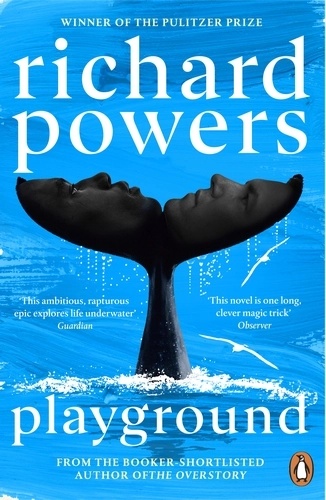
Playground
Four lives converge on Makatea, a French Polynesian island marked by earlier phosphate mining and a new proposal to build floating cities offshore.
About
Spoiler notice: This About discusses the four central characters, the history of their relationships, and the proposed floating-city project on Makatea. It stops before the island’s decision and the novel’s later resolution.
Playground brings four lives toward a single island in the Pacific. Richard Powers begins with different scales of experience: childhood friendship, a young diver’s first encounter with the sea, an artist’s unsettled sense of home, and a remote community deciding how it wants to live. The book’s routes into Makatea are separated by years and continents, so the meeting point does not erase the differences between its characters. Instead, the island gathers their private histories into a public question about who may shape a place and what kind of future can be built there. The title also points beyond one location. Play appears as a childhood bond, a digital world, and a way of understanding the open-ended interactions among people and the ocean.
One thread follows Todd Keane and Rafi Young, boys from sharply different backgrounds who meet at an elite Chicago high school. A three-thousand-year-old board game gives them a shared language for competition and strategy. Rafi is drawn toward literature, while Todd pursues technology and eventually makes an artificial-intelligence breakthrough. Their early connection develops into a friendship marked by intellectual exchange, but their adult lives do not remain aligned. The novel lets the reader see how formative relationships can persist even after they become difficult to recognise in the people they have grown into. Their history matters to the present plot because Todd and Rafi arrive at Makatea carrying a past that complicates every new encounter between them.
The other two central lives begin far from Chicago. At twelve, Evie Beaulieu sinks to the bottom of a Montreal swimming pool wearing one of the world’s first aqualungs. The scene links a childhood act of exploration to a life spent attending to the underwater world. Ina Aroita grows up on naval bases across the Pacific, with art serving as a form of home amid repeated movement. These beginnings give the book two distinct relationships to the ocean: Evie approaches it through diving and observation, while Ina’s Pacific childhood shapes the settings and memories through which she understands herself. Powers brings them together with Rafi and Todd on Makatea, where personal choices become entangled with the histories attached to the island and sea.
Makatea is not an untouched paradise. The island’s phosphate deposits once helped feed the wider world, leaving an extractive history beneath the proposal that now divides its residents. Entrepreneurs want to establish floating, autonomous cities offshore, presenting the open ocean as a new place for settlement and technological ambition. Before that plan can proceed, Makatea’s community must decide whether to allow it. This vote gives the novel a concrete civic centre: the question is not simply whether an engineering project can be built, but who has the authority to invite it and who will live with its consequences. The island’s history makes the promise of a new frontier harder to separate from older patterns of outside influence and resource use.
The novel’s technology thread runs alongside its attention to ecology. Todd’s work points toward systems that can imitate or extend human intelligence, while the floating-city scheme imagines a new kind of built environment on the sea. Both ambitions raise questions of scale and control. A program may turn human activity into patterns; a city at sea may treat a shared ecosystem as a platform for design. The ocean, however, is more than scenery for those ideas. It is a vast living environment that resists being reduced to open space. Richard Powers has said the novel began as a meditation on what had happened to the ocean during his lifetime, after memories of reefs he had known as a child returned to him. That starting point helps explain why the book’s technological possibilities remain bound to loss, memory and attention to nonhuman life.
Playground moves between the intimate and the planetary without making the characters stand in for a single argument. Rafi and Todd’s friendship carries the vulnerability of shared childhood and the strain of adult distance. Ina’s art and Evie’s diving place perception alongside invention. The people of Makatea face a decision that cannot be made from the perspective of an investor alone, because it concerns a home with a particular history and community. By bringing these strands together, the novel asks what people mean when they call something progress, and whether a new possibility can be judged apart from the relationships and environments it changes. Its broad setting gives those questions room to unfold across memory, technology, colonial history and the ocean that connects the characters.
Powers has described his own childhood interest in oceanography and his later return to memories of swimming in the South China Sea as a starting point for the book. That author context sits beside, rather than replaces, the novel’s fictional design: four biographies converge on an island where residents must weigh a proposed transformation of their home. The result moves between coming-of-age, friendship and speculative technology while remaining attentive to place. Its questions reach beyond whether machines can imitate aspects of human thought or whether people can build permanently at sea. They ask what forms of life are overlooked when human ambition treats the planet as an empty board, and how memory might change the choices made in the present.
Book details
- Author
- Richard Powers
- First published
- 2024
- Series
- No series listed
- Subgenre
- Literary fiction, Climate fiction
- Primary genre
- Literary Fiction, Sci-Fi
- Tags
- No tags for this book.
Review
Editor profile
Baby Bat
Goodreads and social links will be added soon.
- Goodreads — link coming soon
- Social media — link coming soon