
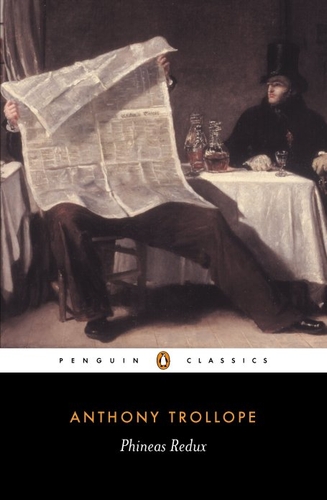
Phineas Redux
Now widowed, Phineas Finn returns to Westminster hoping to recover the career and companionship he left behind.
About
Spoiler notice: Full-plot spoilers, including Bonteen’s murder, Phineas’s acquittal, Emilius’s conviction and the marriage to Marie Goesler.
Phineas Redux brings Phineas Finn back to Westminster after the life he chose at the end of the earlier novel has changed. His wife has died, his father has died too, and a modest inheritance gives him the means to consider another election. Routine government work in Ireland has never replaced the excitement he remembers from London. Barrington Erle’s invitation to try again reaches someone already longing for the public attention and companionship of parliamentary life. Trollope begins the return with party calculations as well as personal ambition, placing Phineas among men whose interest in him depends on the kind of member he might become. The opportunity reopens a familiar world without making him the untouched newcomer who first entered it.
The old relationships have continued changing in his absence. Lady Laura is estranged from Robert Kennedy, whose jealousy keeps her association with Phineas dangerous even when she is no longer living with her husband. Madame Marie Goesler offers another kind of closeness, through friendship that increasingly matters beyond their shared social circle. These attachments exist alongside the practical contest for a parliamentary place at Tankerville. Political friends can help Phineas return, but their support does not remove the resentments generated by his earlier independence. Bonteen distrusts him and competes for advancement, making the struggle over appointments a personal rivalry too. What looks like a resumed career therefore brings him back into arguments about loyalty and reputation that have never remained confined to the chamber.
Bonteen’s murder transforms that rivalry into a threat to Phineas’s life. A public quarrel supplies a motive that other people can easily imagine, while his movements, clothing and possession of a defensive bludgeon become parts of a circumstantial case. Lord Fawn’s belief that he saw a man in a grey coat near the scene gives uncertain observation the force of identification. Phineas can explain why he carried the weapon and describe the route he took, but explanation is no longer entirely under his control. The same public position that made him someone worth knowing makes him a subject for urgent speculation. Arrest and confinement replace political manoeuvring with a situation in which a mistaken account could carry consequences no apology would repair.
His defence depends on people who refuse to let the most convenient explanation become the accepted truth. Madame Goesler takes an active part in pursuing evidence, while lawyers have to examine the timing, identification and assumptions linking him to the crime. The case against him is challenged on its own terms, rather than resting solely on the testimony of influential friends that he is a good man. Evidence about another coat, a duplicate house-door key and a second bludgeon also points towards a different course of events. These details matter because the apparent simplicity of the accusation concealed questions about preparation and opportunity. The inquiry must distinguish between a quarrel that witnesses remember and a murder someone has deliberately arranged to commit.
The jury acquits Phineas, and its foreman adds that he should not have been tried on the evidence presented. The judge welcomes his return to freedom and hopes he can resume his place among the country’s legislators. Yet the narrative does not treat that formal restoration as an immediate recovery of the person who entered the ordeal. He leaves the dock exhausted, without a ready plan for the months ahead. The Duchess of Omnium’s idea of welcoming him through fashionable dinners is distant from what he can yet imagine doing. Being declared free of the accusation does not make the experience disappear. The novel continues past the verdict because his capacity to accept public life, affection and ordinary expectations has itself been affected by it.
The fate of Emilius makes another distinction between narrative knowledge and legal proof. Trollope identifies him as Bonteen’s murderer and assembles the motive, disguise, route and weapon into an account that appears clear to those investigating it. The evidence still cannot support a murder prosecution that the authorities consider justified. Emilius is instead convicted of bigamy and sentenced to penal servitude, leaving the killing legally unpunished. For Phineas, meanwhile, another offer of government office no longer has the uncomplicated appeal it once would have had. He declines it and turns towards marriage to Marie Goesler. Lady Laura has to face the loss of that possible future with him, while his choice gives the devoted friendship that survived his trial a different form.
The conclusion shows Phineas and Marie actually marrying, then travelling abroad before returning to London. Their house reopens into the society from which the accusation had threatened to exclude him, but the narrator resists accepting good fortune as a complete account of what his life should become. The question of useful work remains, and a future return to office is something others expect rather than an event the book has already shown. Around the couple, the ending preserves less comfortable outcomes: Lady Laura lives in seclusion, Lord Fawn disappears after the strain of the affair, and the newspaper campaign against Phineas leaves damage of its own. His freedom and marriage provide a new beginning without distributing the same relief to everyone whose history has been entangled with his.
Book details
- Author
- Anthony Trollope
- First published
- 1874
- Series
- The Palliser Novels, book 4
- Subgenre
- Victorian fiction, Literary historical fiction
- Primary genre
- Historical Fiction, Literary Fiction
- Tags
- No tags for this book.
- Reading order
- Also on this shelf: Phineas Finn (book 2)
Review
Editor profile
Baby Bat
Goodreads and social links will be added soon.
- Goodreads — link coming soon
- Social media — link coming soon