
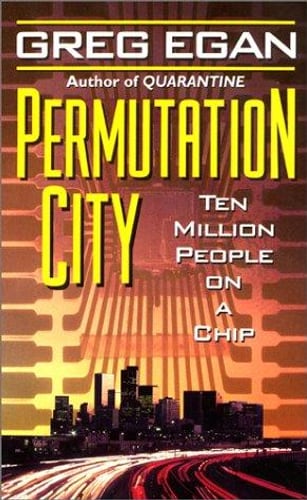
Permutation City
Paul Durham has worked out how to copy a human mind into a computer and keep it running, and he needs paying customers.
About
Permutation City is a science fiction novel by the Australian writer Greg Egan, published in 1994.
Durham's copies, who call themselves Copies, are conscious software running inside a hired simulation, and their world is subject to the people paying for the processing. Maria signs up for the money and then has to live inside the consequences: her copy can be sped up, slowed down, duplicated without her consent and threatened with being switched off. Durham's own project is an experiment in a theory that treats every possible world as equally real, which would mean that the simulation keeps running whether anybody is watching it or not. Egan writes the philosophy as plot, and his arguments about computation and identity are settled by what happens to the characters rather than by assertion.
Parts of the novel were adapted from an earlier story, and it won the John W. Campbell Memorial Award in 1995. Its central proposition is argued rather than demonstrated, and the characters spend a good deal of the book in conversation about what a simulation would have to be like before it counted as a person.
Book details
- Author
- Greg Egan
- First published
- 1994
- Series
- No series listed
- Subgenre
- Hard science fiction, Robot and AI
- Primary genre
- Sci-Fi
- Tags
- No tags for this book.
Rating
Review
Editor profile
Baby Bat
Goodreads and social links will be added soon.
- Goodreads — link coming soon
- Social media — link coming soon