
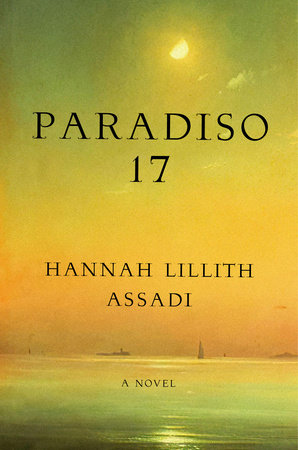
Paradiso 17
Near the end of his life in Arizona, Sufien looks back to his childhood in Safad and the forced departure that begins a lifetime of movement.
About
Spoiler notice: Spoilers for the opening life frame and broad chronology: Sufien’s childhood in Safad, his family’s forced departure around the 1948 Nakba, and his later movement through several countries. The ending is not described.
Paradiso 17 opens near the end of Sufien’s life, in an Arizona desert, with the sense that his spirit is loosening from the present. From there, the narrative turns back toward Palestine and the beginning of his story. That movement establishes a life recalled from its far edge: childhood, departure, and the long succession of places in which Sufien tries to discover what home can mean. The sequence is not a simple march through dates. The book works through a deathbed frame in which time moves between memory, anticipation, and the present of recollection. The reader enters Sufien’s past knowing that the old man’s final moments are already near, while the remembered scenes keep opening into the dreams and possibilities that shape how he understands them.
Sufien grows up in Safad, in a family home marked by a beautiful blue door and by ordinary attachments to parents, siblings, neighbors, and familiar ground. His mother Amal tells and retells the story of his birth, linking family memory with bells, religious imagery, and the hills around the town. As a boy, Sufien plays with friends, sees the Sea of Galilee from a rooftop, and entertains a child’s belief that he might fly. His family’s world contains Jewish neighbors and shared local histories alongside the growing threat of war. His childhood stands on the precipice of the 1948 Nakba, and his family’s forced departure from Safad turns a known place into a memory they must carry with them.
After the family leaves Palestine, Sufien and his mother and siblings pass through a refugee camp in Syria before settling in Kuwait. For the boy, movement first registers through what he can see, smell, and lose: a city he begins to love, the adults who decide where the family will go, and a home that remains vivid after it is no longer reachable. The novel lets a child’s incomplete grasp of events sit beside the historical scale surrounding them. The historical catastrophe gives the journey its scale, while the story remains close to Sufien and his relatives as particular people trying to live through it. In Kuwait, the family builds another life in a dusty, oil-rich desert, but the new setting does not cancel the earlier loss or settle Sufien’s questions about belonging.
As a teenager in Kuwait, Sufien meets his first love and comes to feel that he must leave his family. The title’s number follows him from this turning point into later life, joining the age of departure to a recurring pattern of addresses and losses. It also points to Canto 17 of Dante’s Paradiso, where an ancestor foretells Dante’s exile from Florence. The decision pushes him away from the family’s immediate orbit and toward an uncertain idea of the West. His next stage unfolds in a small Italian university town, where youth is colored by study, wine, and the promise of a different future. Italy becomes one passage in a much longer search, rather than a final answer. Each new setting gives the story forward motion while the sense of having lost an original home continues to shadow it.
In Italy, and later in New York, Sufien encounters versions of himself that do not fit neatly together. The student’s attraction to the West gives way to the practical and emotional work of adult life. In New York he discovers a vocation and falls in love with a Jewish woman whose background is markedly different from his own. Their relationship and the family they create bring intimacy across histories that cannot simply be made identical. Sufien becomes a father, finding pride in a life also punctuated by friendships, distance, and regret. Assadi drew on memories of her late father when making the novel, but Sufien remains a fictional character with his own imagined life.
The novel also makes room for the parts of experience that ordinary chronology cannot contain. Sufien’s memories meet Sufi stories, prophetic dreams, and visions of an afterlife; cats, an open road, and the work of selling leather appear alongside grief and political history. These details give the book a supernatural strand without turning its whole world into fantasy. Dream and supernatural elements create space for Sufien to reckon with a life that resists a simple chronological account. The distinction matters: the displacement and later migration in Sufien’s story belong to the novel’s realist historical frame, while its dreams and visions express the imaginative and spiritual dimensions through which he processes loss. The result follows both what happens to him and the meanings he reaches for when events exceed his control.
The final landscape returns to the Arizona desert where Sufien faces the end of his life. The story’s route across Safad, Syria, Kuwait, Italy, New York, and Arizona makes home less like a single destination than a question that changes with each departure and attachment. Sufien’s movements do not erase the specificity of Palestine or convert his private story into a universal account of exile. Instead, the novel keeps one man’s life in view while showing how inherited memory, family, and longing persist across borders and generations. Its recurring images and shifting time draw the opening and closing edges of that life toward one another. Paradiso 17 is thus at once a family story, a migration narrative, and a meditation on the limits of what a person can recover through memory, love, or dream.
Book details
- Author
- Hannah Lillith Assadi
- First published
- 2026
- Series
- No series listed
- Subgenre
- Literary fiction, Historical fiction, Immigrant fiction
- Primary genre
- Literary Fiction, Historical Fiction
- Tags
- No tags for this book.
Review
Editor profile
Baby Bat
Goodreads and social links will be added soon.
- Goodreads — link coming soon
- Social media — link coming soon