
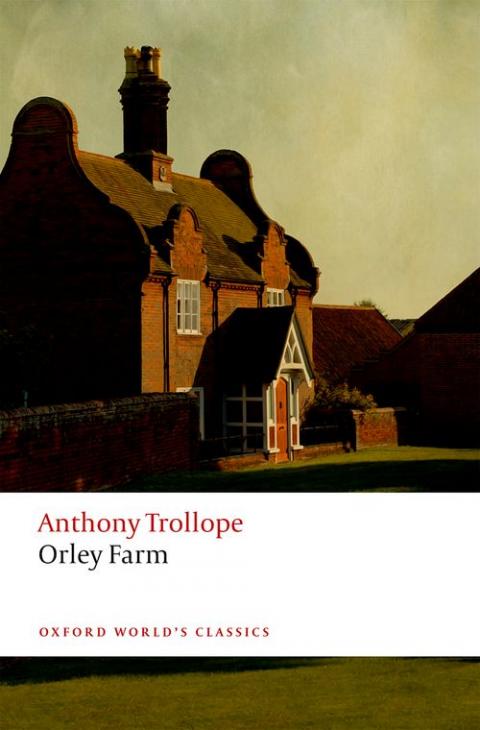
Orley Farm
A disputed codicil has secured Orley Farm for Lady Mason’s son, but his elder half-brother still believes the inheritance was taken from him.
About
Spoiler notice: Full-plot spoilers, including Lady Mason’s confession, the verdict and the surrender of Orley Farm.
Orley Farm begins with an inheritance whose apparent settlement has left a lasting grievance. Sir Joseph Mason’s eldest son, Joseph, expects the farm to pass to him along with the family’s larger estate. A codicil instead leaves it to Lucius, the infant son of Sir Joseph’s much younger second wife. The document also provides money for the daughter of the attorney involved in making it, adding another interest to the question of its authenticity. Joseph contests the codicil, but the first proceedings uphold the younger child’s claim. Years later, the widow’s possession still rests on a history that her stepson refuses to accept. Trollope builds the novel around the consequences of reopening that history for a woman who has made her son’s prospects the purpose of her life.
Lady Mason has acquired the standing of a respectable widow while Lucius grows up believing himself entitled to the property he occupies. The difference between that public position and the secret behind it gives the renewed case its pressure. Joseph’s determination to recover the farm is supported by the attorney Samuel Dockwrath, whose ingenuity is entangled with his own expectations of gain. Neither the personal hostility of these pursuers nor their unattractive motives makes the underlying accusation false. The novel allows the reader to dislike the people attacking Lady Mason without making that dislike a proof of her innocence. As the case develops, her security depends on friends and lawyers whose understanding of what they are defending is not always the same as hers.
The Orme household gives Lady Mason a refuge that becomes harder to accept as its generosity increases. Sir Peregrine Orme believes in her and wants to marry her, while his daughter-in-law, Mrs Orme, offers a friendship that matters beyond the protection of an influential family. Sir Peregrine’s readiness to bind his own reputation to hers finally makes concealment unbearable. Lady Mason tells him that she is guilty, and the narrator confirms that she committed the deed at the centre of the dispute. This revelation does not arrive at the end as a courtroom surprise. It changes the meaning of the support surrounding her while the legal proceedings are still to come, leaving those who know the truth to decide what compassion can require.
Mrs Orme’s response preserves that difficult distinction. She recognises the gravity of Lady Mason’s act while refusing to abandon the person who committed it. Sir Peregrine’s love survives the confession too, though marriage can no longer be treated as the straightforward vindication of an innocent woman. Lady Mason’s motive was to secure a future for Lucius, but the benefit given to him has required years of false appearances before the very son she most wants to respect her. Discovering the truth therefore threatens more than the ownership of land. It threatens the relationship for which the offence was committed, and the place she has occupied among people whose affection depended on knowing a different version of her history.
The later criminal prosecution concerns perjury: Lady Mason’s sworn account of the execution of the disputed document. That charge matters because proving she swore falsely is not identical to proving who physically forged the codicil. The lawyers have to contend with evidence, witnesses and the passage of time, while the reader already knows what her private admission has established. The jury ultimately returns a verdict of not guilty. The brief formal announcement ends the trial but does not turn her confession into a mistake or release her from its consequences. Trollope keeps the legal result beside the moral knowledge rather than allowing either to replace the other. The people relieved by her escape from punishment still have to live with what they now understand.
Lucius’s response makes that continuing cost painfully personal. He promises to stand by his mother, but his restraint withholds the easy forgiveness she hopes for. After the acquittal he resolves to surrender Orley Farm to his half-brother, despite the legal position that would allow him to retain it. The property is given up through his decision, not taken away by the verdict. Lady Mason and Lucius leave for Germany, and Joseph eventually accepts possession when further attempts to secure her punishment prove fruitless. His subsequent dispute with Dockwrath turns the alliance of her opponents into a lawsuit between themselves. Joseph wins that contest, while the attorney’s schemes end in ruin. Recovering the inheritance has not made their shared campaign a disinterested pursuit of justice.
The conclusion distributes futures unevenly among the people touched by the case. Felix Graham marries Madeline Staveley, while the younger Peregrine Orme travels abroad after losing her to him. Sir Peregrine remains attached to Lady Mason but cannot restore the life they briefly imagined together. Mrs Orme keeps writing to her friend, preserving an affection that survives distance and disgrace. Lucius later leaves Germany for Australia, and his mother remains behind for the present. The narrator hopes that she may one day find some happiness, without reporting that this recovery has occurred. Her acquittal and the surrender of the farm close the public dispute; the life left afterwards depends on relationships that cannot be repaired by a judgment, a transfer of property or a tidy final promise.
Book details
- Author
- Anthony Trollope
- First published
- 1862
- Series
- No series listed
- Subgenre
- Literary fiction, Victorian fiction, Legal thriller
- Primary genre
- Literary Fiction
- Tags
- No tags for this book.
Review
Editor profile
Baby Bat
Goodreads and social links will be added soon.
- Goodreads — link coming soon
- Social media — link coming soon