
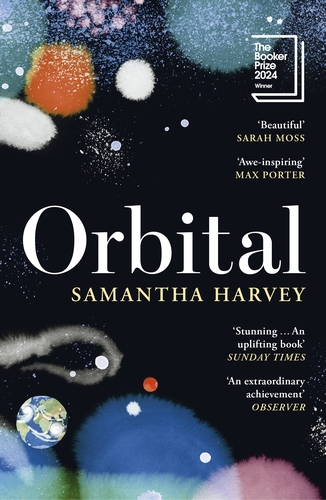
Orbital
Over one day aboard the International Space Station, six astronauts circle Earth sixteen times while carrying out their work and watching the planet pass beneath them.
About
Spoiler notice: Discusses the setup, the crew’s observations, a family death and a developing typhoon; it does not disclose the ending.
Orbital follows six astronauts and cosmonauts aboard the International Space Station through one day of repeated circuits around Earth. The book gives this compact span a clear measure: the station circles the planet sixteen times, carrying its crew across night, morning and the shifting bands of time below. They have scientific work to do, including collecting meteorological data and conducting experiments, and they test the limits of the human body in weightlessness. Yet much of the book’s attention rests on observation. Earth is not a distant backdrop to an adventure across space; it is the constant presence the crew return to in every orbit, a familiar world made strange by distance and speed. The fixed count of sixteen circuits gives the day a quiet architecture: movement repeats, but each passage offers a different relation between the station, the crew and the surface below.
Harvey begins among ordinary details of life in the station. The crew sleep in suspended bags, eat in a galley where utensils are held in place, and move through a workplace kept running by fans, filters and equipment. These practical surroundings establish the physical conditions of the story without turning it into a technical account of spaceflight. The astronauts are enclosed in a small human environment while the planet moves past outside. A birthday celebration is marked with balloons and bunting even though it is nobody’s birthday. Such modest gestures make the station feel inhabited: the crew have routines, shared spaces and ways of marking time, even as their days unfold far from ordinary terrestrial life. These are not decorative details placed outside the main idea; they show how people preserve familiar habits inside an environment where ordinary orientation has changed.
The book’s narration often speaks of the crew as “they,” keeping the six together as a group while allowing attention to pass among individual perceptions. The opening presents them by nationality and role, four astronauts and two cosmonauts, then settles into the collective motion of the station. Their bodies register the effects of living without ordinary gravity, while the prose follows sleep, food, work and the changing view. This perspective suits a novel in which no single person’s journey takes over the whole. The crew are distinct human beings, but the structure repeatedly places them within a shared orbit. Their separation from Earth gives them a common vantage point, while the small scale of their habitat makes the shared conditions of life hard to ignore. A plural voice also resists making the station a stage for a single exceptional hero. Attention belongs to a crew sharing one unusual vantage point and a limited living space.
From that vantage point, weather becomes part of the day’s unfolding action. The sample follows a storm gathering over warm ocean water into a typhoon as the station travels across other regions and time zones. The astronauts cannot control or approach the weather; they watch a vast process develop below while their own craft continues along its fixed path. Continents, oceans, glaciers, deserts and mountain ranges pass through view, joining distant places in a single moving panorama. The spectacle is not presented as an escape from human concerns. The crew remain connected to people and places on the surface, and the publisher’s synopsis describes their awe at the storm alongside fear for people they love in its path. Wonder and vulnerability occupy the same view. The contrast is between the scale of the weather and the limits of the observers, whose view can take in a storm without giving them the power to intervene.
That connection becomes more intimate when news reaches the crew that one astronaut’s mother has died. The information turns the distance between station and home into an emotional fact: a person can be close enough to watch the planet but unable to return at will to someone who has died. The news prompts thoughts of going home, and it sits beside the crew’s continuing work and observation. The book uses this loss to bring private grief into its planetary scale. Earth is immense from orbit, but it is also where family, memory and ordinary life remain. The astronauts’ perspective can make borders and distances look altered, yet their attachments are personal and specific. The view does not erase separation; it sharpens awareness of what separation means. In this way, distance is both physical and emotional: the crew can see the world from above, yet important changes in their lives still arrive as messages from far away.
Orbital builds its movement through recurrence rather than a chain of escalating missions. The station completes its circuits, the light changes, and the crew’s attention shifts between scientific tasks, bodily routines, weather and thoughts of home. The single day and its sixteen orbits allow repeated views of Earth to accumulate differences rather than become a static panorama. The narrative’s scale keeps expanding and contracting: from the mechanics of a meal or a sleeping space to the atmosphere and the planet beneath it, then back to the people watching. Its central interest is how life looks when seen from far away and how that distance can intensify, rather than dissolve, the crew’s sense of belonging to Earth. Repetition gives these observations room to resonate without requiring a conventional sequence of victories or crises. The movement is circular, while the crew's attention keeps changing.
Book details
- Author
- Samantha Harvey
- First published
- 2023
- Series
- No series listed
- Subgenre
- Literary fiction
- Primary genre
- Literary Fiction
- Tags
- No tags for this book.
Review
Editor profile
Baby Bat
Goodreads and social links will be added soon.
- Goodreads — link coming soon
- Social media — link coming soon