
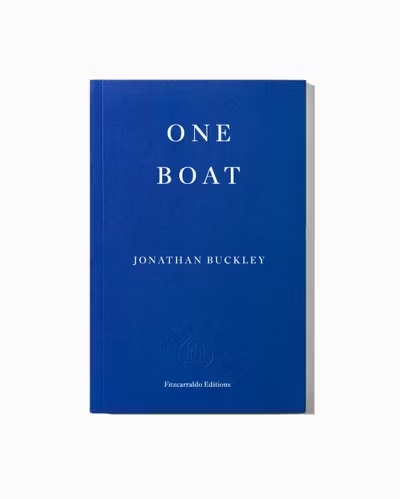
One Boat
After her father’s death, Teresa returns to a small Greek coastal town she visited nine years earlier while grieving her mother.
About
Spoiler notice: Spoilers for the premise and the novel’s central relationships, the amateur murder investigation, and its nonlinear narrative frame; the ending and resolution are not summarized.
One Boat begins with a return to a place that already carries two kinds of grief. Teresa comes back to a small town on the Greek coast after her father’s death, having visited the same town nine years earlier when her mother died. As she observes the inhabitants and reckons with herself, an episode from that first trip resurfaces: her meeting with John, who is struggling with the violent death of his nephew. The setting therefore works through repetition. The coast is not simply a holiday backdrop or a fresh start; it is a place Teresa has known under different emotional conditions, and the earlier visit keeps exerting pressure on the present one. The book’s basic movement joins travel, memory and the effort to make sense of loss.
The return brings Teresa into contact with people she remembers, including Petros, an eccentric mechanic whose life story may have some connection to John’s; Niko, a diving instructor; and Xanthe, a waitress at a café on the town square. These introductions create a small social world rather than a cast assembled around a conventional investigation. The characters talk about longing, regret, time and their sense of who they are. Petros’s story may or may not be connected to John’s, leaving Teresa to weigh a possible link rather than accept one settled explanation. Connections are proposed and reconsidered; not every strand is immediately settled into a single explanation. Their conversations let personal histories sit beside the visible routines of a coastal town, where people continue to work and meet while Teresa tries to understand what her return means.
The novel also places an amateur murder investigation among Teresa’s concerns. The investigation sits beside her relationship to her mother and an account of a love affair, with the three strands interleaved. That combination gives the book several kinds of inquiry at once: the attempt to understand a death, the reconstruction of family memory and the interpretation of intimate relationships. The investigation does more than supply a trail of clues toward a tidy answer. It becomes one part of Teresa’s wider attempt to connect events and people, while the book’s questions about grief, obsession, personhood and human connection keep the emotional and intellectual stakes close together. The mystery aspect is therefore joined to the novel’s broader interest in how people interpret one another.
Buckley’s structure is central to that effect. At the opening, Teresa thinks through the choice of a Greek town, describing the requirements she had set for a quiet place in which to put her thoughts in order. The passage moves through practical details—roads, beaches, a square, a hotel and the prospect of solitude—before an encounter with local life interrupts the plan. It also makes Teresa’s writing visible: she carries a notebook, records observations and reflects on what she has and has not written down. The novel moves between the second trip and memories of the first. Together, these features frame the narrative as a set of remembered, noted and reconsidered materials, with the act of composing an account becoming part of the subject.
That attention to narration links the town’s conversations to questions of identity and responsibility. Questions of free will, guilt and responsibility run through the novel, along with questions of personhood and human connection. These are large ideas, but the available plot material attaches them to ordinary human exchanges: Teresa listening to people speak about regrets, John trying to come to terms with his nephew’s violent death, and familiar acquaintances appearing again after years have passed. Memory does not deliver a neutral record in this setup. What is recalled, what is omitted and how one event is joined to another all shape the account Teresa can give. The book’s philosophical concerns thus remain connected to the particulars of relationships and to the difficulty of knowing another person fully.
The coastal setting supplies a steady present against which those shifting recollections can be placed. Teresa watches residents going about their business, and the town square, cafés and waterfront form recurring social spaces. The care Teresa takes in choosing a place shows how a setting can be both observed and constructed: Teresa arrives with an idea of what she needs, then the actual geography and encounters modify that idea. The Greek location also distinguishes this return from an abstract exercise in memory. It is a particular town she has selected twice in periods of bereavement, and its inhabitants have their own routines and histories independent of her. Place, recollection and self-examination remain in conversation, making the town much more than a backdrop to events.
One Boat brings these journeys through loss and memory into an artfully constructed story; it was longlisted for the 2025 Booker Prize. The grounded outline is compact: after losing her father, Teresa returns to the Greek town where she grieved her mother; she meets people from the earlier visit; and strands involving John’s bereavement, an amateur investigation and a love affair are woven through her recollections and notes. The book’s questions concern how a person understands a past, how responsibility is assigned, and how identities take shape through encounters and stories. Its nonlinear movement asks how a life looks when told through fragments rather than arranged as a single continuous account. The investigation and the relationships around it give Teresa reason to keep looking, while the distance between what she remembers and what she can know remains part of the story.
Book details
- Author
- Jonathan Buckley
- First published
- 2025
- Series
- No series listed
- Subgenre
- Literary fiction
- Primary genre
- Literary Fiction
- Tags
- No tags for this book.
Review
Editor profile
Baby Bat
Goodreads and social links will be added soon.
- Goodreads — link coming soon
- Social media — link coming soon