
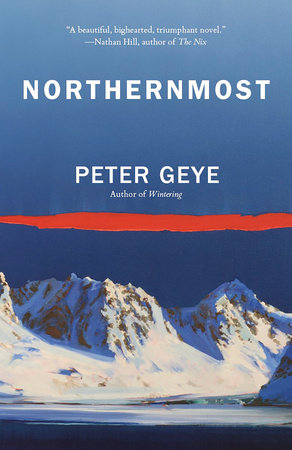
Northernmost
In 1897 Hammerfest, Norwegian fisherman Odd Einar Eide returns from a near-death Arctic ordeal to find his funeral underway, while his wife Inger remains troubled by the loss of their daughter Thea, who left for America.
About
Spoiler notice: This overview covers the opening situations of Odd Einar, Inger, Thea and Greta and the novel’s alternating 1897 and 2017 strands. It withholds later revelations, major outcomes and the ending.
Northernmost begins with a homecoming that feels like a rupture. In 1897, Norwegian fisherman Odd Einar Eide returns from an Arctic near-death experience to find his own funeral underway. His wife, Inger, is alive to his return but cannot simply resume their shared life: the days of believing him lost have changed her, and their daughter Thea has already left for America. This opening makes survival only the first problem. Odd Einar has come back to a household that has continued without him, and his presence does not erase what absence set in motion. Peter Geye builds the historical strand around the unsettled work of living after a loss that seemed final, with the stark northern setting making distance and exposure part of the family’s circumstances.
The novel also follows Greta Nansen, a descendant of Thea, more than a century later. Greta has begun to acknowledge that her marriage is over and travels from Minnesota toward Oslo, where her husband is working. On impulse she changes course for Hammerfest, the Norwegian town her ancestors came from. Her journey gives the story a second kind of return: she is moving toward a place connected to her family before she knows what that connection may mean to her. The two timelines do not simply present parallel couples. One strand begins with a man returning to a marriage altered by his disappearance; the other with a woman travelling as her own marriage appears to be ending. Their different starting points create a conversation about intimacy, estrangement and the stories a family leaves unfinished.
The structure alternates between 1897 and 2017, a design the publisher’s reader guide draws attention to directly. That movement lets the reader hold two periods in mind at once and notice how a life can echo across generations without repeating itself. The book’s family history crosses the Atlantic: Thea’s departure for America separates her from her parents, while Greta’s later passage from Minnesota back toward the family’s Norwegian home gives that separation a new present-day shape. The connection is not an excuse to flatten the characters into symbols. Odd Einar, Inger and Greta face distinct pressures, shaped by their own moment and relationships. Instead, the changing chronology makes inheritance feel active: a choice made by one generation can leave questions that another generation must decide whether to approach.
Northernmost sets these relationships against places defined by distance and weather. Hammerfest, at the far north of Norway, is both a lived town and a point of origin in the family’s memory. The Arctic experience that precedes Odd Einar’s return brings danger into the historical strand, while Greta’s route from the American Midwest to Norway gives geography a contemporary role. In a family story spanning continents and more than a century, travel is never only movement between locations. It changes what characters can know about one another and what they imagine home to be. Geye’s novel therefore makes setting part of its emotional architecture: the cold, the sea and the long distances between Norway and America help frame vulnerability, endurance and the difficulty of finding a way back to people or places.
The family’s central questions concern what remains possible after separation. Inger’s response to Odd Einar is shaped by grief and by the practical reality that life had to continue while he was presumed dead. Thea’s absence matters to him even though she is already far away, and Greta’s present-day crisis gives her reasons of her own to reconsider where she belongs. The reader’s guide raises questions about the characters’ marriages, their differing views of loyalty, and how Greta comes to engage with an ancestor’s story. Those are useful indications of the novel’s concerns, rather than resolutions of its plot. Geye keeps the intimate scale of marriage and parenthood beside the longer scale of migration and family history, allowing both to influence how survival is understood.
That combination gives the book several related modes. The publisher describes it as a story of love and survival; its pages are also framed by historical research, Arctic adventure and a family saga. The strand in 1897 brings the atmosphere and material dangers of an earlier life in northern Norway, while Greta’s strand brings the inherited past into a modern journey. The result is not a straightforward historical chronicle or a simple romance across generations. It moves between the physical demands of surviving and the less visible work of enduring disappointment, grief and distance. The two periods lend one another scale: a personal crisis can be seen against a lineage, while a broad family history is encountered through individual lives rather than dates alone.
Thea is the link between those two journeys. She left Hammerfest for America before her father’s ordeal, and her parents have heard nothing from her. Greta grows up on the other side of that migration, with the freedom to cross the Atlantic again but no simple way to recover what her ancestors felt or chose. The distance between them gives the book its pull: even a return to a family’s place of origin cannot make the intervening century disappear. Odd Einar and Greta each arrive somewhere expecting a reckoning, then have to meet people and memories that have gone on without them. Northernmost follows what it takes to make a life with that incomplete knowledge, and how a family story can matter long after its first tellers are gone.
Book details
- Author
- Peter Geye
- First published
- 2020
- Series
- No series listed
- Subgenre
- Literary historical fiction, Family saga, Wilderness adventure
- Primary genre
- Historical Fiction, Literary Fiction
- Tags
- No tags for this book.
Review
Editor profile
Baby Bat
Goodreads and social links will be added soon.
- Goodreads — link coming soon
- Social media — link coming soon