
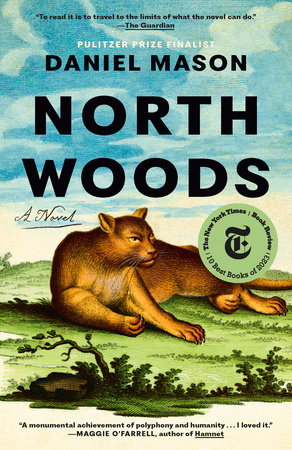
North Woods
When two young lovers leave a Puritan colony, their cabin becomes the home of many generations of human and nonhuman inhabitants.
About
Spoiler notice: This overview includes the novel’s opening premise and names several later inhabitants of the house. It does not reveal the resolution of their stories or the ending.
North Woods begins when two young lovers flee a Puritan colony and make a cabin in the New England woods. The small shelter becomes the fixed point of a much larger story: centuries pass, the cabin changes, and a succession of people and other living beings make the place their home. The novel’s cast includes an English soldier who turns from battle toward apple growing, twin sisters facing war and famine, a crime reporter who investigates an old mass grave, a painter in love, a con man, a panther and a beetle. Their stories do not form a conventional family line. Instead, the house and the land hold together episodes that might otherwise seem separate, giving the book a way to follow change through a single patch of woods.
The structure moves across eras and shifts its focus from one inhabitant to another. Each new life changes what the reader knows about the place, while traces of earlier lives continue to shape what comes next. The novel follows one plot of woods as its human uses and natural conditions change over time. That focus makes the land more than scenery around human events: it has cycles and a history of its own. The house can be occupied, altered, abandoned or investigated, while the surrounding environment continues to shift according to seasons and the actions of people, animals and plants.
The inhabitants confront sharply different circumstances, and the novel’s changing forms reflect that variety. A soldier’s retreat into cultivating apples, twins negotiating scarcity and rivalry, and a reporter’s encounter with an ancient burial site belong to distinct kinds of story. The book also makes room for a painter, an unscrupulous visitor and nonhuman perspectives. Rather than asking one protagonist to carry the whole narrative, it lets successive lives create a broader portrait of the place. Their concerns range from ambition and desire to survival and discovery. These otherwise distinct lives share the house as a common frame. A shift in period becomes more than a change of scenery: each new inhabitant also brings a different relation to the place.
The natural world has a narrative role of its own. Animals and plants share the house’s history with the people who occupy it, bringing attention to lives human characters may overlook. A stalking panther and a beetle are among these inhabitants, and the beetle’s perspective makes the difference in scale especially clear: the woods contain lives that human attention can miss. These shifts widen the novel’s idea of whose existence matters in a place. A tree, an animal or a building can persist through several human eras, while a person’s knowledge of that continuity remains partial. The result is a story in which ecology, habitation and memory overlap, and ordinary details of the landscape can carry evidence of much older changes.
Time itself becomes one of the book’s subjects. People discover or inherit signs of what came before, yet no generation possesses the complete history of the ground beneath it. Traces in an old house can make fragments of that history visible, but no single occupant has the whole story. One period may leave physical evidence that a later inhabitant interprets, ignores or only partly understands. The book’s many forms and perspectives suggest how stories can preserve fragments without making the past fully recoverable. What survives is a layered record rather than a complete account, with each new life adding another partial view of the place and its history.
Across the centuries, the house and woods connect private lives to larger patterns of change. Human plans meet seasonal cycles, inherited landscapes and events beyond any one person’s control. History, nature and language cycle around the house, linking inhabitants to their environment and to one another. Those connections are carried by the movement from inhabitant to inhabitant: a place that once sheltered lovers later contains very different hopes, fears and ambitions. The scale is expansive, but each section begins with particular lives and the things they do in or around the house. North Woods is both a series of human and nonhuman stories and a sustained attention to what a place remembers after its occupants have gone.
The form reinforces this changing view of the setting. The centuries-long story moves among many points of view, writing styles and genres. A stable setting can support markedly different voices and modes of telling. The house offers a point of return, while each new perspective alters the reader’s sense of what belongs in its history: human ambition, natural processes, memory, folklore or the evidence left in a building. The book’s variety is part of its subject. Its separate stories ask readers to keep adjusting the scale of attention, moving from an individual life to the land around it and then to the accumulated past that neither can fully contain.
Book details
- Author
- Daniel Mason
- First published
- 2023
- Series
- No series listed
- Subgenre
- Historical fiction, Literary fiction, Magical realism
- Primary genre
- Literary Fiction, Historical Fiction
- Tags
- No tags for this book.
Review
Editor profile
Baby Bat
Goodreads and social links will be added soon.
- Goodreads — link coming soon
- Social media — link coming soon