
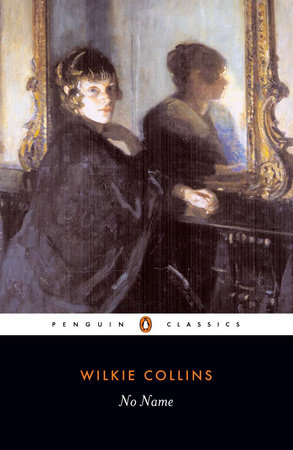
No Name
After their parents die, Norah and Magdalen Vanstone discover a family secret that deprives them of the inheritance their father intended.
About
Spoiler notice: Full-plot spoilers, including the Vanstone family secret, Magdalen’s marriage and the discovery and destruction of the Secret Trust.
Norah and Magdalen Vanstone grow up at Combe-Raven believing that their family’s affection and comfortable circumstances give them a secure place in the world. Their governess Miss Garth knows them closely, while Magdalen’s hopes include marrying Frank Clare, the son of a neighbouring household. Wilkie Collins’s No Name, published in 1862, removes that security through a disclosure that the daughters could not have anticipated. After their parents die, they learn that the family’s public appearance concealed a long-standing legal difficulty. Their father had been married to another woman when he began living with their mother. The daughters were born before the later marriage that their parents were finally able to make, leaving inheritance to depend on arrangements they never knew required protection.
The lawyer Mr Pendril explains the crucial sequence. Andrew Vanstone intended his property to provide for his daughters and had made a will expressing that intention. After his first wife’s death, he married their mother, not realising that the marriage invalidated the earlier document. He learned that a new will was necessary, but died before securing the replacement. Their mother’s death leaves no opportunity for the family to repair what has happened. The money passes to his estranged brother Michael, whose hostility gives the sisters little reason to expect help. Collins places their father’s affection beside an outcome it cannot prevent. The title’s loss of a name concerns the daughters’ recognised legal position and prospects, rather than any discovery that they were unloved.
Norah and Magdalen respond differently to their changed lives. Norah seeks work as a governess and tries to preserve a workable connection with the people who care for them. Magdalen refuses to accept that the property should remain with the relatives who have benefited from their exclusion. Her talent for acting becomes a practical resource, bringing her into association with Captain Wragge. He can organise performances, invent appearances and turn other people’s confidence to financial advantage. Working with him gives Magdalen opportunities unavailable within her former sheltered life, but also draws her into arrangements whose risks she cannot always control. The effort to recover the family money becomes a succession of roles in which concealment is essential to getting close to the people she intends to defeat.
Noel Vanstone becomes the principal target of that effort. Magdalen approaches him under the assumed identity of Miss Bygrave and decides to obtain through marriage what she has lost through inheritance. The plan depends on preventing him from recognising her connection with his family and on managing the circumstances in which he will propose. Wragge assists, while Mrs Lecount, Noel’s housekeeper, becomes a formidable opposing observer. Magdalen does marry Noel, but marriage does not place the fortune permanently beyond the reach of competing influence. Lecount understands enough of the threat to work against her. The documents meant to determine who receives the money become as important as the identities through which people have gained access to the man who controls it.
Noel’s death leaves Magdalen facing another testamentary arrangement instead of the uncomplicated recovery she wanted. A Secret Trust becomes central to the question of where the money will ultimately go, and her search takes her to St Crux. Finding the relevant paper might turn knowledge into a claim, but the pursuit does not yield the discovery she expects. By the closing part of the novel she is recovering from illness, and the ambition that sustained her disguises has become inseparable from suffering and exhaustion. Her reunion with Norah offers a different relationship to the property and to the past. Her sister has married George Bartram, connecting her life with the household in which the missing document was concealed.
Norah recounts finding the Trust during a visit to St Crux with Miss Garth. While the housekeeper describes a metal vessel containing charcoal ashes, Norah idly stirs them and discovers a crumpled letter. George’s explanation connects its position with the late admiral’s sleepwalking, but the practical result lies in what the paper requires. Norah says that the money can now be divided, with one half reaching George and his sister and the other belonging to Magdalen. Rather than take the claim as the reward of her earlier pursuit, Magdalen tears up the Trust and throws the pieces out of the window. She is willing to receive help from Norah and George, choosing the relationship through which it comes over reliance on the document she once sought.
A month later, Magdalen returns to Captain Kirke at Aaron’s Buildings. He has read the letters in which she has told him her whole history, and she fears what that knowledge may have done to his feelings. A letter he is considering about his ship gives her another way to approach the question: will he return to sea, and has hesitation been connected with her? His admission that he has been doubting for her sake brings their feelings into the open. She asks him to judge her without forgetting the suffering and provocation alongside the wrongs she has done. His answer is a kiss. The ending establishes their shared love without narrating a wedding, giving her an honestly disclosed future after the long struggle conducted through assumed identities.
Book details
- Author
- Wilkie Collins
- First published
- 1862
- Series
- No series listed
- Subgenre
- Literary fiction, Modern classics
- Primary genre
- Literary Fiction
- Tags
- No tags for this book.
Review
Editor profile
Baby Bat
Goodreads and social links will be added soon.
- Goodreads — link coming soon
- Social media — link coming soon